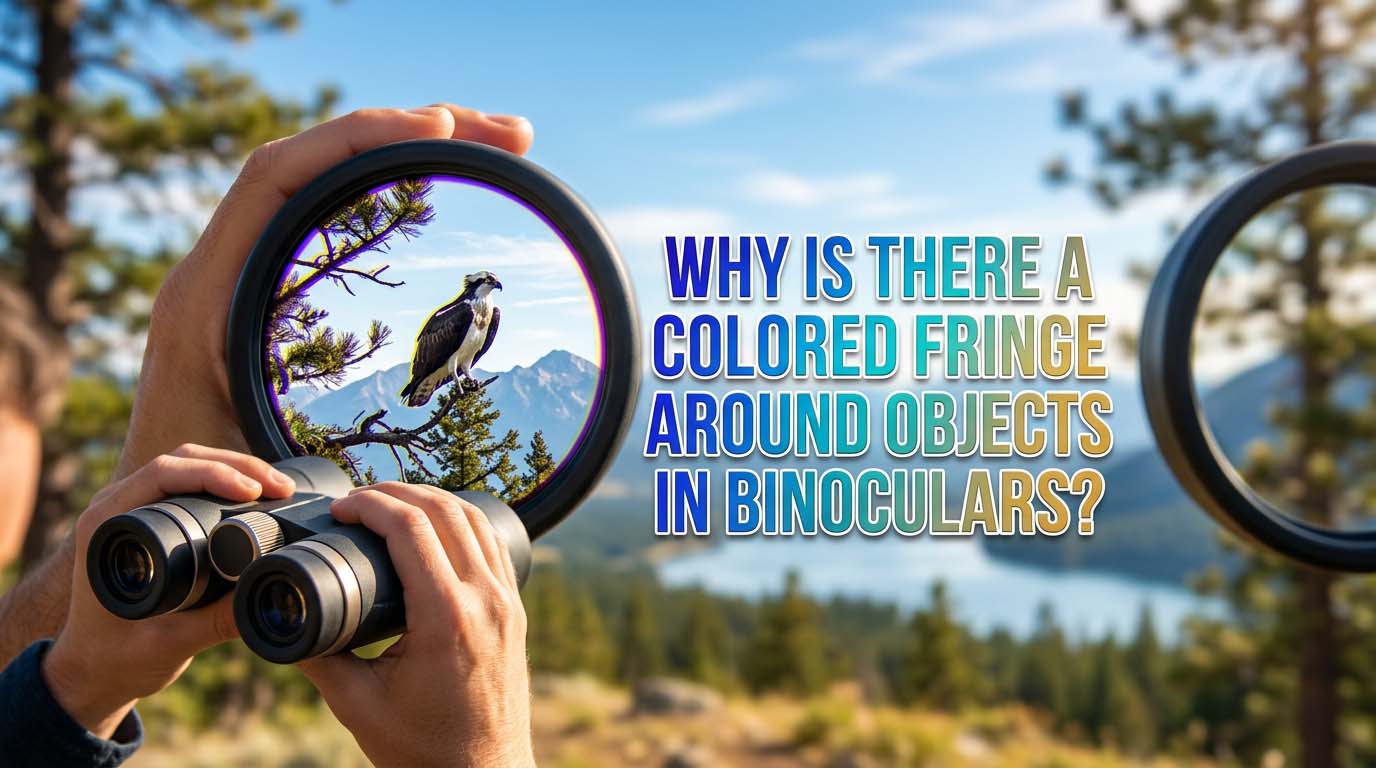
You are looking through your binoculars at a bird against a bright sky. The bird is sharp, but there is a thin purple or blue line along one edge and a yellow or red line on the opposite side. It is distracting. You might wonder if your binoculars are broken or defective.
They are not broken. That colored fringe has a name: chromatic aberration. Every pair of binoculars shows it to some degree. The question is whether yours show too much for what you paid.
What Is Chromatic Aberration in Simple Terms?
Light is not one single thing. It is a mix of colors, each with a different wavelength. When light passes through a lens, each color bends at a slightly different angle. Blue light bends more than red light.
Think of it like a crowd of people walking through a doorway. Some people turn left more sharply than others. By the time they exit the door, they have spread out. Your eye sees that spread as a color shift at the edges of objects.
In a perfect lens, all colors would meet at the same point. No real lens does this perfectly. The colored fringe is the visual evidence of that failure.
Why Binoculars Show This More Than Your Eyes
Your eyes also have chromatic aberration. But your brain is good at ignoring it. Binoculars make it visible for three reasons.
Magnification Amplifies Everything
A 10x binocular takes a small imperfection and makes it ten times bigger. A color shift that is invisible to your naked eye becomes obvious when magnified. Higher magnification binoculars usually show more fringing than lower power ones.
More Lenses Mean More Refraction
Light passes through many glass surfaces in a binocular. Each surface bends light. Each bend adds another chance for colors to separate. A typical binocular has four to eight lens elements per side. That is a lot of chances for color to spread.
Large Objective Lenses Collect More Light Edges
The big front lenses on binoculars gather light from a wide area. Light that enters near the edge of the lens bends more than light that enters near the center. This increases the color separation. A 42mm objective shows more chromatic aberration than a 25mm objective, all else being equal.
When You Will Notice Colored Fringing Most
Chromatic aberration is not equally visible all the time. Certain conditions make it jump out at you.
High Contrast Edges
The fringe is most obvious where a bright object meets a dark background. A white bird against a dark blue sky. A street lamp against the night sky. A bare branch against a bright overcast sky. The sharper the contrast, the more visible the color shift.
Off-Center Viewing
Most binoculars are corrected for chromatic aberration in the center of the field. The edges are where the problem shows up. If you notice fringing only when you look toward the edge of the view, that is normal. If you see it in the center, your binoculars have poor correction.
Bright Light
In dim light, your eye cannot see color well. Chromatic aberration becomes invisible. In bright sunlight or when viewing against a bright overcast sky, your color vision is fully active and the fringe becomes obvious.
White or Light Colored Objects
Dark objects do not show fringing clearly. White objects do. A white building against a blue sky is one of the worst cases. Gray or brown objects like deer or rocks will rarely show visible chromatic aberration.
The Three Types of Color Fringing in Binoculars
Not all colored fringes are the same. Knowing which type you are seeing helps you understand whether it is fixable or just a design limitation.
Lateral Chromatic Aberration
This is the most common type in binoculars. The color shift appears toward the edges of the field. One side shows blue or purple. The opposite side shows yellow or red. It gets worse the farther you look from center.
Lateral CA is a design choice. Wide-angle binoculars often show more of it. Manufacturers trade edge color correction for a wider field of view.
Longitudinal Chromatic Aberration
This type shows as a color halo around bright objects no matter where they are in the field. The object might have a blue halo on one side and a red halo on the other, or a purple haze all around it.
Longitudinal CA is harder to fix. It requires better glass materials or more complex lens designs.
Spherochromatism
This is a mix of spherical aberration and chromatic aberration. The image looks slightly soft or hazy, and the color fringe changes as you adjust focus. You might think the binoculars are out of focus, but no amount of turning the focus wheel gets rid of the color blur.
Spherochromatism is rare in good binoculars but common in cheap ones.
How Much Chromatic Aberration Is Normal?
This depends entirely on what you paid.
- Budget binoculars under $100: You will see noticeable fringing on high contrast objects, even in the center of the field. This is normal for the price.
- Mid-range binoculars $100 to $400: Fringing should be minimal in the center. You will see it at the edges. It should not ruin the view.
- Premium binoculars $400 to $1000: Fringing should be very subtle at the edges. You might not notice it unless you look for it.
- High-end binoculars over $1000: Fringing should be almost invisible. These use special glass like ED (extra-low dispersion) or fluorite to control color.
No binocular is completely free of chromatic aberration. But at each price level, you should get less of it.
Can You Fix or Reduce Colored Fringing?
You cannot eliminate chromatic aberration after the binocular is made. But you can reduce its visibility.
Adjust the focus carefully. Proper focus minimizes the perceived fringe. Even a tiny misfocus makes chromatic aberration worse.
Center the object in the field. If the fringing is only at the edges, keep your target in the center of view.
Shift your eye position slightly. Sometimes moving your eye a millimeter away from the eyepiece changes how you perceive the fringe. Experiment with eye relief distance.
Use binoculars with smaller objectives. A 32mm binocular will generally show less chromatic aberration than a 42mm binocular of similar quality. The smaller lens bends light less at the edges.
How to Test Binoculars for Chromatic Aberration Before Buying
You do not need to go outside to evaluate a binocular for color fringing. Use these indoor tests.
The Lightbulb Test
Point the binoculars at a bare lightbulb against a white ceiling. Focus on the bulb. You should see a clean image with no purple or green halo around the filament. If you see a strong color halo, the binocular has poor correction.
The Window Blind Test
Look at the edge of a window blind against bright sunlight coming through the window. The straight edge should show minimal color shift. Move the edge from center to the edge of the field. Note how the color changes.
The Power Line Test
If you are outside, look at power lines against a bright sky. This is the hardest test for chromatic aberration. A good binocular will show clean black lines. A poor one will show purple on one side and yellow on the other.
Why Your Expensive Binoculars Still Show Fringing
You bought a $500 binocular expecting perfection. You still see color at the edges. This is frustrating.
The reality is that eliminating chromatic aberration completely requires trade-offs. Manufacturers who minimize chromatic aberration often sacrifice edge sharpness, brightness, or field width. Some choose a balance that favors center sharpness over edge color correction.
Also, your eyes matter. Some people are more sensitive to color fringing than others. If you are a birdwatcher or hunter who looks at many high-contrast objects, you will notice it more. A person who uses binoculars only casually may never see it.
Frequently Asked Questions
Can I remove colored fringing by adjusting the focus or diopter?
No. Focus and diopter adjustment only bring the image into sharpness. They cannot change how the lens bends different colors of light. Proper focus does minimize the appearance of fringing, but it will not eliminate it.
Do expensive binoculars completely eliminate colored fringing?
No. Even binoculars with ED glass, fluorite elements, or apochromatic designs show some residual chromatic aberration. Expensive binoculars reduce it to a level most people cannot see in normal use. Under extreme conditions, you can still find it.
Is colored fringe different from the rainbow glare I sometimes see?
Yes. Rainbow glare or veiling glare is caused by internal reflections inside the binocular. It appears as a rainbow pattern or bright haze across the view, especially when looking toward the sun. Chromatic aberration is a fixed color shift at object edges. They are different problems with different causes.
Will colored fringing disappear if I use binoculars with smaller objectives?
Generally yes. Smaller objective lenses bend light less at the edges. A 25mm or 32mm binocular will show less chromatic aberration than a 42mm or 50mm binocular of similar optical quality. The trade-off is less light gathering ability and a dimmer image in low light.
Can I test binoculars for chromatic aberration without going outside?
Yes. Use the lightbulb test described above. A bare lightbulb against a white ceiling is a high contrast target that reveals chromatic aberration clearly. You can also use the edge of a door or window frame against bright window light.