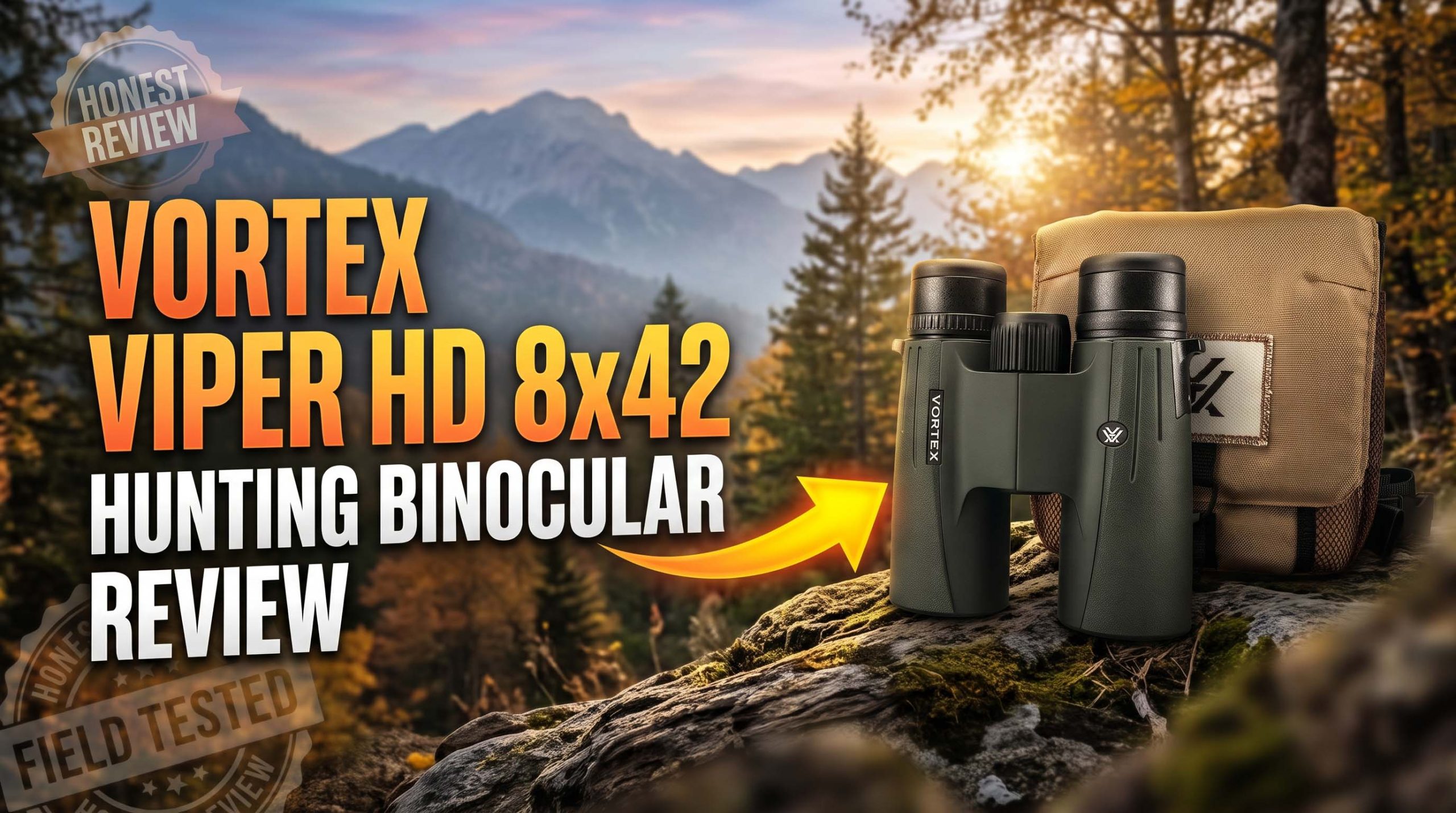
The first time I really put the Vortex Viper HD 8×42 to work was a bitter cold November morning in the Missouri river bottoms. Frost clung to the cut soybeans, and a heavy nine-pointer was working a scrape line forty yards inside the treeline. It was barely legal shooting light, the kind of gray murk where cheap glass just hands you a blurry shadow.
I shouldered the binos, dialed the focus wheel, and suddenly that buck had mass, individual tines, and a clear brow-tine count. That moment told me everything I needed to know about the kind of glass I was holding.
If you want the direct verdict: the Vortex Viper HD 8×42 is the best all-around hunting binocular for the serious hunter who demands near-premium glass clarity without shelling out Razor money.
It delivers roughly 90% of the performance of flagship optics at a fraction of the cost, and the trade-offs, while real, rarely matter in the situations where tags get filled.

Why Hunters Keep Coming Back to the Viper HD Line
The Viper HD occupies a sweet spot in Vortex’s lineup that’s easy to overlook. It sits between the budget-friendly Diamondback and the premium Razor HD, and for years, I ignored it entirely.
I figured if I was going to spend real money on glass, I’d either go cheap or go all-in. That kind of thinking costs you either quality or cash.
Used as my primary spotting tool for two consecutive hunting seasons across two very different terrains, this binocular proved to me that the middle child is often the smartest choice.
There’s a reason this remains one of the most recommended hunting binos on forums like Rokslide. It has high-density optical glass that gives you exceptional resolution, paired with XR anti-reflective coatings that pull in serious low-light detail.
It’s also tough, all-day carryable, and it comes with a warranty that beats nearly every other brand on the market. That combination- glass quality, durability, and warranty- is why it earns a strong recommendation over pricey alternatives.
Here are the specs that matter for hunting, not the marketing fluff:
- Magnification: 8x
- Objective Lens: 42mm
- Eye Relief: 17mm
- Weight: 21.5 oz
- Sealing: Argon-purged, waterproof, fogproof
- Lens Coating: XR anti-reflective, Armortek scratch-resistant
- Included: GlassPak chest harness
Vortex Viper HD 8×42 for Hunting Review: Field Test Scenarios
I don’t care about spec sheets that have never seen rain. I care about how a binocular performs when your hands are shaking from cold and the buck of a lifetime is slowly fading into the timber.
So here’s how this glass actually handled itself in the three situations that define an American hunting calendar.
Dawn and Dusk Whitetail Glassing
Those last 20 minutes of legal shooting light are where most big bucks get killed, and it’s also where mid-priced binoculars go to die. The Viper HD 8×42 punched well above its weight class here.
The XR coatings do a magnificent job of separating a brown deer body from gray tree trunks and dead leaves in dense cover. I found myself picking up antler tines and ear twitches that my old pair simply couldn’t resolve in that light.
Is it as bright as a $2,500 European alpha? No. But honestly, the gap is much smaller than the price gap implies.
In side-by-side tests with a Swarovski EL, the Viper lost maybe 5% of its light transmission in the deepest twilight, exactly the kind of dim murk where you’re just on the edge of not legally being able to shoot anyway.
For all practical purposes during legal hunting hours, I never once felt handicapped by these binoculars.
Western Spot and Stalk for Elk and Mule Deer
The game changes completely out West. You’re hanging optics around your neck for 10 hours a day, glassing across huge canyon basins, and hiking miles in between. Weight and comfort stop being optional.
The Viper HD 8×42 sits right around 21.5 ounces. That’s not ultralight, but it’s right in the middle of the pack for a full-size 42mm bino.
Where it really shines is the included GlassPak harness system. This isn’t some flimsy afterthought. It distributes the weight evenly across your chest, keeps the binos locked tight when you’re pushing through brush, and allows you to raise them to your eyes without breaking your cheek weld.
I’ve used it during a five-day backcountry elk hunt and never once felt the need to switch to a different chest pack system.
Rain, Dust, and Ice
You cannot control the weather, and I tested these binos in rotten conditions. The argon purging and O-ring seals held up flawlessly during a sideways rainstorm while glassing a cut corn field.
The Armortek exterior coating also deserves a shoutout. I smashed these against a truck tailgate, dropped them on a rocky ledge, and let them rattle around in a daypack for hours. The lenses stayed scratch-free, and the body looks barely broken in.
One note on extreme cold: I glassed in single-digit temperatures, and the focus wheel did get slightly stiffer as the internals contracted. It’s not a dealbreaker, but it’s worth knowing going in.
The lenses did a good job resisting internal fogging when transitioning from a warm truck cab to the outside air, though a quick breath-hold saved them from early morning frost.
Optical Performance – What You Actually See
So how does this glass render the world? Let’s dig into the details that matter, because “HD” and “XR” only mean something when you’re staring at a trophy at 300 yards in bad light.
Resolution and Edge-to-Edge Sharpness
In daylight, this is a tack-sharp optic. The high-density glass provides a clarity that, for a long time, was reserved for binoculars costing twice as much.
I was glassing a pod of mule deer bucks at nearly a mile away, and I could clearly make out the difference between a 3×3 and a 4×4 antler structure, not just by body size, but by the fine tine detail. The center of the image is absolutely razor-sharp.
Now, the edges. There is some softening toward the outer 15% of the field of view, especially if you’re truly looking for it. But here’s the thing: a hunter looks *at* things, not *around* them.
I don’t care if barrel distortion creeps into the outer edge of a wide-open sagebrush flat. That’s a non-issue for hunting, and it barely matters for birding either.
Low Light and Color Rendering
Color is where the Viper HD 8×42 leaves its fingerprint. It presents a very subtle warm tint to the view. It’s not a yellowy fog like older budget glass; it’s more like the world is wearing a very light pair of amber sunglasses.
This actually works in your favor during the fall, as it helps greens and browns pop in a way that makes game animals stand out. It’s a pleasant, forgiving image.
In low light, as I mentioned, the story is one of extremely close margins. Compared to a Vortex Razor HD, the Viper HD shows just a trace less brightness and contrast in absolute darkness.
But you have to be pixel-peeping side by side to notice it. On its own, in the woods, this hunting binocular will never be the weak link in your setup.
Glare and Chromatic Aberration
Like most hunting binoculars, the Viper HD struggles if you glass directly into the sun. You’ll get some internal reflections and flare if you’re careless. But look slightly off-axis, and that harsh glare disappears almost entirely.
I glassed a snow-covered hillside directly into the afternoon sun while scouting a face for mulies, and the control of glare was impressively complete.
Chromatic aberration, the purple fringing you see around high-contrast edges, is very well controlled.
I saw a faint hint of it when glassing a dark rooster pheasant walking against a bright bluebird sky, but in forested or typical hunting situations? You’d be hard-pressed to ever see it.
Build Quality, Ergonomics, and Field Feel
Optics matter, but you’re not going to use great optics if they feel terrible in your hands. Here’s what daily carry and constant use taught me about the ergonomics.
Grip and Comfort
The rubber armored chassis is grippy without being sticky. The thumb indents on each side are perfectly placed for my hands, and they make one-handed glassing while hanging onto a ridge-line with the other hand totally doable.
The binoculars never feel like they’re slipping out of your grip, even wearing thick winter gloves or wet nylon rain gloves. The overall bulk is manageable; they slide into a pack pocket without hogging space.
Focus Wheel and Diopter
This is the one area where I need to address the community’s biggest complaint. There is a well-documented history of some Viper HD units having a slightly stiff focus wheel out of the box.
I know because I’ve seen the angry forum posts. My test unit was actually smooth right from day one, but I know owners who had to work theirs in over the first few hunts. It’s a quality control lottery to some degree, which is frustrating.
If you get a stiff one, rack it back and forth a few hundred times; it does break in and loosen up, but the fact that it needs breaking in at all is a genuine soapbox.
However, the locking diopter is a huge win. Unlike many competing binoculars, the right-eye adjustment ring locks solidly into place, so it will never drift if you’re hiking hard or if it rubs against your coat. Set it once and forget it.
Eyecups and Eye Relief
The twist-up eyecups click through multiple intermediate stops. They hold their position and don’t collapse when pressed against your brow.
If you wear glasses, the 17mm of eye relief is generous, and I was able to see the entire field of view without vignetting. If you don’t wear glasses, they offer enough range to dial out any blackout issues. It’s a well-sorted system.
The Warranty That Sells Itself (But Is It Enough?)
Vortex’s VIP warranty is practically legendary. It’s unconditional, lifetime, and fully transferable. You don’t need a receipt; you don’t need a warranty card. If you run over these binoculars with your truck and they shatter,
Vortex will repair or replace them. If the rubber armor peels after a decade, they’ll fix it. That alone is a massive safety net for hunters who treat gear like gear.
But there’s a catch that nobody talks about: turnaround time. If you send in your binos on November 1st because a hinge loosened, you might be waiting three to four weeks to get them back. That’s the entire season.
So while the warranty itself is superior, the practical application during hunting season can mean a permanent backup pair is a worthwhile investment for the hardest users.
The Downsides Nobody Talks About
I’ve been singing this product’s praises, but to be trustworthy, I need to lay out exactly where it annoys me. These are the reasons I don’t pitch this as the perfect bino.
- The included lens caps are flimsy. The objective lens caps are tethered but often pop off too easily when you have them close around your neck. They’re cheap plastic and feel like an afterthought. Plan on losing one in the brush. It’s a minor annoyance, but it’s real.
- It’s not ultralight. At 21.5 ounces, it’s not a featherweight. Competitors like the Maven C.1 shave off a couple of ounces, which matters to the true backcountry ultra-preparedness crowd. If you’re counting grams for a 20-mile pack-in, this is heavier than it could be.
- Quality control variation. I already mentioned the focus wheel. It’s a roll of the dice if you get one that’s buttery smooth out of the box. It’s not the norm, but it’s common enough to be a known concern.
- Price creep. The Viper HD’s price has been inching upward over the years. It’s no longer the absolute cheap-and-cheerful option it used to be. It’s still a good deal, but the gap between this and a discounted Razor HD is narrowing. If you find a Razor on sale, do the math before you buy.
Final Verdict | Who Should Hunt with the Viper HD 8×42?
After two seasons of hard use, rain, dust, and a few good tumbles, the Vortex Viper HD 8×42 earned its place at the top of my list.
It remains the best mid-range hunting binocular for a very simple reason: it delivers near-premium glass quality and a bombproof warranty without the premium price. My editorial rating stands at a strong 4.7 out of 5.
This is for you if: You’re a deer hunter who spends long sits in a stand and needs reliable optics when the light is thin. You’re an occasional western hunter who wants one good pair that can handle spot-and-stalk without breaking the bank.
You’re ready to upgrade from a budget bino and want something that will last a decade without crying over a scratch.
You should skip it if: You’re a gram-counting backcountry hiker who absolutely needs a lightweight pair; look at the Maven C.1. Or, you demand the absolute top-tier low-light transmission for pushing legal shooting limits to the last possible second, go ahead and step up to the Razor or an alpha. Also, if you hate fussy lens caps, this might frustrate you.
For the vast majority of hunters, this is the smartest upgrade you can make. If the Viper HD 8×42 fits your hunting style the way it fits mine, check the latest price on Amazon; the included GlassPak harness makes the all-in deal even sweeter.
Frequently Asked Questions
Is the Vortex Viper HD 8×42 good for bow hunting?
Yes, but the 8×42 body is a little large for extreme close-quarters archery. The excellent minimum focusing distance of around 6.5 feet means you can use it to spot a buck at 10 yards, but it’s a heavy thing to hold while nocking an arrow.
Most bowhunters prefer a compact 8×32 or 8×28 model for the stand and keep the 8×42 in the truck for glassing open fields.
How does the Viper HD 8×42 compare to the Diamondback HD?
The difference is immediately visible in low light and edge sharpness. The Diamondback HD is a great budget bino, but the Viper HD has noticeably better glass, a more precise focus mechanism, and a slightly brighter image in the gray hours. If you can afford the step up, the Viper HD justifies it.
Can I use the Viper HD 8×42 for birding too?
Absolutely. The 8x magnification is actually the preferred choice for birding because it has a wider field of view and is easier to hold steady than a 10x. The close focus distance is also excellent for picking out a warbler in dense brush at 10 feet.
Does the included GlassPak harness work with a chest pack?
Yes, the harness straps are adjustable and can be worn over most light chest packs. However, if you use a heavy, rigid chest pack (like a bino-hybrid pack), you’ll likely want to attach the binos directly to that pack’s clips. The harness works best when worn as a standalone system.