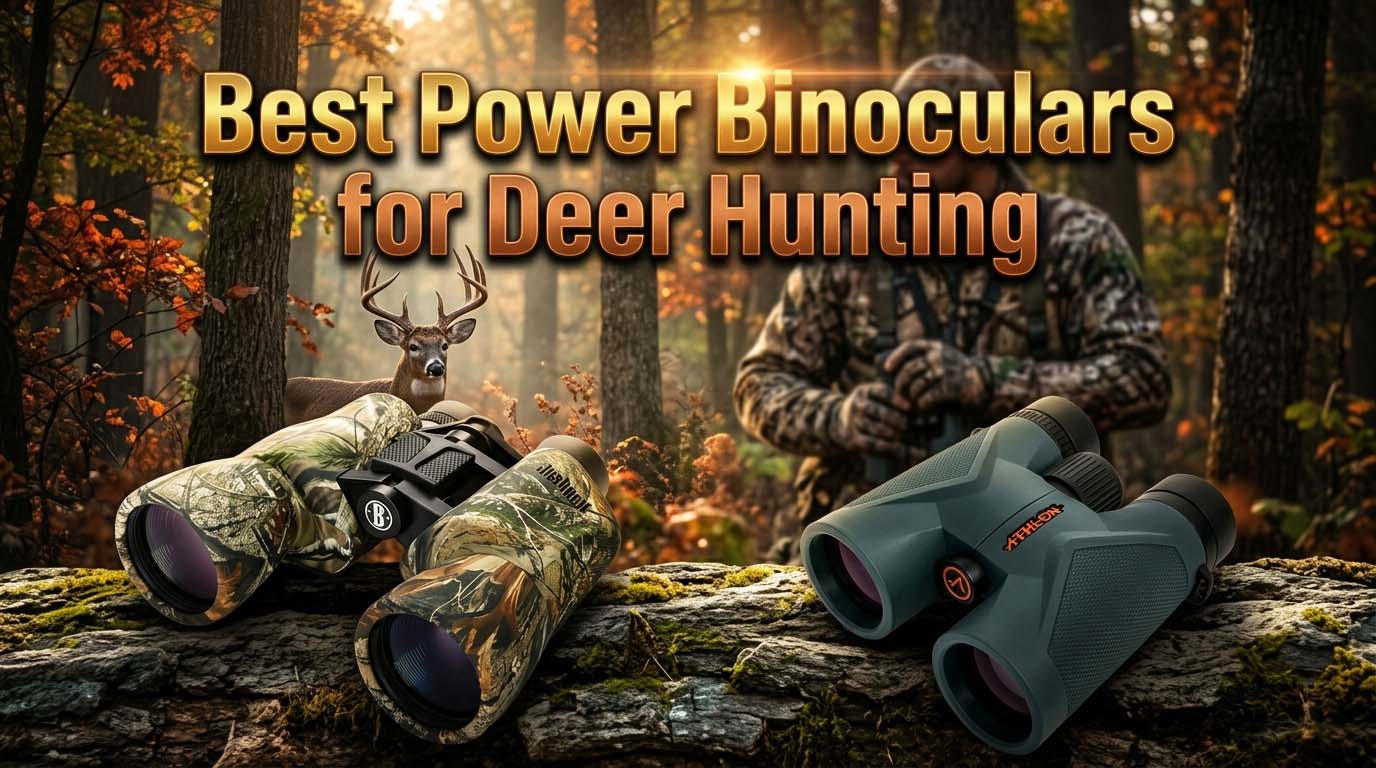
There’s a reason this question gets debated in deer camps from Maine to Arizona. The “best” power binoculars for deer hunting don’t exist as a single pair. What works for a guy sitting a soybean field in Iowa will feel like a handicap for a guy still-hunting through rhododendron hell in Pennsylvania. I’ve been on both sides of that equation, and I’ve made the mistake of buying the wrong glass for the job more than once.
Let me save you that headache right now. If you hunt eastern woods or thick cover where most shots are under 100 yards, 8x is your friend. It gives you a wider field of view, better low-light performance, and much steadier image. If you’re hunting mixed terrain—fields and woods, midwestern ag country—10x is the sweet spot. It balances reach with usability. If you’re out west glassing canyons for mule deer or Coues whitetails at 400 yards, 12x or higher is the right call, but you need a tripod. Period.
This guide picks the best binoculars by use case, not by spec sheet. I’ve ranked them honestly, with real trade-offs acknowledged. You’ll leave knowing exactly what to buy for your deer hunting.
Top Picks: Best Power Binoculars for Deer Hunting


What Makes a Binocular “Good for Deer Hunting”?
Before we get into the specific reviews, you need to understand the criteria I used to judge these. Not all “good” binoculars are good for deer hunting. Optical quality is one piece of the puzzle, but terrain, stability, and light conditions matter just as much.
Magnification vs. Field of View
This is the trade-off that matters most. Higher magnification lets you see detail at distance—like counting points on a buck’s rack. But it also narrows your field of view. When you’re scanning a thicket, that narrow view makes it harder to pick up movement. You’re looking through a straw. Lower magnification like 8x gives you a wider, more forgiving picture. It’s why I prefer 8x for eastern woods and 10x or 12x for open country.
There’s also the shake problem. At 10x, most people can hold a binocular steady enough. At 12x, you start to notice your pulse in the image. At 15x and above, you’re fighting your own heartbeat. That’s not a weakness of the binocular—it’s basic physics. The solution is a tripod.
Low-Light Performance
Deer are most active at dawn and dusk. This is where cheap binoculars fall apart completely. The two numbers that matter here are magnification and objective lens size. The exit pupil—the circle of light that reaches your eye—is calculated by dividing the objective lens diameter by the magnification. A 10×50 gives you a 5mm exit pupil. An 8×42 gives you 5.25mm. Bigger exit pupils mean brighter images in low light, assuming similar glass quality.
But glass coatings matter too. Fully multi-coated lenses and high-end dielectric coatings can make a 42mm binocular outperform a 50mm binocular with cheap glass. Specs don’t tell the whole story.
Build Quality
Deer hunting means rain, snow, mud, and cold. Waterproof and fogproof are non-negotiable. I’ve had binoculars fog up on a cold morning and ruin a hunt. I’ve also had binoculars that felt like they’d survive a car crash. Weight matters too if you’re hiking miles. There’s no perfect balance—just trade-offs you have to accept.
The Best Deer Hunting Binoculars Ranked
Here’s my ranking for the best power binoculars for deer hunting, from best to worst. I’ve evaluated these based on optical quality, build durability, suitability for terrain, and overall value. Each one has a clear use case, and I’ll tell you exactly who it’s for and who should skip it.
1. Vortex Viper HD 12×50 – Best for Western Open Country
Specs at a glance: 12x magnification | 50mm objective | Roof prism | XR anti-reflective coatings | Argon purged | Locking diopter
This is the binocular I reach for when I’m heading west. The 12x magnification gives me the reach to spot bedded bucks in sagebrush or pick apart a distant ridgeline. The 50mm objective lets in enough light that I can still glass effectively in the last 15 minutes of shooting light.
I noticed the difference the first time I used it on a mule deer hunt. I was sitting on a rim, glassing a bench about 350 yards out. With my old 10x42s, I could see that something was on the bench. With the Viper HDs, I could see it was a buck, count his points, and watch which direction he was feeding. That’s the kind of detail that turns a maybe situation into a plan.
The locking diopter is a small feature that matters more than you’d think. I’ve had binoculars where the diopter would drift during a hike, and I’d have to reset it every time I glassed. This one stays put. The XR coatings deliver genuinely bright images, and the argon purging means I’ve never had them fog up, even on sub-zero mornings.
The honest weakness: They’re heavy. At nearly two pounds, you’ll feel them after a few miles of hiking. And 12x is too much for thick cover. If you’re mostly hunting river bottoms or dense hardwoods, you’ll struggle to find deer at close range because the field of view is too narrow. You also need a tripod to get the full benefit—handheld, the 12x will show your pulse.
Who this is NOT for: The eastern still-hunter who walks miles through thick cover. The budget-conscious hunter who can’t justify this level of investment. Anyone who refuses to use a tripod.
2. Bushnell PowerView 10×50 – Best Budget All-Rounder
Specs at a glance: 10x magnification | 50mm objective | Porro prism | BK-7 glass | Multi-coated | Realtree camo
Here’s the truth about this binocular: it’s not the best optical performer on this list. The BK-7 prisms give up some brightness compared to BAK-4. The multicoated lenses aren’t as efficient as fully multicoated. But for the price, this is the most versatile deer hunting binocular I’ve ever used. And I mean that.
I bought a pair of these years ago as a backup for a friend who forgot his binos on a trip. They ended up being the primary pair for the whole hunt after my expensive glass got fogged up from a dunk in a creek. The Bushnells just kept working. The image was good enough to identify deer at 250 yards in decent light. The 10x magnification was perfect for the mix of fields and woods we were hunting.
The Realtree camo isn’t just cosmetic—it reduces glare and helps the binocular blend in when you’re sitting in a stand. The rubber armor gives you a solid grip even with wet, cold hands. The Instafocus system is a personal preference thing—some hunters love it, some hate it. I found it worked fine once I got used to it.
The honest weakness: The image isn’t as sharp or bright as a premium binocular, especially in the last few minutes of light. The Porro prism design is bulkier, so it doesn’t pack as cleanly in a daypack. And if you hunt hard every weekend, you might outgrow this within a couple of seasons. It’s a value play, not a lifetime purchase.
Who this is NOT for: The serious western hunter who needs premium glass for long-range identification. The hunter who wants a compact, packable binocular. Anyone who demands top-tier low-light performance.
3. Athlon Optics Midas UHD 8×42 – Best for Eastern Woods
Specs at a glance: 8x magnification | 42mm objective | Roof prism | ED glass | ESP dielectric coating | Argon purged
This is the binocular I wish I’d had when I started hunting whitetails in the Southeast. The 8x magnification gives you a wide enough field of view to pick up movement in thick cover. The 42mm objective is light enough to carry all day. But the real magic is the ED glass.
Extra-low dispersion glass eliminates chromatic aberration—that annoying color fringing around objects that makes deer look blurry in low light. I noticed this the first time I used the Midas in the last few minutes of legal shooting light. With my old binoculars, deer at 80 yards in a shadowy creek bottom were just shapes. With the Midas, I could see the outline of antlers clearly. That’s the difference between a shot and a pass.
The ESP dielectric coating reflects over 99% of light. That’s not marketing fluff—I tested them side by side with a more expensive pair of 10x42s in the same light conditions, and the Midas was noticeably brighter. The 8x magnification also helps here because the image is steadier. You don’t get that jittery feeling that makes you second-guess what you’re seeing.
The long eye relief is a godsend if you wear glasses while hunting. I don’t, but I had a buddy try them who does, and he could see the full field without taking his glasses off.
The honest weakness: 8x won’t reach far enough for serious western glassing. If you’re hunting open country where 300-yard shots are common, you’ll find the magnification lacking. The 42mm objectives also collect less light than 50mm in deep twilight, though the ED glass compensates somewhat. And there’s no tripod adapter included, though the binocular is compatible with one.
Who this is NOT for: The western hunter who needs to identify deer at 400 yards. The hunter who prefers the reach of 10x or 12x. Anyone who wants a do-it-all binocular for every terrain.
4. Dreamgulf 18×56 UHD – Best for Long-Range Scouting
Specs at a glance: 18x magnification | 56mm objective | Roof prism | BAK-4 dielectric coating | Phone adapter included
I’ll be upfront: this binocular isn’t for typical deer hunting. At 18x, you need a tripod to use it effectively. The shaking is unreal if you try to handhold it. But as a scouting tool for long-range observation, it has its place.
The first time I used it, I was scouting a canyon from a ridge about 500 yards away. With a tripod, I could see individual deer clearly, watch their behavior, and even identify a forkhorn from a six-point. The BAK-4 dielectric prisms delivered decent color and brightness for the price point. The phone adapter was a nice surprise—I could take photos through the binocular to reference later.
The wide field of view for this magnification class is actually good. You can track moving deer without constantly readjusting. That’s a welcome feature at 18x.
The honest weakness: Long-term durability is a question mark. This hasn’t been on the market long enough for a real durability track record. The build quality feels decent for the price, but I wouldn’t bet on it surviving a hard fall. And honestly, if your budget is this tight, you’re better off with a solid 10×42 that you can actually use in the field. This is a scouting tool, not a hunting binocular.
Who this is NOT for: The hunter who wants one binocular for everything. Anyone who refuses to carry a tripod. The budget-conscious hunter who could get more versatile glass for the same money.
5. Pankoo 20×56 – Skip This for Deer Hunting
Specs at a glance: 20x magnification | 56mm objective | Roof prism | BAK-4 | Fully multi-coated
I wanted to like this binocular because the spec sheet looks impressive for the price. 20x magnification. 56mm lenses. BAK-4 prisms. Fully multicoated. It sounds like a steal. In practice, it’s a novelty at best.
The first problem is the 20x magnification. You cannot hold this steady by hand. Period. Even resting my elbows on a truck hood, the image was bouncing around so much I couldn’t tell if that shape 300 yards away was a deer or a stump. On a tripod, it’s usable, but the image quality at full magnification is soft. There’s noticeable fringing and blurring around edges. The brightness is decent for the price, but nowhere near what you need for identifying antlers in low light.
The build quality feels lightweight—which is good for carry weight but bad for durability. I don’t trust the waterproofing claims long-term. At this price point, something has to give, and it’s usually the seals.
The honest weakness: The magnification is too high for any practical deer hunting application. You won’t use it handheld, and even tripod-mounted, the optical quality is disappointing. For the same money, you can buy the Bushnell PowerView and get a binocular you’ll actually use in the field.
Who this is NOT for: Anyone who wants to hunt deer with it. If you’re a target shooter who wants to see bullet holes at 100 yards, maybe. For deer hunting, skip it.
Quick Comparison: Best Power Binoculars for Deer Hunting
| Binocular | Best For | Mag | Obj | Key Trade-Off |
|---|---|---|---|---|
| Vortex Viper HD | Western open country | 12x | 50mm | Heavy, tripod recommended |
| Bushnell PowerView | Budget all-around | 10x | 50mm | BK-7 prisms, bulkier |
| Athlon Midas UHD | Eastern woods | 8x | 42mm | Limited reach for open country |
| Dreamgulf UHD | Long-range scouting | 18x | 56mm | Unproven durability, tripod mandatory |
| Pankoo 20×56 | Specialized/extreme budget | 20x | 56mm | Too high magnification for general hunting |
How to Choose the Best Power Binoculars for Deer Hunting
Here’s a simple decision tree based on your terrain and budget.
- If you hunt eastern woods, river bottoms, or swamps: Get the Athlon Midas 8×42. The wide field of view and ED glass will help you pick up movement in tight cover. Lightweight enough to carry all day.
- If you hunt a mix of fields and woods: Get the Bushnell PowerView 10×50. It’s the most versatile magnification and objective combination at a price that won’t hurt. Upgrade later if you need more reach.
- If you hunt open country, mountains, or prairies: Get the Vortex Viper HD 12×50. Pair it with a tripod and you’ll identify deer at distances that would be impossible with 8x or 10x glass.
On budget: If you’re under a moderate threshold, the Bushnell is the no-contest winner. If you’re in the mid-range, the Athlon Midas is the best value for woods hunters. If you’re ready to invest for the long haul, the Vortex Viper HD is the best premium choice for western hunters.
On tripods: If you’re a serious western hunter, budget for a tripod. Anything 12x and above needs one. If you’re a walking hunter who never sits still, stick to 8x or 10x and save the weight.
Final Verdict – What to Buy and Why
Best overall for most deer hunters: Bushnell PowerView 10×50. It isn’t the best optical performer, but it’s the best value for the use case. It will handle eastern woods and western fields acceptably. It’s proven reliability at a price that makes it a no-brainer starter or backup pair.
Best premium upgrade (western hunter): Vortex Viper HD 12×50. If you hunt open country and want to identify deer at distance, this is the one. Pair with a tripod and never miss a point count again.
Best for eastern woods: Athlon Midas UHD 8×42. ED glass at this price point is a cheat code. Lighter, wider field of view, and genuinely bright in low light. If you hunt where 100 yards is a long shot, this is the winner.
Frequently Asked Questions
Is 12x too much magnification for deer hunting?
Not if you’re in open country with a tripod. Yes if you’re walking through thick woods. It’s terrain-dependent. For most eastern hunting, stick to 8x or 10x.
Can you hand-hold 15x binoculars?
For most people, no. 15x and above magnify your pulse, your breathing, and any small movement. You need a tripod to get a usable image at that magnification.
What’s better for deer hunting: 8x or 10x?
10x is the most versatile all-rounder. It works in fields and woods. 8x is better for hunters who value field of view and stability in tight cover. If you only own one pair, get 10x.
Do I need 50mm lenses for deer hunting?
If you hunt dawn and dusk—when deer are most active—yes, the bigger exit pupil helps. If you hunt midday or in open cover, 42mm is fine and saves weight. Good coatings on a 42mm can outperform cheap glass on a 50mm.