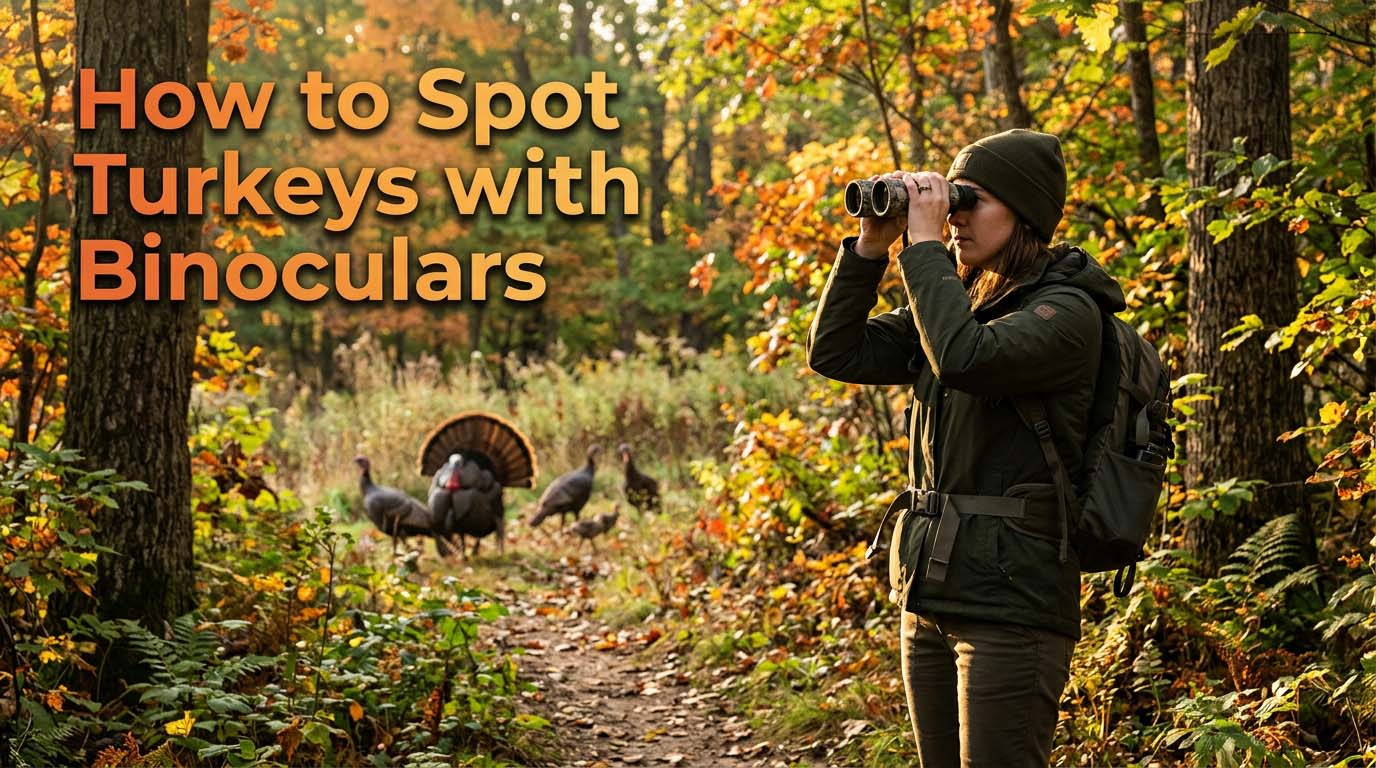
I’ve spent more mornings than I can count behind a pair of binos, staring into fields and timber for turkeys. Early on, I made the same mistake most hunters do: I used the same glassing habits I picked up from deer hunting.
That works fine for a big brown body in a bean field. It fails hard when you’re trying to pick out a hen feeding in tall grass or a gobbler holding still in shadow.
Spotting a turkey with binoculars is a game of identification, not magnification. You’re not trying to see a whole bird. You’re trying to spot a part of it—a flash of blue, a red lump, a single feather that catches light wrong. Once you train your eye to look for those anomalies instead of a full silhouette, everything changes.
Here’s the process I use, broken into the phases that actually moved the needle for me.
Why Your Deer Glassing Habits Fail on Turkeys
When I started hunting turkeys seriously, I carried the same approach I used for whitetails. I’d scan a field edge slowly, looking for a body shape. That works when the animal is the size of a deer and stands out against snow or corn stubble. But a turkey is smaller, lower to the ground, and its brown and black feathers blend into leaf litter, grass, and tree trunks better than you’d believe.
The second problem is movement. Deer feed with a steady head-down, head-up rhythm. Turkeys scratch and peck with quick, jerky motions. If you’re scanning at deer speed, you’ll miss those little flicks. I had to teach myself to slow down even more and to ignore the big picture. I stopped looking for turkeys and started looking for parts of turkeys.
Here’s the shift that helped me: assume the bird is hidden. Don’t expect to see it clearly. Look for something that doesn’t belong. An odd shade of blue in the grass. A bright red spot against a green field. A single patch of black that looks too smooth to be bark. That’s where the real spotting happens.
The Visual Language of a Turkey
You can’t spot what you don’t know to look for. Turkeys have three visual signatures that stand out even when the rest of the bird is hidden. Once you memorize these, you’ll start seeing birds that were always there.
Head Color as a Beacon
The head of a turkey is the easiest part to see. Male heads turn bright blue and red during breeding season, and even hens have a muted version of that. That blue and red cuts through grass, shadows, and brush far better than the body. When I glass a field, I don’t scan for a brown lump. I scan for a tiny blue or red dot. If I see a color that doesn’t match the vegetation, I stop and study that spot. Nine times out of ten, it’s the top of a turkey’s head poking above the grass.
Feather Iridescence in Low Light
Turkey feathers aren’t just black. They have an iridescent sheen that reflects light green, copper, and gold. When the sun is low, that reflection creates a flash that stands out against dark timber or dull brown leaves. I’ve spotted turkeys in thick shadows just because the morning sun hit their back feathers at the right angle and tossed a green glint back at me. That flash is often the first sign of a bird you would have walked right past.
The Movement Signature
Turkeys don’t move like deer or squirrels. Their feeding motion is a short, quick scratch followed by a peck. When they strut, they rock forward on their toes and drag their wing tips. That strutting saunter has a rhythm you can learn to recognize even at long range. If you see any movement that doesn’t match the wind or leaves, lock onto it. Peacocks aren’t the only birds that strut.
My Scanning Protocols for Different Terrain
The way I glass changes completely based on where I am. Here are the two main patterns I use.
Open Fields: The Grid Scan
In a cut cornfield, wheat field, or pasture, the turkey is likely feeding or strutting in the open. But open doesn’t mean easy. Turkeys in a field can look like rocks or dirt clods from a distance. I run a slow, deliberate grid from left to right, starting at the far edge and working my way back. Each pass covers about a binocular field of view. I pause for five seconds on each stop to let my eyes adjust.
The trick is to look for shapes that break the uniform line of the crop rows or grass. A turkey’s body is rounder than a corn stalk. A tom’s tail fan creates a curve that doesn’t fit the square grid of a cut field. If something looks even slightly off, I zoom in with my binos and hold steady. More often than not, that “off” shape has a head that changes position after a few seconds.
Timber: The Flash and Freeze
Woods are harder because the light is broken and the background is messy. I use a different method here: a fast, wide scan to pick up motion or shine, then a hard stop to analyze. I call it flash and freeze.
I sweep my binos across the forest floor in a quick arc, covering ground fast. If I catch a flash of iridescence or a flicker of movement, I freeze the glass on that spot and wait.
Turkeys in timber often hold still when they sense something watching. But they can’t keep their head still forever. If I think I saw something, I stay on that location for a full minute.
That extra time is what usually confirms the bird. I’ve lost count of how many times a head popped up or a wing flicked just when I was about to move on.
Setting Up Your Optics for Turkey Spotting
Your gear setup matters as much as your technique. I run a compact 8×42 bino for most of my hunting because the wide field of view helps me pick up motion in timber.
A 10x is better for open fields, but in tight woods, the narrower view makes it easy to miss birds that are close. If you only own one pair, 8x is a solid all-rounder for turkey.
I also use a tripod when I’m scouting fields. Handholding binos for more than a few minutes makes your arms shake, and your eyes tire.
A lightweight tripod lets me glass for twenty minutes without fatigue, and the stability reveals details I’d miss freehand. That extra steadiness is what turns a suspicious blob into a bearded tom.
A harness is non-negotiable. A neck strap will beat you up on a crawl, and it swings the binos into dirt and rocks. A harness keeps the glass against your chest, quiet and out of the way until you need it.
Frequently Asked Questions
What is the first sign of a turkey you should look for when glassing a field?
Look for a small blue or red dot above the grass line. That is almost always the head. If you see a color that doesn’t belong, focus on it and wait for movement.
How do you spot a turkey that is holding still in tall grass or brush?
Scan slowly and look for a smooth shape or an edge that differs from the grass. Turkeys are rounder than grass blades. If you see a curve that doesn’t match the vegetation, watch that spot. The bird will move eventually. Use the flash and freeze method in timber.
What is the best time of day to use binoculars for scouting turkeys?
Early morning and late afternoon. The low sun angle creates the strongest feather iridescence and makes head colors pop. Midday light flattens everything and makes turkeys harder to distinguish from the background.
Do you need a high-end bino to spot turkeys, or will a budget pair work?
A budget pair works fine if the glass is clean and the focus is sharp. Spending more gets you better low-light performance and sharper edges, but a $150 bino in the hands of a patient hunter will find turkeys. The technique matters more than the price tag.
The next time you walk out with your binos, slow down. Forget looking for a whole bird. Look for a single blue dot, a green flash, or a movement that doesn’t match the breeze.
That shift in how you see the landscape will put turkeys in your glass that were always there. All you needed was to know what to spot.