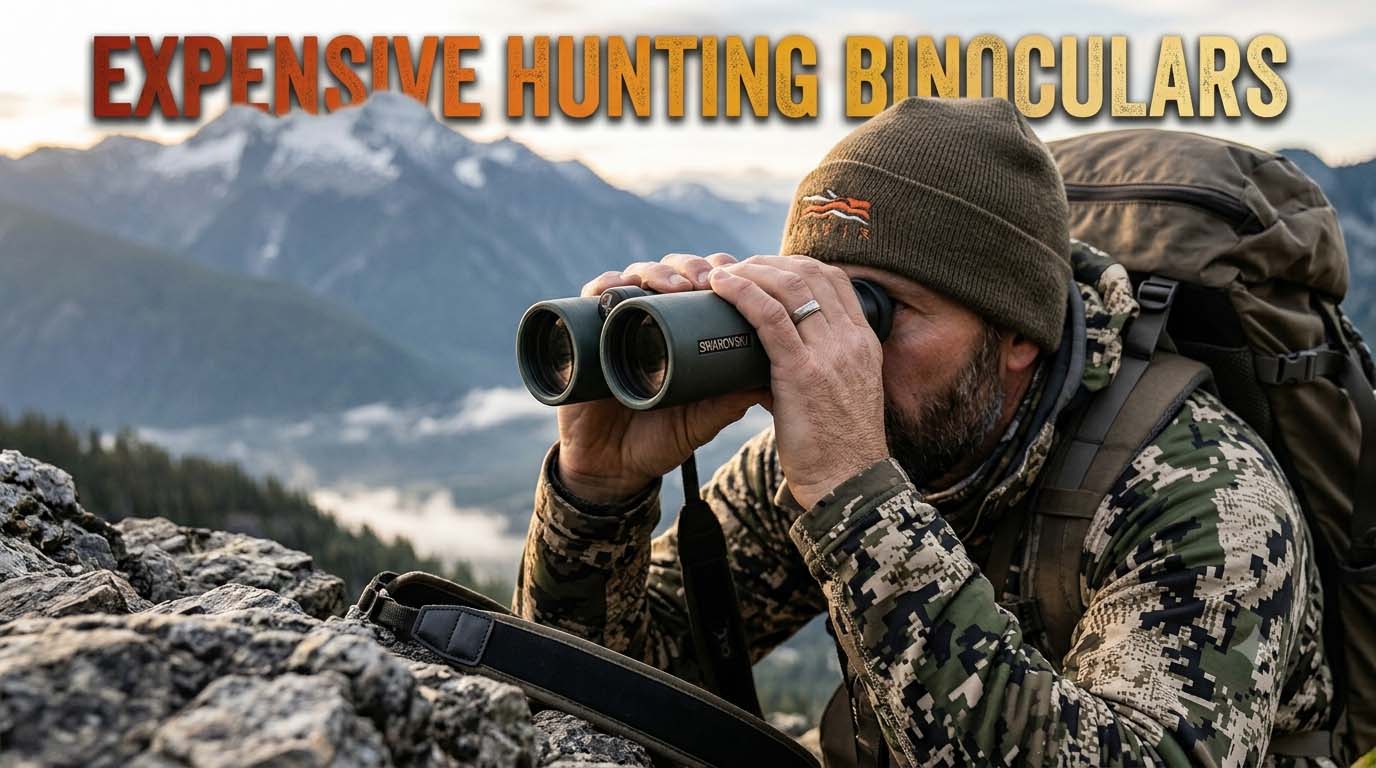
I remember standing in an optics shop, staring at a pair of Swarovski ELs that cost more than my first car. My gut said no way. But the guy behind the counter, a hunter who had spent decades glassing mountain basins, just smiled and said, “Think about how much you use them and how long they’ll last.” That conversation changed how I think about gear.
The answer to whether expensive hunting binoculars are worth it isn’t a simple yes or no. It depends on how often you hunt, what kind of country you hunt, and what you value in the field. Let me walk you through the real factors so you can make the call for yourself.
Understanding the Price Spectrum
Binoculars fall into four rough tiers. The budget tier runs from $100 to $300. These get you into the game. The mid-range from $300 to $800 offers a big jump in clarity and brightness.
Premium from $800 to $2,000 delivers serious glass quality, and ultra-premium above $2,000 is where the best optics live.
At the budget end, you get decent images in good light, but the coatings are basic, and the glass often shows color fringing. Mid-range binoculars use better coatings, often called HD or ED, which cut down on chromatic aberration.
Premium and ultra-premium use high-index glass, advanced phase coatings, and tighter quality control. The difference between a $200 and an $800 binocular is huge. The difference between a $1,500 and a $3,000 binocular is small, but real, especially in low light.
The True Cost Calculation
Let me hit you with a number that shifted my thinking. A $2,500 pair of binoculars used for 15 years costs about $167 per year. That’s less than a tank of gas for a hunting trip.
Now compare that to a $300 pair that might last only five years before the focus wheel gets sticky or the seals fail. That’s $60 per year. The premium binocular actually costs more per year, but you get a better experience every time you use it.
But the math gets better. Premium binoculars hold resale value. I sold a used pair of Leicas for 60% of what I paid after ten years. Budget binoculars are basically disposable. You also have to factor in the cost of upgrading.
If you buy a $300 pair now and then a $1,500 pair in three years because you want better glass, you have spent $1,800 total. That’s more than going straight to a $1,200 pair that meets your needs.
The Cost-Per-Year Framework
Here is a simple table to see how the numbers shake out over realistic lifespans:
| Price | Expected Lifespan | Cost Per Year |
|---|---|---|
| $300 | 5 years | $60 |
| $800 | 10 years | $80 |
| $1,500 | 15 years | $100 |
| $2,500 | 20 years | $125 |
The difference between $60 and $125 per year is small. What you get for that extra $65 annually is dramatically better light transmission, sharper edges, and a warranty that backs the product for life.
The Optical Difference You Can Actually See
I have used binoculars in every price range. The most obvious difference is low-light performance. At dawn and dusk, when animals move, budget binoculars turn into muddy messes.
Premium glass lets in more light and holds resolution longer. That extra 15 minutes of usable light at the end of the day can mean seeing a buck that would have been invisible.
But there is a point of diminishing returns. The human eye can only perceive so much. The jump from a $300 to an $800 binocular is massive. You see more detail, less color fringing, and better contrast.
The jump from $800 to $1,500 is noticeable but smaller. Past $1,500, the improvements are real but subtle. You need a trained eye and ideal conditions to tell the difference between a $2,000 and a $3,000 binocular.
What You Are Actually Paying For?
Beyond the glass, premium binoculars pay for better quality control, more durable materials, and a warranty that stands behind the product.
A company like Swarovski or Leica will repair or replace a binocular for almost any reason, even if you drop it off a cliff. That peace of mind matters when you are miles from the truck.
The Smart Money Guide
If you cannot afford the top tier, don’t worry. The sweet spot for most hunters is between $800 and $1,500. In that range, you get excellent glass, good ergonomics, and a strong warranty. Brands like Vortex, Meopta, and GPO offer models that compete well with the big names at half the price.
Another smart move is buying used. Hunters often upgrade and sell their old binoculars in great condition. I bought a pair of Vortex Razor HDs from a guy who used them for one season and saved $400.
As long as the glass is clean and the focus works, used premium binoculars are a steal. Also look for demo models from retailers or last-year models that are still new but discounted.
Buy Once, Cry Once vs. Incremental Upgrades
The “buy once, cry once” philosophy works if you know you will hunt hard for many years. If you are just starting, an incremental upgrade path is fine. Start with a solid mid-range pair, then upgrade when you outgrow them. But do not buy cheap twice.
Avoid the $100 binoculars if you plan to hunt seriously. They will frustrate you and cost you more in the long run.
Matching the Price to Your Hunt
The answer to “are expensive hunting binoculars worth it” changes completely based on your hunting style. Let me break it down by the type of hunter you are.
The Local Whitetail Hunter
If you hunt from a stand or blind in thick cover, you rarely glass more than 100 yards. You do not need a $2,000 binocular. A good mid-range 8×42 or 10×42 will serve you perfectly. You spend more time waiting than glassing, so the cost per use is low. Stick with the $300 to $600 range.
The Western Mountain Hunter
This is where expensive binoculars prove their worth. You glass for hours, covering miles of open country. You need to pick out a bedded buck at 800 yards in the last light of the day. A premium 10×42 or 12×50 will save you time and energy.
The clarity and low-light performance directly translate to finding more animals. I have used $1,500 binoculars on elk hunts and would not go back. For this hunter, expensive binoculars are worth it.
The Mixed-Use Hunter
If you hunt a mix of timber and open country, you need a versatile binocular. A 10×42 is the standard. Mid-range to premium is fine. You do not need the absolute best, but you will appreciate good glass when you are glassing a field edge at dusk. The $800 to $1,200 range is ideal.
The Guided Hunter vs. the Do-It-Yourselfer
If you have a guide, they do most of the glassing. You can get away with a cheaper binocular. But if you are on your own, you rely entirely on your own optics. The quality of your binocular directly affects your success. DIY hunters should invest more.
The Frequency Factor
How many days do you hunt per year? If you hunt five days, a $2,500 binocular costs $500 per day. That is hard to justify. If you hunt 30 days, it drops to $83 per day. The more you use them, the more sense the investment makes.
The Critical Considerations Before You Buy
Before you pull the trigger, think about these factors.
The Warranty Factor
A lifetime warranty is a huge value. Vortex, Swarovski, Leica, and others offer no-questions-asked warranties. If you drop a Vortex Razor in a creek, they will fix it. That warranty effectively extends the life of your binoculars and makes the cost per year argument even stronger.
The Fit Factor
Ergonomics are personal. A binocular that feels great in my hands might feel awkward in yours. The way the focus wheel turns, the eye relief, the weight distribution, all matter. You cannot judge fit from a spec sheet. Go to a store and hold them. Spend five minutes looking through them. If they do not feel right, do not buy them.
The Tripod Factor
If you plan to glass from a tripod, you can get away with a higher magnification. A 12x or 15x binocular on a tripod is a game changer for open country. But if you only handhold, stick with 8x or 10x.
The tripod also changes the value equation because you can use a lower-tier binocular more effectively when it is stable.
The “Good Enough” Reality
Here is the truth. For most hunting situations, a $300 binocular is good enough. You can kill deer with it. You can see well enough to make a shot. The difference is ease of use, comfort, and the ability to see at the edges of legal light.
Premium binoculars are a luxury, not a necessity. The question is whether you want to make your hunting easier and more enjoyable.
The Verdict Framework
So, are expensive hunting binoculars worth it? Here is my decision matrix. Use this to decide.
- If you hunt more than 15 days a year in open country, buy premium.
- If you hunt less than 10 days a year in timber, save your money and buy mid-range.
- If you can afford it and you value the best possible view, buy premium.
- If you are on a strict budget, buy a quality used mid-range binocular.
- If you plan to hunt for the next 20 years, buy once and buy well.
Expensive binoculars are worth it for the hunter who uses them enough to amortize the cost, demands the best low-light performance, and values reliability in extreme conditions.
For everyone else, a good mid-range binocular will do the job. Know yourself, know your hunting, and spend accordingly.
Frequently Asked Questions
Do I need expensive binoculars for hunting, or will budget options work?
Budget binoculars work for most daytime hunting in good light. But they struggle at dawn, dusk, and in heavy cover. If you hunt only during midday, save your money. If you hunt the edges of legal light, invest in at least mid-range glass.
What is the best price point for hunting binoculars?
For most hunters, the sweet spot is $800 to $1,200. That range delivers excellent optical performance, solid build quality, and a good warranty. You get 90% of the performance of a $2,000 binocular for half the price.
Are expensive binoculars more durable than budget options?
Yes, generally. Premium binoculars use better seals, stronger chassis, and more robust internal components. They are more likely to survive a drop in the rocks or a dunk in a creek. But budget binoculars have improved. A $300 Vortex Crossfire is still durable enough for most hunts.
How long do premium hunting binoculars typically last?
With reasonable care, premium binoculars can last 20 years or more. The seals hold, the focus stays smooth, and the glass does not degrade. I have seen 30-year-old Swarovskis still in use. Budget binoculars often develop issues after five to ten years.
What is the difference between 10×42 and 12×50 for hunting?
10×42 is the all-around standard. It is easier to handhold, has a wider field of view, and works well in most situations. 12×50 gives you more magnification, which helps in open country, but it is heavier and shakier.
If you handhold most of the time, stick with 10×42. If you use a tripod, 12×50 is a great choice.
Should I buy used premium binoculars to save money?
Absolutely. Used premium binoculars from reputable sellers are a smart way to get top-tier glass at a mid-range price.
Look for clean lenses, smooth focus, and no internal fogging. A used pair of Leicas or Swarovskis from a few years ago still outperforms many new budget binoculars.