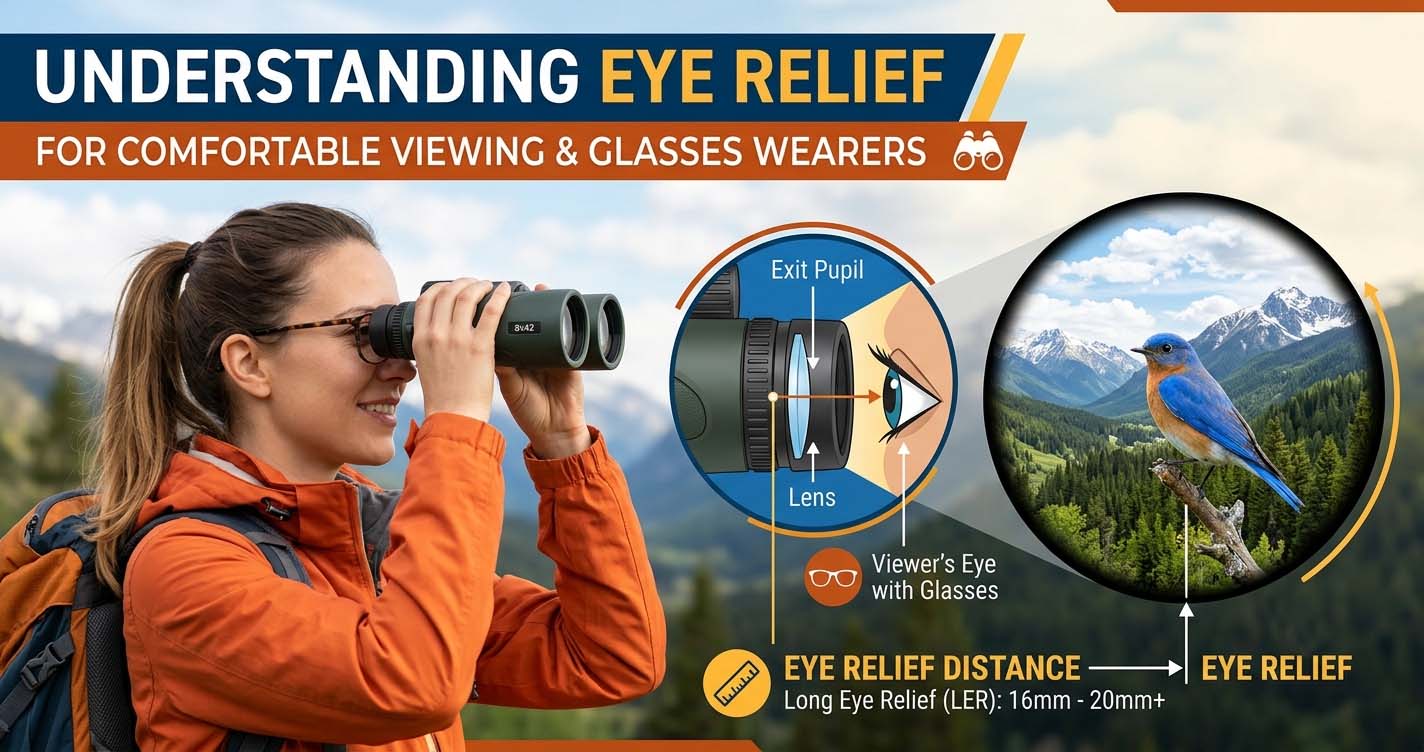
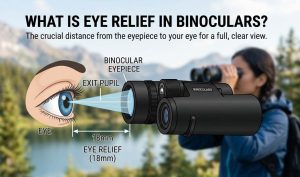
Eye relief is the distance, measured in millimeters, from the outer lens of the eyepiece to your eye where you can see the entire circular field of view. If your eye is too close or too far, you will see a cut‑off image or black edges.
For people who wear glasses, sufficient eye relief, typically 15 mm or more, is essential to accommodate the thickness of the lenses and still see the full picture.
When I first picked up a pair of binoculars with only 10 mm of eye relief, I could not understand why the image kept disappearing every time I blinked. That is the moment I realized that a long number on the spec sheet matters more than most people think.
In this guide, I will walk you through everything I have learned about eye relief from years of testing binoculars for birdwatching, hunting, and astronomy.
What Eye Relief Means in Practice
Imagine holding a magnifying glass between your eye and a postage stamp. There is only one spot where the stamp appears sharp and fills the whole lens.
Move the magnifying glass even a little bit closer or farther, and the image gets cut off. Eye relief works the same way; it is the sweet spot where your eye can align perfectly with the exit pupil of the binoculars.
Every binocular has a fixed eye relief number, usually stamped somewhere on the body or listed in the manual.
This number tells you the distance from the outer surface of the eyepiece lens to the point where your eye needs to be. If you wear glasses, the back of the frames adds a few millimeters, so you need extra eye relief to make up for the space.
The Visual Effect of Too Little Eye Relief
When your eye is too close to the eyepiece, you see a sharp ring or a half‑moon shadow cutting into the view.
When your eye is too far, the image looks like you are looking through a keyhole; the edges go black. You end up squinting, shifting your head, and missing the action.
The Visual Effect of Too Much Eye Relief
Surprisingly, too much eye relief can also cause trouble. If your eye is not perfectly centered in the exit pupil, the image can flicker or black out. I have tested 20 mm+ binoculars where I had to hold them at an awkward distance to see the full circle. More is not always better.
Why Eye Relief Matters for Comfort and Glasses
Comfort and glasses compatibility are the two main reasons most people care about eye relief. Let me break them down.
Comfort Without Glasses
Even if you do not wear glasses, eye relief affects how long you can look through the binoculars. When the eye relief is too short, you have to jam your eye socket right against the eyecup.
That leads to eye strain, headaches, and shaky views because you cannot hold the binoculars still. I have seen this happen to friends who switch from a 14 mm model to a 9 mm model, they complain about nausea after a few minutes.
Glasses Compatibility
This is where eye relief really shines. If you wear glasses, you need at least 15 mm to see the full field of view with your glasses on. But the eyecup design matters just as much. Twist‑up eyecups that fully retract give you a flat surface to press your glasses against.
Fold‑down eyecups are less reliable because they often leave a rubber ring that pushes your glasses away. I always tell people: check the eyecups, not just the number.
What Is “Good” Eye Relief for Different People
There is no single magic number. Here are the ranges I have found to work well in practice.
- If you wear glasses: Aim for 15 mm or more. Some people with thick frames or deep‑set eyes need 18 mm. I personally use 16 mm, and it works fine with my prescription sunglasses.
- If you do not wear glasses: 10 mm to 14 mm is usually comfortable. Below 10 mm, you will feel cramped. Above 14 mm, you might struggle with blackouts unless the eyecups are adjustable.
- If you share binoculars: Look for models with very adjustable eyecups so each user can set their own distance. A fixed 12 mm model will leave one person happy and the other frustrated.
Good eye relief also depends on your face shape. People with high cheekbones or a prominent brow may need longer eye relief because their eye sits farther back. There is no substitute for trying them on, but the numbers above give you a starting point.
The Critical Trade‑Offs of Long Eye Relief
Most online guides stop at “longer is better.” That is not true. Long eye relief, anything above 18 mm, comes with real downsides.
Blackouts and Vignetting
When eye relief is very long, the exit pupil is far from your eye. Your eye can drift slightly off‑center, and the image will black out. This is especially annoying in low‑light conditions when you are trying to hold the binoculars steady.
I had a pair of 20 mm binoculars that gave me a perfect view only if I glued my eye to a tiny spot; any movement, and poof, gone.
Larger Exit Pupil Required
To make long eye relief work, manufacturers often need a larger exit pupil. Exit pupil is the diameter of the beam of light coming out of the eyepiece. It is calculated by dividing the objective lens diameter by the magnification.
For example, a 10×42 binocular has a 4.2 mm exit pupil. To get comfortable long eye relief, the designer may need to increase the exit pupil to 5 mm or more. That means a larger objective lens, which adds weight and cost. You end up paying more for a heavier binocular.
Narrower Field of View
Long eye relief can also restrict the apparent field of view. The eyepiece lenses have to be bigger to cover the same field, but the mechanical design often forces a trade‑off.
I have seen 10× binoculars with 17 mm eye relief that feel like you are looking through a toilet paper tube. Always check the field‑of‑view specs too.
How to Measure Eye Relief Yourself
Manufacturer specs are measured under ideal conditions. Here is how you can test eye relief at home or in a store to see if it works for you.
- Set the binoculars to their furthest focus distance.
- Twist or fold the eyecups all the way down if you wear glasses, or all the way up if you do not.
- Hold the binoculars at arm’s length with the eyepieces pointing away from you.
- Slowly bring the binoculars toward your eye while looking through them.
- Stop when you first see a full, clean circular image with no black edges.
- While holding that position, have someone measure the distance between the eyepiece lens and your eyelid with a ruler.
That distance is your usable eye relief. It may be 1–2 mm less than the spec because of your eye socket shape. If the measured number is uncomfortably low, move on to a different model.
A quick store test: When you are shopping, hold the binoculars to your eyes normally. If you see black half‑moons or need to press hard, the eye relief is too short for you. Do not rely on the number alone.
How Eye Relief Connects to Exit Pupil
Eye relief and exit pupil work together. The exit pupil is the little circle of light you see when you hold the binoculars at arm’s length and look into the eyepieces.
A larger exit pupil (say 5 mm) usually requires a longer eye relief to keep your eye at the right distance. That is why many 8×42 binoculars have 16–18 mm eye relief, while 10×25 compacts often have only 10–12 mm.
Here is a real example: compare a 10×42 with a 4.2 mm exit pupil to an 8×42 with a 5.2 mm exit pupil. Both may have 16 mm eye relief, but the 8×42 will feel more comfortable for glasses wearers because the larger exit pupil gives a bigger sweet spot.
The 10×42 requires you to line up your eye more precisely. Always consider both numbers together.
Myths vs. Reality | What Nobody Tells You About Eye Relief
Myth: “Longer eye relief always gives a wider view.”
Reality: Long eye relief can actually restrict your field if your eye is not perfectly centered. The view may look fine in the center but darken at the edges.
I have seen 20 mm eye relief binoculars that feel narrower than a 14 mm pair because you cannot keep your eye in the sweet spot.
Myth: “Eye relief does not matter if you do not wear glasses.”
Reality: It still affects comfort. Short eye relief forces your eye into the eyecup, which can cause eye fatigue and make it harder to hold the binoculars steady. You will appreciate a bit of extra eye relief even without glasses.
Myth: “Only the eye relief number matters.”
Reality: The eyecup design is equally important. A 17 mm eye relief with poorly designed twist‑up eyecups that do not lock into place is worse than a 14 mm model with smooth, fully retracting cups. I have returned binoculars because the eyecups would not stay down.
Why Some Binoculars “Fail” With Glasses Despite the Specs
You see a binocular listed as having 16 mm eye relief, you try it with your glasses, and the image is still cut off. Why? There are three common reasons.
- Thick frames or oversized lenses: The spec assumes your glasses are flush against the eyecup. If your frames push your eye farther back, you need more relief. I wear wraparound sunglasses that add about 4 mm of distance. A 16 mm spec becomes 12 mm in practice.
- Eyecups that do not fully retract: Some binoculars have “twist‑up” eyecups that still have a ridge when fully down. That ridge pushes your glasses away. Always twist them all the way down and feel if there is a bump.
- Astigmatism in your glasses: Even with perfect eye relief, if your glasses have astigmatism correction, the image can still appear blurred or distorted at the edges. You might need models with larger eye relief to give you more room to adjust your head angle.
To test in store: bring your actual glasses. Adjust the eyecups all the way down. Look for a full circle with no shadows. If you see any black edges, the eye relief is not enough for your setup.
Quick Answers to Common Questions
Can eye relief be adjusted after purchase?
No, eye relief is fixed by the optical design. But adjustable eyecups mimic the effect by changing the physical distance between your eye and the lens. You can also add aftermarket eyecup extenders, but that only reduces eye relief, not increases it.
Does eye relief change with focus?
No, eye relief stays constant regardless of focus. However, some internal focusing mechanisms can shift the eyepiece position very slightly. In practice, the change is negligible, less than a millimeter.
What is the difference between eye relief and eye distance?
Eye relief is a property of the binoculars. Eye distance (interpupillary distance, or IPD) is the distance between the centers of your pupils. You adjust the binoculars’ hinge to match your IPD, but you cannot change eye relief.
Why do some binoculars list eye relief in inches instead of millimeters?
Some older or budget brands convert from millimeters incorrectly or use inches to seem familiar. Always convert: 1 inch = 25.4 mm. If a spec says 0.6 inches, that is about 15 mm. Double‑check the actual mm number to avoid confusion.
Is 12 mm eye relief enough for occasional glasses use?
It depends on your frame thickness. If you have thin metal frames and your glasses sit close to your eye, 12 mm might work for short sessions. But for prolonged use or with thick plastic frames, you will likely see black edges. I recommend at least 15 mm for regular glasses wearers.