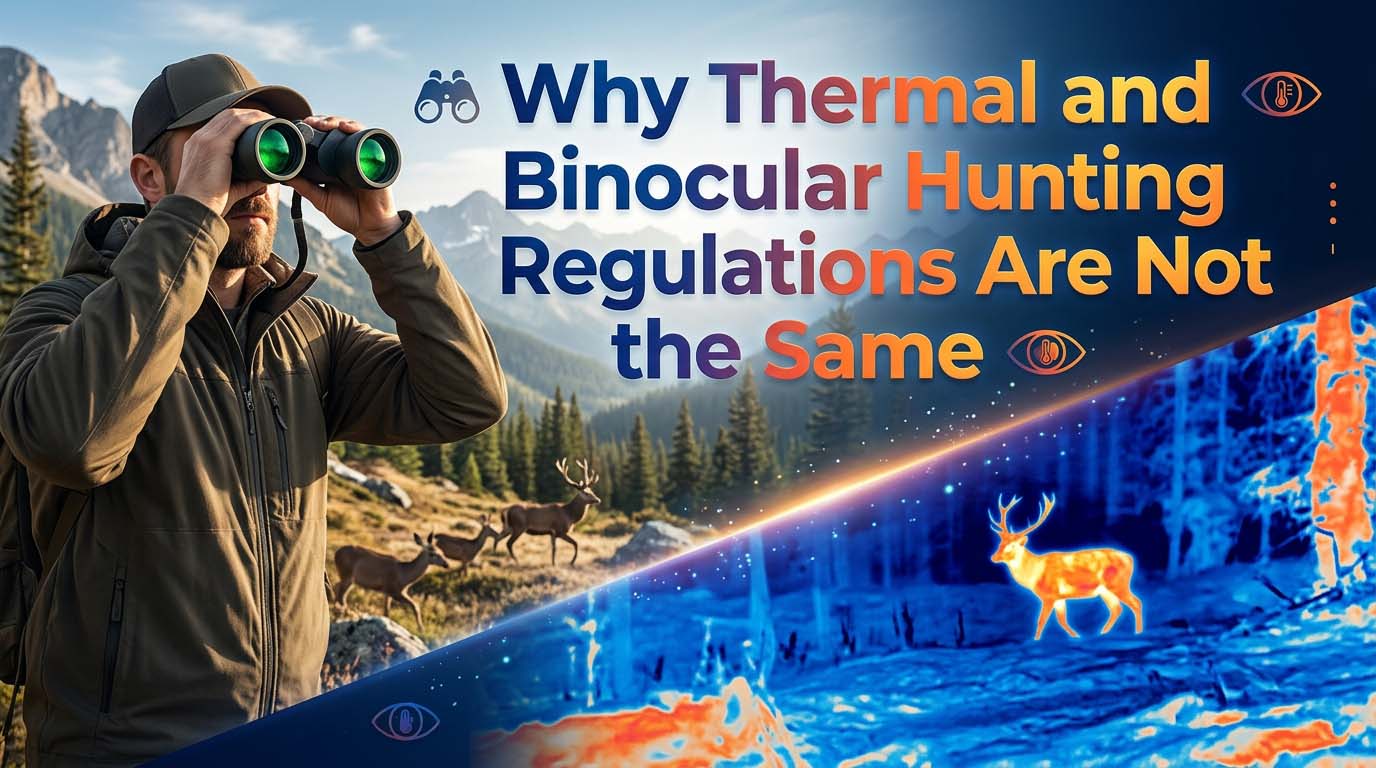
If you hunt with both thermal imaging and standard binoculars, you have probably noticed something odd. One device gets you a warning from a game warden, while the other raises no eyebrows. This is not random. The law treats thermal and binoculars as completely different tools because they give you completely different advantages in the field.
Thermal imaging reads heat signatures. It works in total darkness, through fog, and even through light brush. Binoculars only magnify whatever light is already bouncing off an animal. One actively reveals hidden animals. The other just helps you see what is already visible a little better.
That single difference drives nearly every regulation you will encounter. Here is what you need to know to stay legal.
Why Thermal and Binoculars Are Regulated Differently for Hunting
The core principle behind hunting laws is fair chase. The animal must have a reasonable chance to evade you. When you use thermal, you take away most of that chance. You can spot a bedded deer in thick cover at midnight without ever moving. That is not fair chase in the eyes of wildlife managers.
Binoculars do not give that advantage. They do not penetrate darkness or foliage. They only bring distant objects closer. In legal terms, binoculars are a passive optical aid. Thermal is an active detection system. Many state regulations specifically ban any device that can detect heat or movement beyond natural human ability.
Some hunters argue that binoculars with built-in rangefinders cross a line. That depends on the state. A few states classify any electronic rangefinder as an illegal aid. But in most places, plain binoculars are completely unrestricted.
Are Binoculars Ever Illegal for Hunting?
Most of the time, plain binoculars are legal everywhere. But there are exceptions worth knowing.
If you attach an infrared illuminator to your binoculars, you turn them into a night vision device. That changes the legal status in many states. Even if the binoculars themselves are fine, using them with active IR lighting may put you in the same category as someone using a dedicated night vision scope.
Some states also have broad bans on electronic devices for hunting. If your binoculars include a digital compass, a laser rangefinder, or a ballistic calculator, they may fall under that ban. Check your state’s definition of a prohibited electronic aid. It varies.
Another gray area is using binoculars at night. The binoculars themselves are not illegal, but night hunting itself may be restricted for certain species. You can legally use binoculars during legal shooting hours. But if deer season says you can only hunt deer from 30 minutes before sunrise to 30 minutes after sunset, your binoculars do not give you extra time.
Thermal vs Binocular Regulations by Region: A State-by-State Comparison
The differences become clear when you look at actual state rules. Below is a comparison of how several states treat thermal imaging versus standard binoculars.
| State | Thermal Allowed? | Binoculars Allowed? | Notes |
|---|---|---|---|
| Texas | Yes for feral hogs and coyotes; no for deer | Yes for all species | Thermal restricted to nuisance species only |
| California | No for all game animals | Yes | Thermal banned under general ban on artificial light |
| Florida | Yes for hogs and predators; no for deer | Yes | Check county-specific rules |
| Idaho | Prohibited on public land for any game | Yes | Private land may have different rules |
| New York | Banned for big game; allowed for coyotes with permit | Yes | Permit required for night hunting |
| Oregon | Banned for all game | Yes | No exceptions |
This pattern repeats across the country. Thermal is almost never allowed for deer or elk. It is often allowed for invasive species like hogs and for predators like coyotes. Binoculars are universally permitted.
In Europe, the divide is even sharper. Most European countries ban thermal for all hunting. Binoculars are legal. The European Union also controls the export of thermal devices under dual-use regulations, meaning you cannot buy one without proving you have a legitimate civilian use.
Canada falls somewhere in between. Several provinces allow thermal for predators but ban it for big game. Binoculars face no restrictions at all.
The Confusing Case of Thermal Binoculars: Form vs Function
A growing number of devices look like binoculars but work like thermal imagers. They have two eyepieces and a bridge, just like a traditional binocular. But inside, they contain a thermal sensor, not glass lenses.
Hunters often assume these are regulated as binoculars. They are not. Wildlife agencies look at function, not shape. If the device detects heat, it is a thermal device. It does not matter how many eyepieces it has.
For example, a thermal binocular like the Pulsar Merger Duo is legally a thermal imager. You cannot use it in a state that bans thermal for deer just because it looks like binoculars. Always check the regulations for the specific capability, not the product name.
The same logic applies to clip-on thermal attachments. If you mount a thermal clip-on in front of a binocular, the binocular becomes part of a thermal system. That system is then subject to thermal restrictions.
Myths About Binocular Hunting Laws
Myth 1: Binoculars with built-in rangefinders are illegal. Only in states that ban any electronic device. Most states allow them, but always verify.
Myth 2: Thermal binoculars are just binoculars. False. They are thermal sensors in a binocular form factor. They inherit thermal restrictions.
Myth 3: You can use binoculars at night without restriction. Partly true. Binoculars themselves are legal, but night hunting for certain species may be illegal. Check the method and species restrictions.
Myth 4: Federal law bans thermal for hunting. No federal hunting law exists. All regulation is at the state level. However, export controls are federal.
Myth 5: If a device is marketed for hunting, it is legal. Marketing does not equal legality. Companies sell devices that are illegal in some states. It is your responsibility to check.
Why Thermal Faces Stricter Rules: The Fair-Chase Argument
Wildlife managers have a consistent reasoning. Thermal imaging violates the spirit of fair chase because it eliminates the animal’s ability to hide. A deer can bed down in a thicket, motionless, and be invisible to a hunter with binoculars. That same deer is a bright white heat blob to a thermal user at 500 meters.
The argument is not just about ethics. It is about population management. If hunters could take deer at night in heavy cover with impunity, harvest rates would spike. States use restrictions to keep harvests sustainable.
Binoculars do not change the fundamental balance. They help you see farther, but they do not help you see through brush or darkness. The animal still has the advantage of cover and low light.
Some states extend this logic to include thermal for predators only. Coyotes and hogs cause damage. Wildlife managers want them removed efficiently. So they allow thermal for those species while keeping the ban for big game.
Real-World Legal Mistakes Hunters Make
Mistake 1: Using thermal on public land in Idaho. Idaho bans thermal on public land for any game. A hunter scouting for elk with a thermal monocular on public land was cited. He argued he was not hunting. The warden ruled that scouting with thermal during hunting season constituted an active aid.
Mistake 2: Assuming thermal binoculars are different. A hunter in New York used a thermal binocular for deer at night. He thought because it was binoculars, it was allowed. He lost his hunting license for a year.
Mistake 3: Using a thermal clip-on on binoculars. In Oregon, a hunter attached a thermal clip-on to his binoculars to spot coyotes in the daytime. The state bans all thermal use for any game. He was fined.
Mistake 4: Using an IR illuminator with binoculars at night for deer. In many states, that setup counts as night vision, which is banned for deer. The hunter was using legal binoculars but added the IR light. That changed the classification.
Mistake 5: Ignoring county-level rules. In Florida, some counties ban thermal entirely while others allow it. A hunter traveled from a permissive county to a restrictive county without checking and was cited.
Frequently Asked Questions
Can I use regular binoculars for night hunting if the moon is full?
Yes, in most places. But you still need to check if night hunting for your target species is legal. Binoculars themselves are not the problem. The activity may be.
Do regulations apply differently to monocular vs binocular thermal?
No. Both are thermal devices. The number of eyepieces does not change their classification.
Are there federal laws that restrict thermal but not binoculars?
No federal hunting law. But export controls under the International Traffic in Arms Regulations apply to thermal devices, not to binoculars.
Does the European Union treat binoculars and thermal the same for hunting?
No. Thermal is tightly controlled under dual-use regulations. Binoculars are not restricted for hunting unless they exceed 10x magnification in some countries.
Can I use thermal for hog hunting if it is illegal for deer?
Yes, in most states that distinguish by species. Always check the specific game animal you intend to hunt.
What happens if I accidentally hunt with thermal in a restricted area?
Penalties range from a fine to license suspension to confiscation of the device. It is your responsibility to know the law. Ignorance is not a defense.
Understanding the difference between thermal and binocular regulations keeps you in the field and out of trouble. The key takeaway is simple: if it detects heat, treat it as restricted. If it only magnifies light, you are probably safe. But always verify with your state wildlife agency before you head out.