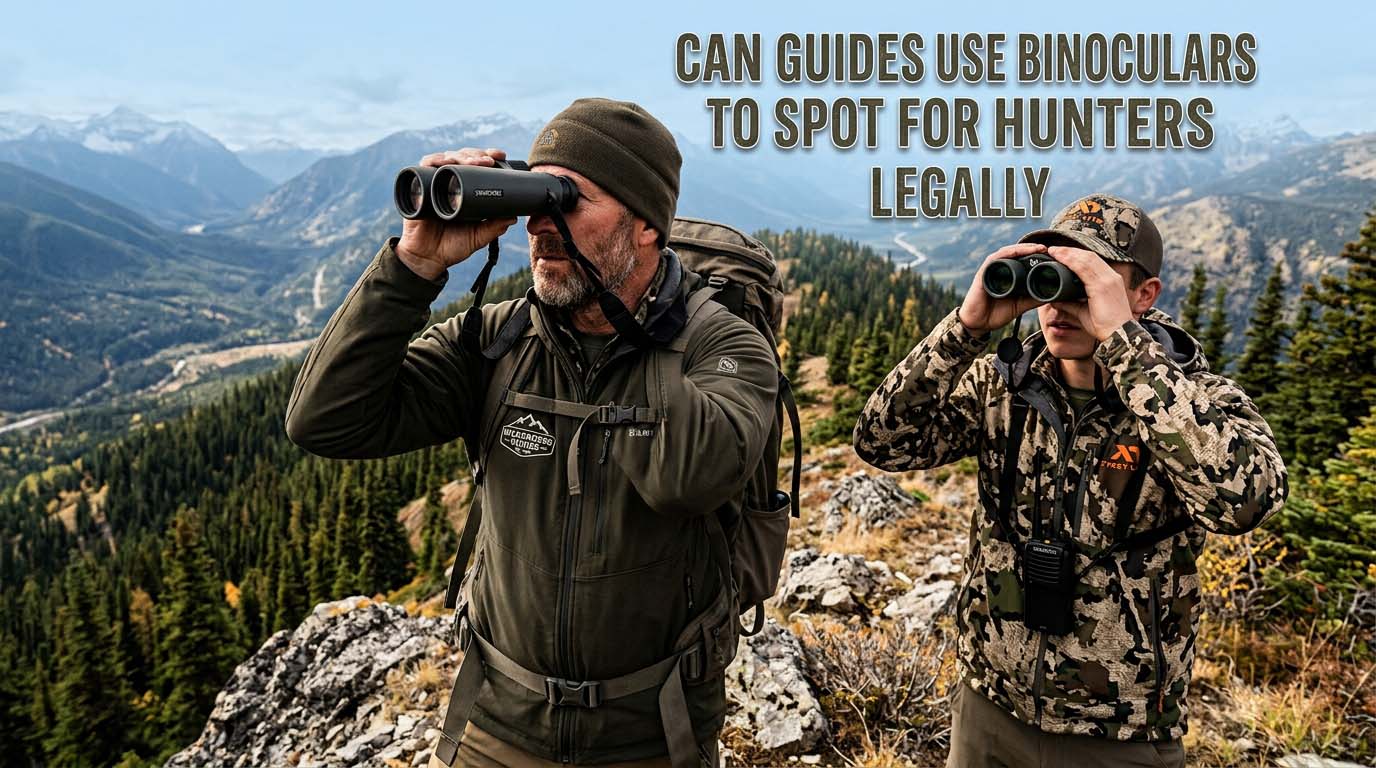
I’ve been guiding elk hunts for over a decade. Every season, I get the same question from new guides and hunters alike: “Can I use binoculars to spot for my client, or is that illegal?” It’s a fair question.
The answer isn’t a simple yes or no. It’s a mix of state law, fair chase rules, and common sense. Let me walk you through what I’ve learned from experience and from digging into the regulations.
The Legal Status of Guide-Spotted Elk Hunting
In most western states where elk hunting is common, there is no explicit law that says a guide cannot use binoculars to locate an elk and tell the hunter where it is. The legal trouble comes from three areas: fair chase regulations, hunter harassment laws, and rules against using electronic devices to aid in taking game.
The key distinction is between locating and directing. If you as a guide simply say, “There’s a bull at 300 yards, left of that dead pine,” that’s generally legal. But if you start telling the hunter exactly when to shoot, or if you use the binoculars to calculate the exact holdover for a shot, you may cross a line.
Some states have specific language about “directing the harvest” or “using visual aid to substitute for the hunter’s own effort.” Those are the phrases to watch for in your state’s wildlife code.
For example, Colorado has an advisory that says using a rangefinding binocular to calculate shot distance for a client can be considered an illegal “electronic aid.” That’s a gray area that many guides don’t realize exists.
How State Wildlife Codes Treat Binocular-Assisted Spotting
The regulations vary widely by state, by land type, and by season. I’ve learned to check the rules for every state I guide in. Here’s how the general frameworks break down.
Public Land Archery Seasons
In states like Colorado, Montana, and Idaho, archery elk hunting is considered a spot-and-stalk challenge. Many of these states have “fair chase” clauses that prohibit taking elk with the aid of another person’s visual location in a way that eliminates the challenge.
If you’re glassing from a ridge 400 yards away and directing your client’s every move, you could be in violation. The rule is often enforced if the guide’s spotting is the primary reason the hunter gets a shot.
General Rifle Seasons
Rifle seasons are usually more permissive. The emphasis shifts to safety and clean kills. Guides are often allowed to spot and describe the animal’s location. However, some states have “party hunting” laws that prohibit one person from spotting and another from shooting under a single tag.
If you are guiding a client, the tag belongs to the client. The spotter cannot be considered a second hunter.
Guided vs. Unguided Distinctions
A few states explicitly define what a guide can and cannot do during the actual shot opportunity.
For instance, Oregon’s regulations say that a guide may “locate game” but may not “direct the harvest.” That’s a subtle difference that can get you a ticket if you overstep.
Case Law Examples
One Colorado case involved a guide who used a digital rangefinding binocular to dial in the exact yardage for a client’s shot. The state determined that the binocular’s laser rangefinder was classified as an “electronic device used to aid in taking game,” which is illegal during archery season.
The guide was fined and lost his license for a year. That case is a reminder that not all binoculars are treated the same.
The Ethical Argument Beyond the Law
Even if something is legal, that doesn’t mean it’s right. I’ve seen guides who spot every single animal for their clients, never letting the hunter develop their own field skills. That approach undermines the conservation ethic we’re supposed to pass on.
There’s also the wounding risk. A guide’s binoculars can gather more light than a hunter’s scope or eyes. I’ve been in situations where I could see a bull clearly in low light, but my client’s view was too dark to make a clean shot. If I had told him to shoot anyway, it could have led to a wounded animal.
I learned that lesson the hard way years ago when I was hunting with my own son. I had cheap binoculars, he was looking through his scope, and I couldn’t tell him if the shot was safe. That experience taught me that the guide’s job is not just to spot, but to know when to stay quiet.
Another ethical consideration is client expectation. Some clients want you to do all the work. Others want a true mentorship. I always ask before the hunt: “How much guidance do you want?” That conversation sets the tone and avoids disappointment.
Critical Distinction: Spotting vs. Spotting With Electronics
Standard binoculars are passive optical devices. They don’t emit signals, record data, or transmit images. That’s why they are almost always legal to use for spotting.
The trouble starts when binoculars have built-in electronics. Digital binoculars with Bluetooth, image stabilization that feeds to a smartphone, or laser rangefinders that calculate ballistic solutions, these can trigger state prohibitions against “electronic devices” used to aid in taking game.
In some states, even a simple digital compass integrated into the binoculars is considered an electronic aid if used to navigate to a specific animal.
The line is clear: if your binoculars can send or receive data, or if they calculate something for you, you might be breaking the law. Stick to standard glass when you are guiding. Leave the high-tech gear for your personal scouting.
Guide Liability and Best Practices
I’ve developed a set of best practices over the years that keep me out of trouble and help my clients have a better hunt.
Document Your Approach
Keep a simple written policy on how you use optics during client hunts. It doesn’t need to be a legal document, just a note that explains your typical process. This can protect you if a wildlife officer asks questions.
Pre-Hunt Briefing
Before the hunt, tell your client exactly what you will do. Say something like: “I will glass for you. I will describe where the elk is. I will not tell you precisely when to shoot or where to aim beyond general shot placement. That is your call.” This manages expectations and covers you legally.
Distance and Terrain Constraints
I try to stay close enough to my client that our visual perspectives are similar. Spotting from a distant ridge can make you think the shot is easier than it actually is. If I’m not within 100 yards of the hunter, I don’t give detailed shot advice.
Know Your State’s Spotting Definition
Pull up the actual regulation text for your primary guiding states. Look for phrases like “locating game,” “directing the harvest,” or “visual aid.” If you don’t understand a term, call the state wildlife agency. They’re usually happy to explain.
Frequently Asked Questions
Can a guide use a spotting scope mounted on a tripod, or only handheld binoculars?
Spotting scopes are generally treated the same as binoculars. However, their higher magnification can raise fair chase scrutiny during archery seasons.
I’ve seen guides ticketed for using a spotting scope to read the exact number of points on a bull, then telling the client to shoot. That crosses the line into “directing the harvest.”
If a guide is not licensed but is a friend helping on a hunt, does the same legality apply?
Yes. In most states, the spotting restrictions apply to anyone, not just licensed guides. A friend spotting for you carries the same legal and ethical weight. I’ve seen friends get citations for guiding without a license because they were actively spotting and directing.
Do outfitters need to include optics policies in their liability waivers?
Yes. A well-written waiver should acknowledge that the guide will assist with glassing, but the hunter retains final shot decision responsibility. This protects both the guide and the outfitter if something goes wrong.
Can a guide use binoculars with a built-in digital compass or GPS to spot?
Only if those features are not used to transmit data or calculate ballistic solutions in real-time. Passive compass and altimeter features are normally allowed.
But if you use the GPS to mark the elk’s location and then guide the hunter to that exact spot, some states consider that an electronic aid. I avoid using any digital features while actively hunting with a client.
Is there any federal land restriction on guide spotting?
In National Parks, hunting is generally prohibited. On National Forests and BLM land, state regulations apply.
However, some wilderness areas have additional restrictions on “mechanical assistance.” That usually applies to vehicles and bikes, but I’ve seen it interpreted broadly to include any device that aids the hunt. Always check the specific wilderness area rules before you start glassing for a client.
The bottom line is this: you can use binoculars to spot for a hunter, but you have to know the rules of the state you’re in, the land you’re on, and the season you’re hunting.
More importantly, you have to use good judgment. The best guides I know use their binoculars to help the hunter see the animal, not to make the hunt easier for themselves. That’s the difference between a guide who gets results and one who gets cited.