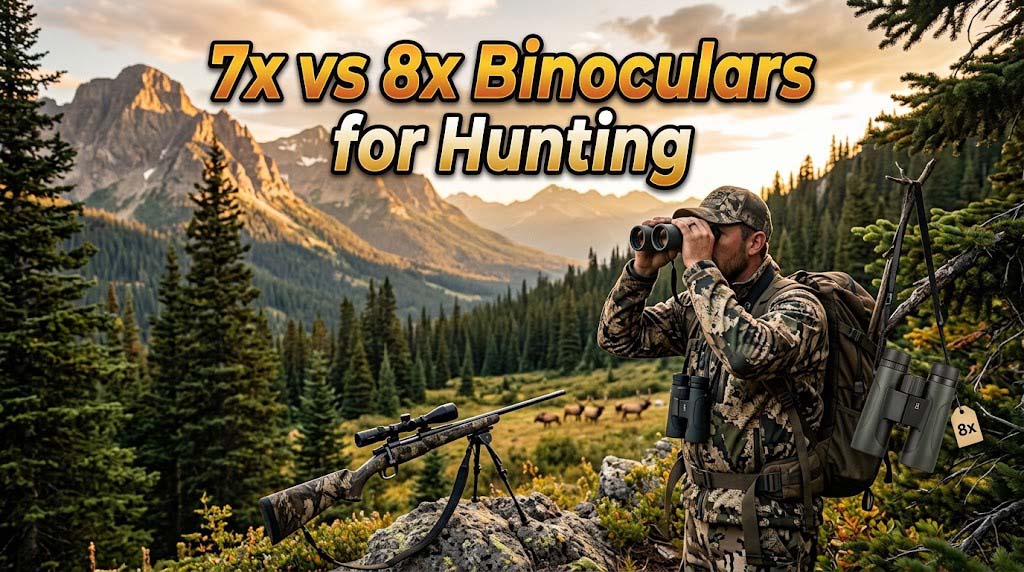
I have spent more mornings than I can count sitting in a treestand with steam rising off my coffee, glassing a ridgeline at first light, or pushing through alder thickets after a blood trail. Through all of that, the question of 7x versus 8x binoculars has come up more often than any other. And the honest answer is not one-size-fits-all.
For the majority of hunters, 8x is the better all-around choice because it gives you that extra reach without wrecking your view. But 7x wins decisively in specific conditions that most advice columns skip right over.
The difference comes down to three things: the kind of terrain you hunt, how much light you have left, and how steady your hands are after the third hour of glassing.
What Actually Changes Between 7x and 8x
The number itself tells you how many times closer an object appears. An 8x binocular makes a deer at 200 yards look like it is 25 yards away. A 7x makes it look like 28.6 yards away. That small gap matters less than you think until you start looking at the trade-offs that come with it.
Field of view is the first thing that shifts. A typical 8×42 binocular gives you around 330 to 360 feet at 1,000 yards. A 7×42 gives you 380 to 420 feet. That extra 50 to 90 feet of width means you can scan a field edge faster and catch movement in your peripheral vision that an 8x would miss.
In dense cover, that wider view can be the difference between spotting the flick of an ear and never knowing the animal was there.
The exit pupil is the second piece. Divide the objective lens diameter by the magnification. For 7×42, that is 6.0 millimeters. For 8×42, it is 5.25 millimeters. Your own pupil dilates to about 6 to 7 millimeters in low light.
A 7×42 delivers enough light to match your eye. An 8×42 gives you less. In practical terms, that means you can see game clearly about 15 to 20 minutes longer at dawn and dusk with the 7x pair. If you hunt the first and last legal shooting light, that window matters.
Brightness also depends on glass quality, but binoculars’ exit pupil is the physics you cannot outrun. No coating can fix a light deficit that big.
Terrain Dictates Everything
Hunting is not one activity. The best magnification for a bottomland swamp is not the best for a sagebrush flat. Here is how each performs in the three most common hunting environments.
Dense Timber and Thick Cover
If you hunt whitetails in river bottoms, black timber for elk, or any place where your shots rarely stretch past 80 yards, reach for 7x. The wider field of view lets you pick apart brush and see movement through branches that would block an 8x. You also get less of the “tunnel vision” feeling.
When you lift 7x binoculars in thick cover, you still have a sense of what is happening around you. With 8x, you tend to lose the peripheral and have to sweep more to see the same area. That extra sweeping eats time and masks movement.
Open Agricultural Fields and Prairies
On a wheat stubble field or a CRP meadow where shots can go 200 to 400 yards, 8x pulls ahead. The extra magnification helps you identify antler tines, count points, or distinguish a coyote from a rock at longer distances.
The narrower field of view matters less because you are scanning an open space and you can use a grid pattern. Many hunters here prefer 8x because they do not need the low-light edge as badly, they usually set up well before legal light and wait.
Mountainous Glassing Positions
When you are sitting on a ridge looking across a canyon, both magnifications work, but the game shifts. If you glass without a tripod, 7x is noticeably easier to hold steady for long periods.
If you use a tripod, which I strongly recommend for serious mountain hunting, then 8x is fine, and some hunters even move up to 10x.
The stability of a tripod eliminates the shake advantage of 7x, so the extra reach of 8x becomes the clear winner. For spot-and-stalk in open country, 8x is my go-to.
The Physical Reality Check
Nobody talks enough about how much your arms fatigue when you glass for twenty minutes straight. The difference between 7x and 8x is not just numbers on a spec sheet. It is a physical demand.
Hand Shake Amplification
Every human has a natural tremor. At 7x, that tremor is multiplied by 7. At 8x, it is multiplied by 8. That one extra multiple pushes many hunters past what I call their shake threshold.
Once you cross that line, the image wobbles enough that you lose the detail you are trying to gain.
A shaky 8x view is actually worse than a steady 7x view because your eye cannot resolve the fine details. You end up looking at a blurry shape instead of a clear animal.
Testing Your Own Threshold
Here is a simple test you can do with any binocular. Pick a distant object with fine detail, a sign, a fence post, or a bird on a wire. Hold the binoculars steady for sixty seconds without bracing your elbows.
If the image starts to wobble within the first fifteen seconds, you are probably past your threshold for that magnification. Try the same test with a 7x pair. If the image stays steady, that is the one you should carry.
How Tripods Change the Math
If you commit to using a tripod every time you glass, the stability argument disappears. On a tripod, 8x is rock solid, and the extra magnification is pure gain. But very few hunters actually carry and set up a tripod for every glassing session.
I have. It is worth it for long sits. But if you are the kind of hunter who mostly glass from the truck window, off the hood, or with elbows on your knees, the shake advantage of 7x stays real.
The Exit Pupil Reality
I mentioned exit pupil in the difference section, but it deserves its own deep dive because it is the most overlooked factor in the 7x versus 8x debate.
A 7×42 binocular has a 6mm exit pupil. That matches the maximum dilation of a young adult’s pupil. An 8×42 has a 5.25mm exit pupil.
When the sun drops behind the horizon, your eyes open up to let in more light. If the exit pupil of your binocular is smaller than your dilated pupil, you are wasting light. The image looks dimmer, and you lose contrast.
This is not theoretical. I have tested this side-by-side on multiple dusk sits. With 7×42 binoculars, I could still make out the outline of a buck at 150 yards when the 8×42 pair had already gone to a muddy silhouette.
That extra 15 to 20 minutes of usable light can be the difference between pulling the trigger and walking home empty.
If you hunt species that move at legal light edges, whitetails, hogs, coyotes, the 7x exit pupil advantage is real. If you hunt midday for prairie dogs or ground squirrels, it does not matter.
Myth versus Reality: The Hunting Magnification Fallacy
A lot of hunters believe that higher magnification always lets you see better. It does not.
Wider Field of View Helps You Find Game
A 7x binocular reveals more ground per glance. When you scan a hillside, you cover more acres per minute. That means less time with your eyes pressed to the glass and more time looking at the big picture.
Especially in timber, animals blend into the background. The wider view catches the small movement of an ear or a tail flick that an 8x would miss because it is looking at a smaller piece of the puzzle.
Narrower FOV Hides Movement
With an 8x, you are essentially looking through a tube. If an animal moves into your view while you are scanning elsewhere, you might not catch it. With a 7x, the larger tube catches more of the surroundings.
This is critical when you are watching a field edge where deer can step out at any moment. The wider view reduces the chance of missing the action.
Not All Hunting Demands the Same Thing
A bow hunter sitting in a treestand at 20 yards does not need 8x. They need field of view to watch the trail and the scrape at the same time. A rifle hunter in a prairie pothole needs the extra magnification to confirm species and count birds.
A predator caller needs to scan wide and fast between calls. The one-size-fits-all advice fails because it pretends hunting is the same everywhere.
The Decision Matrix
Here is the direct, conditional recommendation based on real field use.
| Scenario | Choose | Why |
|---|---|---|
| Dense timber, whitetail, eastern woods, thick cover | 7x | Wider field of view, easier to pick through brush, better low-light performance at dawn |
| Open fields, prairies, CRP, long shots (200+ yards) | 8x | Extra magnification for identification, sufficient light, less shake issue if braced |
| Mountain glassing without tripod | 7x | Easier to hold steady for long periods, wider scan |
| Mountain glassing with tripod | 8x or 10x | Stability eliminates shake, extra reach is pure gain |
| Bow hunting from treestand (close shots) | 7x | Wide view, low-light advantage at first and last light |
| Rifle hunting open terrain | 8x | Better ID at distance, standard for most hunters |
| Predator calling (wide scanning) | 7x | Faster scans, catch movement in periphery |
| Spot-and-stalk mule deer (open basins) | 8x | Extra reach for picking out antler details |
If you hunt a mix of terrain, 8x is the safer all-around pick because it gives you more reach when you need it and you can work around the narrower field of view by scanning methodically. But if you spend most of your time in the dark timber or hunting low-light edges, 7x will show you more.
Frequently Asked Questions
Can I use a 7x binocular for western mule deer hunting where shots are longer?
Yes. Many western hunters carry 7x binoculars and do fine. The key is whether you glass from a tripod or freehand. Without a tripod, the 7x gives you a steadier image. You lose some detail at extreme ranges, but you gain stability and field of view.
Most mule deer hunters I know prefer 8x or 10x when using a tripod. If you go 7x in the West, pair it with a good spotting scope or rangefinder to confirm antler points.
Why don’t more hunters consider 6.5x binoculars as a compromise?
6.5x is actually a great choice for thick cover hunters who want maximum field of view and low-light performance. The exit pupil on a 6.5×42 is 6.46mm, which is even brighter than 7x.
But 6.5x is less common because most manufacturers focus on 8x and 10x. You can find a few high-end 6.5x models, but they are niche. If you hunt exclusively in dense timber and never take shots past 100 yards, 6.5x is worth looking at.
Does stabilizing technology like image stabilization binoculars change the 7x vs 8x debate?
Absolutely. Image stabilization (IS) removes the hand-shake problem. With an IS binocular, 8x becomes as steady as a tripod-held 7x. In that case, the magnification advantage of 8x is pure gain.
IS binoculars are heavier and more expensive, but for hunters who glass long hours from a boat or a ridge, they are a game-changer. The trade-off is battery life and weight. For most stationary hunting, IS makes 8x the clear winner.
How does objective lens size (42mm vs 50mm) interact with magnification choice for hunting?
A 7×50 gives a huge 7.14mm exit pupil, which is overkill for most human eyes because your pupil never dilates that much. The extra weight and bulk are wasted. An 8×50 gives a 6.25mm exit pupil, which matches your eye better but still adds weight. For most hunters, 42mm is the sweet spot.
If you need more low-light performance, go to 7×42 rather than 8×50. That gives you the same exit pupil (6mm) with less weight. If you go to 8×50, you are carrying an extra half-pound for marginal gain.
Should I choose different magnification for bow hunting vs rifle hunting?
Yes. Bow hunting is almost always under 40 yards, sometimes as close as 10. For bow hunting, 7x is better because you watch the trail and the animal’s body language in a wide frame.
Rifle hunting can go to 400 yards, where 8x helps you pick a specific spot on the animal. Some bow hunters even use 6x or 5x for the widest possible view. If you bow hunt in low light, 7x is practically a must.
Final Thoughts from the Field
I have carried both 7x and 8x binoculars on hunts from the Florida pine flats to the Montana breaks. Every time I switch back and forth, I remember that the number on the barrel is less important than how it feels in your hands during the ten minutes before shooting light.
If you can, try both in the environments you actually hunt. Stand in a thicket and glass a doe at 80 yards. Then try the same with the other pair. Your eyes will tell you which one works.
For most hunters, 8x is the right answer because it covers the majority of scenarios. But if you hunt thick country or push the edges of legal light, do not let anyone talk you out of 7x. It is not a compromise. It is a specialized tool that performs exactly where you need it most.