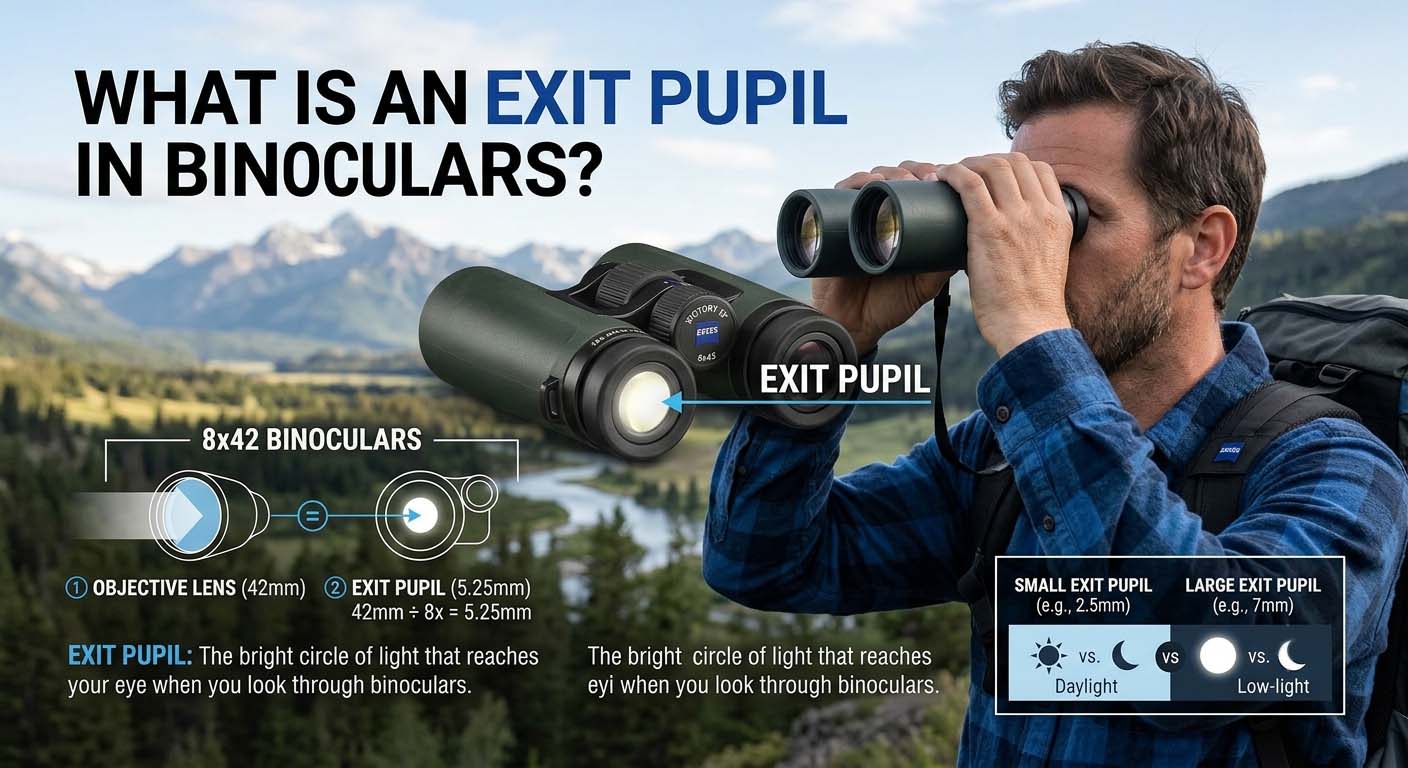
If you hold a pair of binoculars about a foot from your eyes and point them at a bright light, you’ll see two small bright circles inside the eyepieces. That circle is the exit pupil. In simple terms, it’s the beam of light leaving the eyepiece and entering your eye. The size of that beam matters a lot for how bright the image looks, especially in dim conditions.
The exit pupil diameter is easy to calculate: divide the objective lens diameter by the magnification. For an 8×42 binocular, that’s 42 ÷ 8 = 5.3mm. That number tells you how wide the light beam is as it exits.
If the beam is smaller than your own pupil, you’ll see a darker image. If it’s the same size or larger, the image will be as bright as what you see with your naked eye.
How Does Exit Pupil Size Affect Image Brightness?
Your eye’s pupil changes size depending on the light. In bright daylight, it shrinks to about 2–3mm. In darkness, it opens up to around 5–7mm, depending on your age. The exit pupil of your binoculars needs to match or exceed your eye’s pupil to deliver full brightness.
Let’s look at two common examples:
- 8×20 binoculars (2.5mm exit pupil): In daylight, your 2–3mm pupil is about the same size, so the image looks bright. But at night, your pupil opens to 7mm while the exit pupil is only 2.5mm – you’re effectively looking through a tiny hole. The view will be noticeably dim.
- 7×50 binoculars (7.1mm exit pupil): At night, that 7.1mm exit pupil matches your dilated eye, so the brightness matches what you see with your naked eye. In bright daylight, your pupil shrinks to 2–3mm, but the extra light from the larger exit pupil is simply blocked by your iris; the image still looks normal, not too bright.
The key takeaway: a larger exit pupil benefits you only in low light. During the day, a 2.5mm exit pupil looks just as bright as a 7mm one.
The Age Factor | Why Bigger Isn’t Always Better
Here’s something most articles don’t mention: as you get older, your pupils don’t dilate as much. A 20-year-old might have a 7mm pupil in the dark. A 40-year-old might only reach 5mm. By age 60, it’s often around 4mm.
If you buy a 7×50 binocular with a 7.1mm exit pupil but your eyes can only dilate to 5mm, you’re carrying extra weight and paying for a feature you can’t use. The light outside your pupil’s opening is wasted; it hits your iris and never reaches the retina.
So for stargazing, if you’re over 50, a 5mm exit pupil (like an 8×40 or 10×50) is plenty. Anything larger just adds bulk without improving brightness. This is why many experienced birders and hunters in their 40s and 50s prefer 8×32 or 8×42 binoculars over 7x50s.
Common Misconceptions About Exit Pupil
There are three myths I hear all the time. Let’s clear them up.
Myth 1: Larger exit pupil = brighter image in all conditions.
Reality: Only in the dark. In bright light, your pupil is so small that any exit pupil above 2mm looks the same. A 10×25 (2.5mm) and an 8×56 (7mm) will appear equally bright on a sunny day.
Myth 2: Exit pupil determines image sharpness.
Reality: No. Sharpness (resolution) depends on the quality of the glass, coatings, and alignment. Exit pupil only affects brightness, not detail. You can have a perfectly sharp image with a 2mm exit pupil.
Myth 3: Exit pupil is the same as eye relief.
Reality: This is the most common confusion. Exit pupil is the diameter of the light beam. Eye relief is the distance from the eyepiece lens to where that beam forms – the spot where you need to place your eye. They are completely different specs.
Exit Pupil vs. Eye Relief | Why They’re Confused
People often search for “exit pupil distance” thinking it means how far away you hold the binoculars. That’s actually eye relief.
The proper term is “eye relief,” and it’s measured in millimeters. If you wear glasses, you need eye relief of at least 15mm so you can see the full field of view without pressing your glasses against the eyepiece.
Exit pupil diameter is the size of the light circle. Exit pupil distance is a misnomer – it doesn’t exist as a separate measurement. So next time you see “exit pupil distance” in a product description, know they probably mean eye relief.
How to Choose the Right Exit Pupil for Your Use?

Here’s a practical guide based on what you’ll be doing:
- Birding (daylight with some dawn/dusk): A 4mm exit pupil is ideal. That’s an 8×32 or 10×40. It gives enough brightness for early morning but keeps the binoculars lightweight.
- Astronomy (nighttime under dark skies): Aim for 5–7mm if you’re under 40. If you’re older, stick with 5mm. A 7×50 or 10×70 works well for younger stargazers, but an 8×40 is a better choice for those over 50.
- Hunting (variable light from dawn to dusk): A 4–5mm exit pupil is the sweet spot. 8×42 (5.3mm) or 10×42 (4.2mm) are classic choices. They perform well in low light without being too heavy.
- Marine or boating (bright, steady light): A 3–4mm exit pupil is plenty. 7×28 (4mm) or 8×32 (4mm) keep the binoculars compact and easy to hold steady on a moving boat.
Frequently Asked Questions
What is the ideal exit pupil for stargazing if I’m over 60?
Aim for 5mm, not 7mm. Your pupils won’t dilate fully, so a 7mm exit pupil is wasted weight. An 8×40 (5mm) or 10×50 (5mm) will give you all the brightness you can use.
Can exit pupil be too small for daytime use?
No, as long as it’s 2mm or larger, you won’t notice any darkness. A 1.5mm exit pupil (like a 10×25) can feel dim even in good light, especially if your eyes are tired.
Does a larger exit pupil give a wider field of view?
No. Field of view depends on the eyepiece design, not the exit pupil diameter. You can have a 7mm exit pupil with a narrow field and a 3mm exit pupil with a wide field.
What is relative brightness?
It’s a calculated number: exit pupil squared. For a 5mm exit pupil, relative brightness is 25. It’s a rough way to compare brightness between binoculars, but it only matters in low light. Ignore it for daytime use.
How does exit pupil relate to twilight factor?
Twilight factor is the square root of (magnification × objective diameter). It measures detail resolution in low light, not brightness.
Exit pupil is about how much light reaches your eye; twilight factor is about how much fine detail you can see. They are different tools for different needs.