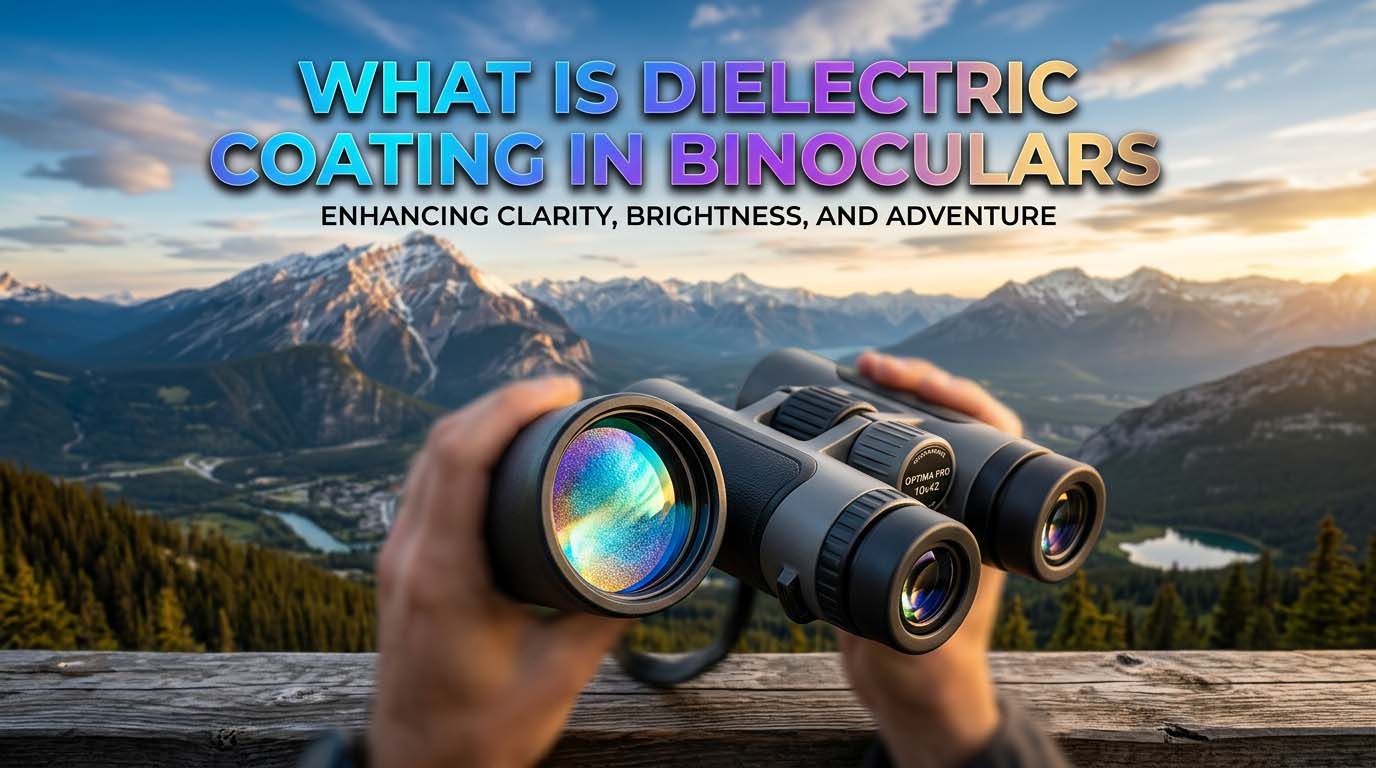
You are standing in a shadowy forest at dusk. A bird moves in the branches thirty yards away. Through cheap binoculars, you see a dark silhouette. Through a pair with dielectric-coated prisms, you see feather details and warm browns even in that failing light. That difference is not magic. It is physics, applied in layers thinner than a human hair.
Dielectric coating is a stack of microscopic layers applied to the reflecting surfaces inside roof prisms. These layers act as a perfect mirror, bouncing nearly all incoming light to your eyes. Where standard silver coatings reflect around 90-95% of light, dielectric coatings push that number to 95-99%. The result is a brighter image with colors that stay true to life instead of shifting warm or dull.
How Dielectric Coatings Actually Work
To understand dielectric coatings, you need to know what happens inside your binoculars. When light enters the objective lens, it travels through glass and hits a prism. That prism bends the light path so the image appears upright. But prisms are not perfect reflectors. Some light escapes or scatters, and that lost light means a dimmer image for you.
Coating manufacturers solved this by depositing alternating layers of materials with different refractive indexes. One layer might have a high refractive index, the next a low one. When light strikes this stack, each boundary reflects a small portion. Through careful engineering, those reflections combine constructively — they reinforce each other instead of canceling out. This is called an interference mirror, and it is what dielectric coating really is.
A typical dielectric stack contains 20 to 40 individual layers. Each layer is between 50 and 150 nanometers thick. To put that in perspective, a human hair is about 80,000 nanometers thick. These layers must be applied with extreme precision in vacuum deposition chambers. A thickness error of even a few nanometers shifts the reflection properties and ruins the coating.
The Real Difference Between Dielectric, Silver, and Aluminum
Not all reflective coatings perform equally. The table below shows the light transmission ranges for the three common prism coating types.
| Coating Type | Light Transmission | Color Character | Typical Price Impact |
|---|---|---|---|
| Aluminum | 85-92% | Slightly cool, neutral | None (budget standard) |
| Silver | 90-95% | Slightly warm (yellowish) | Moderate |
| Dielectric | 95-99% | Neutral, true-to-life | High |
Aluminum coatings were the standard for decades. They work fine in bright daylight, but the 8-15% light loss becomes obvious at twilight or in deep shade. Silver coatings improved things significantly and are still found in many mid-range binoculars. Silver reflects across the visible spectrum but dips in the blue range, which is why images can look slightly warm.
Dielectric coatings reflect evenly across the entire visible spectrum. That even reflection is what preserves true colors. Birds that appear gray through silver-coated binoculars show their actual olive and rust tones through dielectric ones. The transmission improvement from aluminum to dielectric — about 7-10% — is the difference between seeing a deer’s outline and seeing the texture of its fur in low light.
How Much Better Is Dielectric in Real-World Use
Here is the honest truth: in bright midday sun, you will not see a noticeable difference between good silver and dielectric coatings. Your eye cannot perceive a 2-5% transmission difference when there is abundant light. The gains appear in specific conditions:
- Twilight and dawn: This is when the extra 5-10% light makes the biggest difference. Objects that are barely visible through silver-coated optics become identifiable through dielectric ones.
- Dense forest or heavy overcast: Shaded environments reduce available light dramatically. Dielectric coatings maximize what little light reaches your eyes.
- Astronomy: When observing the moon or planets, every photon counts. Dielectric coatings reveal fainter details on planetary surfaces.
- Deep shadow areas: Looking into dark ravines, under thick canopy, or into shaded buildings benefits noticeably.
If you only use binoculars for daytime sports or casual birdwatching in open areas, the upgrade from silver to dielectric may not justify the price difference. If you hunt at dawn, bird in forests, or observe wildlife in overcast conditions, dielectric coatings are worth every extra dollar.
How to Verify Dielectric Coating Claims
Manufacturers throw around “fully multi-coated” and “high-definition optics” all the time. Dielectric is a specific claim you can actually test. Here is how:
Method 1: The Prism Reflection Test
Hold your binoculars with the eyepieces facing you. Aim the objective lenses at a bright light source, not directly but at a slight angle. Look into the eyepieces and observe the color reflecting off the prisms. Dielectric coatings reflect a distinctive blue, purple, or violet hue. Silver coatings reflect a neutral or slightly warm tone. Aluminum reflects a bluish-gray. If you see that blue-violet color, dielectric coating is present.
Method 2: Check the Specification Sheet
Look for the exact words “dielectric coating” or “dielectric prism coating” in the specifications. Vague terms like “multi-coated optics” or “premium coatings” do not mean dielectric. Some budget brands use “dielectric” loosely, so cross-check independent reviews whenever possible.
Method 3: Understand the Layer Question
Some manufacturers apply dielectric coating to only one prism surface and silver to the other. This is a cost-cutting measure. True full dielectric coating covers all reflecting prism surfaces. Premium brands disclose this. Affordable brands often do not. If a binocular costs under $400 and claims dielectric, verify with Method 1 and read detailed reviews before buying.
The Cost-Benefit Reality Check
Dielectric coatings add roughly $50 to $200 to a binocular’s price depending on the brand and overall quality. That premium is not uniform across products. A $300 binocular with dielectric coatings may have mediocre glass and poor ergonomics. A $150 binocular with silver coatings might offer a sharper image because the glass and lens quality are better.
The coating is only one part of optical performance. Lens glass quality, anti-reflective lens coatings, phase-correction coatings, and prism alignment all matter. Dielectric coating on poor glass produces a bright but blurry image. Silver coating on excellent glass produces a sharp but slightly dimmer image. For most daytime users, the sharp image wins.
Here is a practical rule: if you mostly use binoculars in good light, spend your money on glass quality and lens coatings first. If you regularly push your optics into low-light situations, dielectric is the upgrade that matters most.
Common Misconceptions About Dielectric Coatings
Several ideas float around that are simply wrong. Let me clear them up.
Dielectric improves resolution. It does not. Resolution comes from the lens and prism quality, plus phase-correction coatings that fix light wave interference. Dielectric only improves brightness and color fidelity. A bright fuzzy image is still fuzzy.
Dielectric makes binoculars waterproof. No. Waterproofing comes from O-ring seals and nitrogen purging. Dielectric coatings are internal and have nothing to do with moisture protection.
Dielectric on objective lenses is the same as on prisms. It is not. Objective lenses use anti-reflective coatings to reduce surface reflections. Prism dielectric coatings are reflective mirrors. These serve opposite functions. Some brands blur this distinction in marketing.
More layers always means better. Not true. The precision of each layer’s thickness matters far more than the total count. A 20-layer coating with accurate thickness beats a 40-layer coating with sloppy control.
Durability and Lifespan of Dielectric Coatings
Silver coatings tarnish over time. The silver reacts with sulfur compounds in the air, gradually reducing reflectivity. This process takes years but is real. A pair of silver-coated binoculars used heavily for a decade may show measurably dimmer images than when new.
Dielectric coatings are made of inert metal oxides like titanium dioxide and silicon dioxide. These materials do not oxidize or degrade under normal conditions. The coating layers are bound to the prism surface and remain stable indefinitely. With normal cleaning and care, dielectric-coated prisms will perform the same in twenty years as the day they were made.
This longevity matters if you buy binoculars as a one-time investment. The lower maintenance and consistent performance over time offset the higher initial cost for serious users.
When You Do Not Need Dielectric Coatings
Let me save you money. You do not need dielectric coatings if your binocular use never involves low light conditions. Here are scenarios where silver or aluminum coatings are perfectly adequate:
- Daytime sports events: Stadium lighting and daylight provide plenty of light.
- Open-country birding at midday: Birds are bright and the sun is high.
- Boating on sunny days: Glare reduction matters more than light transmission.
- Budget-conscious beginners: A $100 pair with aluminum coatings teaches you what you need without a big investment.
- Indoor use with proper lighting: Museums, theaters, and indoor arenas have controlled lighting.
If you fit these categories, ignore the dielectric marketing pressure. Spend your money on ergonomics, field of view, and lens quality instead. You will get a better experience for your actual use case.
Frequently Asked Questions
Can I add dielectric coating to my existing binoculars?
No. Dielectric coatings are applied inside vacuum deposition chambers during the manufacturing process. The prisms must be completely disassembled and re-coated, which costs more than a new pair. Aftermarket retrofitting is not practical in any way.
Do Porro prism binoculars ever use dielectric coatings?
Rarely. Porro prisms have angled surfaces that make uniform coating deposition difficult and expensive. Almost all dielectric-coated binoculars use roof prisms. A few premium Porro models exist, but they cost considerably more than equivalent roof prism options.
Does dielectric coating change the image color tone?
Yes, compared to silver. Silver coatings produce a slightly warm image because they reflect less blue light. Dielectric coatings reflect all visible wavelengths evenly, producing neutral colors. This is why birders and nature observers prefer dielectric — feather and fur colors appear as they actually are.
Can I clean dielectric-coated binoculars normally?
Yes. Cleaning methods are identical to any multi-coated optics. Use a lens brush or air blower for dust, then a microfiber cloth with lens cleaning solution for smudges. Dielectric layers are no more fragile than other optical coatings. Just avoid abrasive materials and excessive pressure.
How many layers does a dielectric coating have?
Most dielectric coatings use between 20 and 40 alternating layers. Some premium designs exceed 50 layers. The materials alternate between high-refractive-index compounds like titanium dioxide and low-refractive-index compounds like silicon dioxide. Each layer is designed to a specific thickness for optimal reflection across the visible spectrum.
Is dielectric coating worth it for astronomy?
Yes, especially for deep-sky observation. When you are looking at faint nebulas or galaxy clusters, the extra 5-10% light transmission directly translates to seeing dimmer objects. Planetary observation also benefits from the improved contrast. Astronomers should definitely prioritize dielectric coatings over silver.
What is the difference between dielectric and phase-correction coatings?
These serve completely different purposes. Dielectric coatings make the prism more reflective, improving brightness and color. Phase-correction coatings fix the interference pattern that occurs when light passes through roof prisms, improving resolution and sharpness. High-quality binoculars use both. A binocular with dielectric but no phase-correction will be bright but not sharp. One with phase-correction but silver coating will be sharp but dimmer.
Understanding dielectric coatings comes down to this simple framework: they are the most efficient mirror technology available for roof prism binoculars, boosting brightness and color accuracy when light is limited. The extra cost is justified only if you actually push your binoculars into those conditions. If you are a birder who starts at dawn, a hunter who sits in blinds at twilight, or an astronomer who scans the night sky, dielectric coatings are the difference between seeing something and barely seeing it. If you only reach for binoculars in full daylight, save your money and let your eyes do the work.