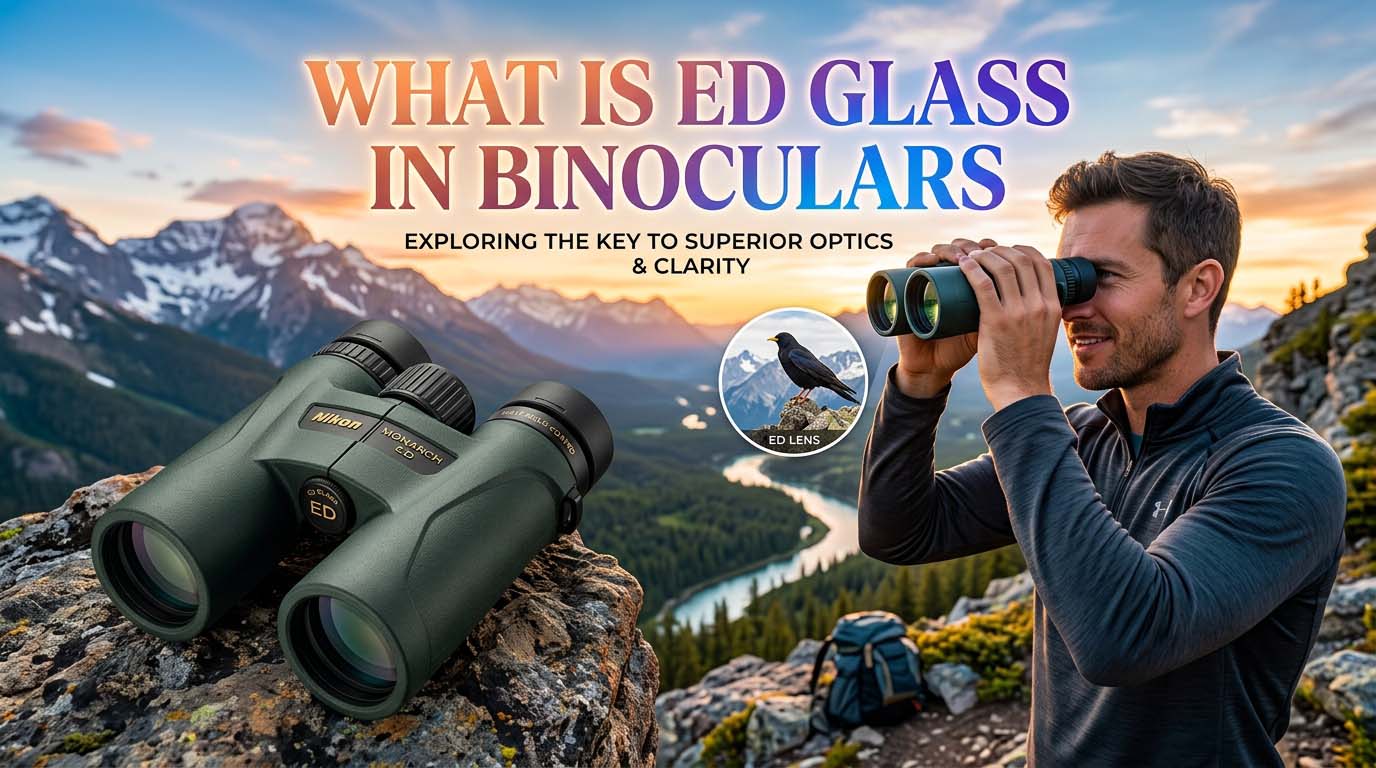
If you’ve shopped for binoculars recently, you’ve seen “ED glass” on product pages and wondered what it actually means. I remember the first time I picked up a pair with ED glass and compared them side-by-side with standard binoculars.
The difference was obvious: edges were sharper, colors looked natural, and that purple-green haze I’d gotten used to was gone.
ED stands for Extra-low Dispersion. It’s a type of optical glass that does one specific job well: it stops different colors of light from spreading apart inside the lens. The result is a cleaner, more detailed image. But not all ED glass is the same, and it’s not always the right upgrade for every user. Let’s go beyond the label and see what’s really happening.
What ED Glass Actually Does Inside Your Binoculars
To understand why ED glass matters, you need to know about a problem called chromatic aberration. Imagine shining a flashlight through a glass prism. White light splits into a rainbow because each color bends at a slightly different angle. The same thing happens inside a binocular lens, but on a much smaller scale.
Standard optical glass bends blue light more than red light. When those colors don’t focus at the same point, you see color fringing—usually purple or green halos around bright objects, especially near the edges of the view. It’s most noticeable when looking at a bird against a bright sky or a white building in sunlight.
ED glass has a lower dispersion index. That means its ability to separate colors is weaker, so all wavelengths bend at nearly the same angle. The blue and red light end up focused together, and the color fringing disappears. You get sharper detail, better contrast, and more accurate color reproduction.
In practice, this means the fine feather patterns on a hawk or the lettering on a distant sign are crisp, not muddy. The image looks “cleaner.” I’ve found that even in mid-priced binoculars, a good ED glass element makes a noticeable difference in overall image quality.
Why Not All ED Glass Is the Same
Here’s where it gets complicated. The term “ED glass” covers a range of materials with different performance levels. Manufacturers use different types, and the price of the binocular often reflects which grade they chose.
The three most common types you’ll see are:
- FK-61 – A common ED glass used in many mid-range binoculars. It offers a good reduction in chromatic aberration for the price. You’ll find it in models from $150 to $400. It’s a big step up from standard glass, but it doesn’t perform as well as higher-end materials.
- FPL-53 – This is a fluorite-equivalent glass made by Ohara (a Japanese optical glass company). It has an extremely high Abbe number (measure of low dispersion). Binoculars with FPL-53 are usually premium models costing $500 or more. The color correction is near-perfect, and the image sharpness is outstanding.
- SD (Synthetic Dispersion) glass – Some brands use their own low-dispersion formulations. They can be good, but without knowing the specific Abbe number or the manufacturer, it’s hard to compare. Often these are entry-level “ED-like” glasses.
The Abbe number is the key metric. A higher number means less dispersion and better color correction. Standard glass has an Abbe number around 50–60. FK-61 is roughly in the 70–80 range. FPL-53 can reach 90 or above. When you see a binocular advertised with “ED glass,” try to find out which specific glass it uses. The cheapest ED binoculars might use a grade barely better than good standard glass, while top-tier models use FPL-53 for a real jump in quality.
Cost is directly tied to the glass grade. FPL-53 is expensive to manufacture, and that cost shows up in the final price. If you see a binocular priced under $200 promising ED glass, check the fine print. It might be a lower-grade material that still helps, but don’t expect the same performance as a $600 model.
The Real Trade-Offs of ED Glass
ED glass is not a magic bullet. It fixes one specific problem—chromatic aberration—but other optical issues can still affect image quality. A poorly designed binocular with cheap coatings and low-quality prisms will still look bad, even with an ED element.
When comparing ED vs. non-ED binoculars, here’s what you actually gain:
- Sharpness and contrast – Especially at the edges of the field of view. Standard glass often shows softening near the edge; ED glass keeps details crisp across the whole image.
- Color accuracy – Colors look natural, not washed out or tinted. Birds, foliage, and landscapes appear more true to life.
- Low-light performance – This is indirect. By reducing chromatic aberration, the image has better contrast, which can make details easier to see in dim conditions. But ED glass does not increase light transmission—coatings and lens size do that.
However, there are diminishing returns. If you use binoculars only for casual daytime spotting—watching sports, taking a quick look at a landscape—the difference between a decent non-ED binocular and an ED model may be subtle. Your brain already compensates for slight color fringing. The extra cost might not feel justified.
Where ED glass truly matters:
- Birdwatching, where feather detail and color are critical.
- Hunting at dawn or dusk, where every bit of clarity helps.
- Stargazing, where bright stars against a dark sky exaggerate chromatic aberration.
- Any activity where you spend long periods looking through the binoculars—the cleaner image reduces eye strain.
When standard glass is sufficient:
- General outdoor recreation, hiking, or travel.
- Watching sports or concerts.
- Budget-limited buyers who can invest in better coatings or a larger objective instead.
I’ve owned both types. For my birding outings, the ED pair is worth every penny. But for tossing in a backpack on a camping trip, I’m happy with a well-made non-ED model.
Common Myths About ED Glass
Myth 1: All ED glass gives the same result.
Reality: As I explained, the grade matters a lot. A cheap ED binocular may only reduce chromatic aberration by a small amount compared to standard glass. Always look for the specific glass type (FK-61, FPL-53, etc.) to judge performance.
Myth 2: ED glass makes binoculars waterproof or fogproof.
Reality: Waterproofing comes from O-rings and sealing. Fogproofing comes from nitrogen or argon purging. ED glass only affects the optics. A binocular can have great ED glass and still let moisture in if it’s poorly sealed.
Myth 3: ED glass is fragile and breaks easily.
Reality: ED glass has similar physical properties to standard optical glass. Modern coatings protect the surface. The main difference is thermal expansion—some ED glasses expand slightly more with heat, but modern bin design accounts for that. It’s not a practical concern for normal use.
How to Verify True ED Glass
Manufacturers sometimes use vague marketing like “HD glass” or “premium optics” to imply ED performance. To know for sure:
- Check the spec sheet for phrases like “FK-61,” “FPL-51,” “FPL-53,” or “fluorite.” If it only says “ED glass” without details, it’s likely a lower-grade material.
- Look for third-party reviews that test chromatic aberration specifically. A good review will show you photos or describe how much color fringing remains.
- Be wary of “ED-like” terms such as “HD” or “high-definition.” Those often refer to coatings or resolution, not low dispersion. “ED” should appear explicitly.
- Compare at a store if you can. Look at a tree branch against a bright sky through both models. If the ED model shows noticeably less purple or green fringe, it’s the real thing.
Frequently Asked Questions
Is ED glass the same as HD glass?
No. HD usually stands for “High Definition,” which can mean higher resolution coatings or a sharper design. ED glass specifically reduces dispersion to cut color fringing. A binocular can be HD without ED, and vice versa.
Does ED glass help in low light?
Indirectly. By improving contrast and sharpness, it can make details easier to see. But it doesn’t let more light in—that’s the job of lens coatings and objective size.
Can I see chromatic aberration without ED glass if I have perfect vision?
Yes. Chromatic aberration is an optical artifact from the lens, not your eyes. Even with 20/20 vision, you’ll see color fringing on bright edges with a standard binocular.
Are there binoculars with ED glass under $200?
Sometimes, but they usually use a lower-grade ED material (like entry-level FK-61) or a small objective. At that price, you’re better off investing in a high-quality non-ED binocular with good coatings and phase-corrected prisms. The performance difference may be small.
What does “Fully Multi-Coated” have to do with ED glass?
Coatings reduce reflections and increase light transmission. ED glass reduces dispersion. They work together for a brighter, cleaner image. A binocular can have great coatings but poor dispersion, and vice versa. Both matter.
ED glass is a genuine advancement in binocular optics. It solves an annoying problem and makes the image more enjoyable. But it’s not necessary for everyone. Assess your needs, check the specific glass type, and don’t assume that simply seeing “ED” on a product page guarantees a huge leap in quality. With the right information, you’ll know exactly what you’re paying for.