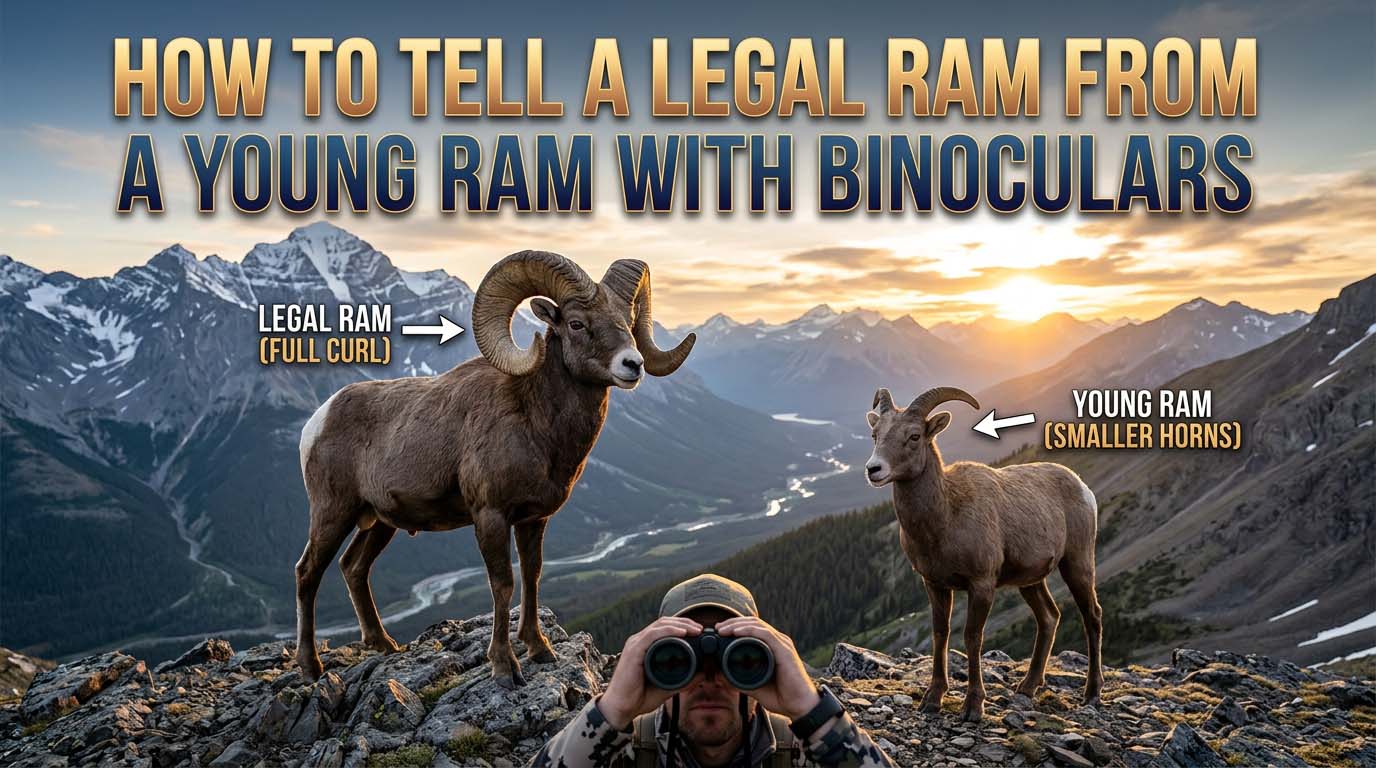
I have spent more time than I care to admit lying on shale slides, peering through binoculars at sheep that look exactly the same from a distance. Every hunter who draws a sheep tag knows the feeling: you spot a ram, your heart jumps, and then the doubt creeps in. Is that horn long enough? Does it cross the nose? Is the tip broomed? The rule book says “full curl” or “4/5 curl” or whatever your state or province demands, but that rule is useless when the ram is half a mile away and looking straight at you.
Forget the tape measure. Your binoculars are a truth serum for horn architecture, not for measurement. The difference between a legal ram and a young ram is revealed by three specific visual relationships: the base-to-face ratio, the tip-to-nose axis, and the horn’s tolerance for wear. Once you learn to see those, you stop guessing and start knowing.
What Makes a Ram Legal?
Different places have different rules. In Montana and Alberta, the standard is “full curl”; the horn tip must reach past the eye and drop to or below the line of the nose. Some jurisdictions use age (for example, you cannot shoot a ram younger than four years old) or a 4/5 curl rule.
I am not going to recite the regs you can find in any booklet. What matters is that all these rules ask the same thing: can you tell, with certainty, that this ram is not a young one?
The only way to answer that from a ridge is to understand how a mature horn sits on the skull versus how a young one sits. A legal ram’s horn is not just longer; it is heavier, wider at the base, and the last quarter of the curl is blunt and worn. A young ram’s horn looks like a new piece of plumbing: tight, smooth, and sharp at the tip.
The Three-Position Glassing Check
You cannot judge a ram from one angle. I learned this the hard way when I passed on what I thought was a young ram, only to watch him get shot by another hunter later that day; he was legal, but I saw him facing me and misjudged the length.
Now I force myself to see the ram in at least two of these three positions before I make a call.
Position 1: Broadside — The Ideal View
This is the position every diagram shows. The ram is standing sideways to you, head up. Look at where the tip of the horn falls relative to the bridge of the nose.
A legal ram’s horn will pass the eye and drop to at least the jaw, if not below it. But do not just look for the tip; look at the gap between the last quarter of the horn and the ram’s face.
On a young ram, that gap is thin and steep. The horn curls tight against the cheek. On a mature, legal ram, the gap is wider, and the horn seems to “swing out” away from the face before turning up.
I call this the “shadow gap.” If you see a dark, narrow wedge between horn and face, be suspicious. If you see a parallel gap that stays wide all the way to the tip, that is a heavy, old horn.
Position 2: The Facing Ram — The Trap
This is where most hunters make a mistake. The ram is looking straight at you. The horn is foreshortened; it looks stubby and short. You cannot see the curl length at all. So how do you judge legality?
Look at the base of the horn, where it attaches to the skull. A legal-class ram has a base that flares outward like a bell. It pushes away from the skull and blocks part of the ram’s own neck.
A young ram’s base looks pinched; the horn starts narrow and stays narrow. When a ram faces you, ignore the tip entirely. Judge the width of the base across the forehead. If the base is wider than the ram’s eye, you are likely looking at a mature animal.
I also check the flare at the top of the skull. On a legal ram, the base is so thick that it creates a visible “V” shape where the two horns meet. On a young ram, the base is smooth, and the horns sit closer together.
Position 3: The Bedded Ram — The Profiler
When a ram is bedded and facing away or slightly sideways, you only see the top arc of the horn and the back of the skull. You cannot see the tip at all. Here, the only clue is the horn’s diameter as it crosses over the shoulder.
A pencil-thin line crossing the shoulder means a young ram. If the horn is thick enough to create a visible hump on the animal’s back silhouette, like a ridge of mass, that ram has the weight of a legal animal.
I have passed on rams that looked small in the bedded view, only to discover later they were legal. Now I do not bother judging length from this angle. I only judge mass. If the horn looks like a tree branch, it is likely legal.
How Binoculars Change the Picture
You already know that heat mirage and shaky hands can make a sharp tip look blunt and a blunt tip look sharp. What many hunters miss is that magnification level changes your perception of proportion.
When I use 15x binoculars, I see the horn in detail, but I lose the context of the body. A young ram with fast genetics can have a thick base that looks huge at high magnification.
I have seen hunters spot a heavy base on a ram, assume he is legal, and then stalk into a 5-year-old that barely makes 3/4 curl.
The fix is simple: drop to 8x or 10x and look at the whole animal. If the body looks sleek and athletic, with a thin neck and long legs, the ram is probably young, even if the horn looks big in the close-up.
The single most reliable optical filter is the broom test. A legal ram almost always has broomed tips; the tip is blunt, chipped, or squared off from years of rubbing and fighting. A young ram has a sharp, pointy tip.
You can see this through any binoculars with a steady hold and decent light. If the tip is sharp, do not shoot.
Mirage and Heat Distortion
On a hot day, the air shimmers. Sharp tips appear to wiggle and can look bigger than they are. Heavy bases, on the other hand, stay relatively still because they have more mass and less sharp edge.
If you see a tip that looks fuzzy or dancing, assume it is sharp until you confirm with a more stable view, wait for the wind to cool the air, find a rock to rest your binos on, or come back later in the evening.
The Confirmation Loop
Here is the mental checklist I run through before I commit to a stalk:
– Base is thick and flares outward (check in facing or broadside view).
– The tip is blunt or broomed (check in broadside view with steady glass).
– The horn crosses the eye and drops to at least the jaw (broadside).
– The horn shows a wide shadow gap in the last quarter (broadside).
– The body is heavy, with a thick neck, big shoulders, and scars on the hide.
If I check four out of five, I stalk. If the tip is sharp and the body is lean, I pass. I have never regretted passing on a ram with a sharp tip.
The “B-Curl” Anomaly — When Genetics Fool You
Some young rams, especially in areas with good genetics, develop a heavy base at 5 or 6 years old. That base can fool you into thinking the ram is mature. But look at the first quarter of the curl, the part that drops down from the skull.
On a heavy, young ram, that drop is steep and almost straight. On a true legal ram, that drop has a gradual, sweeping curve like the letter “J.” The horn seems to arc away from the head before it starts circling.
You need a steady rest on your binoculars to see this. I use a trekking pole to brace my elbows. In the field, I sit down and put my binos on my knees or a backpack. A shaky view will hide this subtle curve.
Legal Does Not Mean Trophy
A “legal” ram is the minimum. Some hunters shoot a ram that barely makes full curl at 5 years old; that ram looks tight, clean, and almost polished. An old legal ram looks broken.
The horn texture is rough, with ridges and chipped edges. The base is massive, the tip is stubby, and the horn itself may show flaring at the tip; the last inch actually widens slightly.
I use binoculars to judge character, not just legality. If the horn looks “new”, smooth and uniform, I think twice. If it looks like it has been through ten winters, I know I am looking at a legal ram.
—
Frequently Asked Questions
Can you tell if a ram is legal based solely on horn color?
No. Color is a function of dirt, minerals, and where the ram beds. A dark horn does not mean old. A light horn does not mean young. Focus on texture and shape, not color.
How long should you glass a ram before making a decision?
Until you have seen it in at least two different body positions. Three minutes of continuous, stable observation with a supported binocular is the minimum for a confident call. If the ram moves, wait until you get the angles.
Does a ram’s body condition help you judge its horns?
Yes. A ram that is necked up, thick-necked, heavy-bodied, with rubbed or scarred hide, is almost certainly mature.
A sleek, long-legged, unscarred ram is suspicious. Compare the horn size to the skull size, not to the body. A ram with a tiny skull and big horns is older than a ram with a big skull and small horns.
What is the most common binocular mistake when judging rams?
The “Cape of Ram illusion.” You see a single big ram and assume it is legal because it is big. The horns may be small relative to its body. Always compare horn to skull and horn to face, not horn to body.
Can you judge a legal ram when he is facing directly away from you?
Not reliably. You need at least a partial side view. If the ram is walking away, watch for the horn diameter over the shoulder. If it is thin, do not shoot. If it is thick enough to block the shoulder line, it might be legal, but get a better angle before you commit.