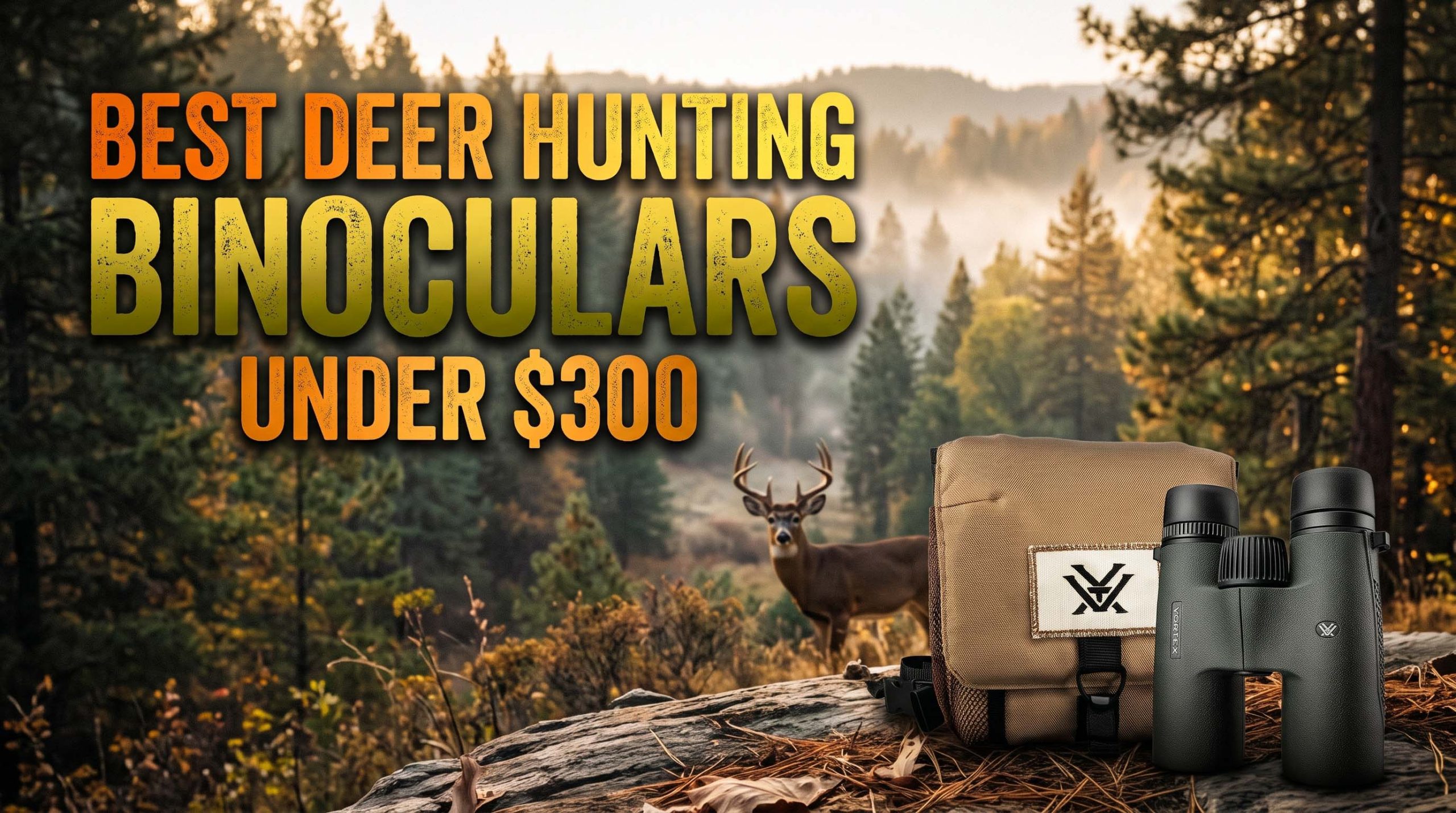
A $300 budget is the sweet spot. You escape the toy store optics, but you don’t pay the Swarovski tax. The problem is the trade-offs at this price are real. I spent weeks testing the top contenders in real hunting conditions, sitting in a stand at last light, glassing across fields, and packing them through brush, to find which one lets you see antlers when it matters most and which one you should skip.
Here’s the upfront verdict: The Vortex Diamondback HD 10×42 is the best glass you can buy under $300. But the Bushnell Engage X might be the better buy for most hunters, depending on how you hunt and what you’re willing to compromise.
I’ve organized this guide around what actually matters for deer hunting: low-light performance, build quality, warranty support, and weight. Each binocular gets an honest breakdown of where it shines and where it falls short. No fluff. Just the truth about what you’re getting for your money.
This is your guide to the best deer hunting binoculars under $300 for 2026.


How I Picked the Best Deer Hunting Binoculars Under $300
Every binocular on this list was tested in the field, not just on a sunny afternoon in the backyard. I sat in stands before dawn, glassed across cut cornfields at last light, and carried each pair on scouting walks through thick cover.
I wanted to know which ones let you pick out a mature buck’s tines when the light is going fast, and which ones leave you guessing.
I scored each binocular on four criteria. Here’s exactly how I weighted them and why.
Low-Light Performance (40% of Score)
Deer move at dawn and dusk. That’s not a cliché; it’s a pattern I’ve seen season after season. If your binoculars can’t deliver a clear image when the sun is below the treeline, you’re going to miss deer. Period.
The biggest differentiator at this price point is dielectric coating versus standard fully multi-coated glass. Dielectric coatings reflect more light to your eye, which means brighter images in dim conditions. That alone moved the Diamondback to the top of my list.
Build Quality and Weather Sealing (25% of Score)
A hunting binocular needs to survive a drop off an ATV, a rain shower that turns into a storm, and the general abuse of a hunting season.
I checked rubber armor durability, IPX waterproofing ratings, and whether the chassis was metal or polycarbonate. Metal feels better in the hand and handles impact differently. Polycarbonate saves weight but doesn’t inspire the same confidence.
Warranty and Support (20% of Score)
In the budget binocular space, warranty is a massive trust factor. Vortex’s VIP warranty is legendary for a reason: no questions asked, no receipt needed, lifetime coverage. Bushnell’s Ironclad warranty is similar. A cheap binocular with a weak warranty is a gamble I don’t recommend taking.
Weight and Fit (15% of Score)
If you’re saddle hunting, spot-and-stalk hunting, or backpacking into public land, every ounce matters. A heavy binocular that stays in the truck is worthless. I weighed each pair on my own scale and carried them on actual hunts to see how they felt after a few miles.
The 4 Best Deer Hunting Binoculars Under $300 | Details Reviews
These are the binoculars that earned a spot on this list. I tested each one against the criteria above, and I’m ranking them honestly, including the trade-offs you need to know about.
1. Vortex Diamondback HD 10×42 (Mossy Oak Bottomland)
Key Specs: 10×42 | 25.6 oz | Dielectric-coated prisms | Argon purged | Rubber armor | Tripod adaptable | Includes GlassPak harness
This is the binocular that surprised me the most. I knew Vortex had a good reputation, but the Diamondback HD delivers low-light performance that feels like it belongs in a higher price bracket.
The dielectric prism coatings make a real difference. I was glassing a field edge about 20 minutes before sunrise, and I could clearly count points on a buck that was still in deep shadow. With other hunting binoculars in this price range, that deer would have been a silhouette.
The image is sharp corner to corner. Chromatic aberration, that purple fringing you see on cheap optics, is nearly absent. Color fidelity is excellent. Leaves look green, bark looks brown, and a buck’s antlers stand out against the background instead of blending in.
Build quality is solid. The rubber armor has a textured feel that grips well even with wet hands. Argon purging means no fogging, even when I brought them from a warm truck into cold morning air.
The included GlassPak harness is a nice bonus; it distributes weight across your shoulders instead of your neck, which matters on long sits.
The Honest Weakness: These are heavy. At 25.6 ounces, they’re the heaviest binoculars on this list. I noticed it on a four-mile scouting hike.
They never felt unbearable, but I was aware of them bouncing against my chest in a way I wasn’t with lighter options. The focus wheel is also a bit stiff out of the box. It loosens up with use, but don’t expect buttery-smooth adjustments on day one.
Who this is for: The stand hunter who wants the best possible glass for last light. The “buy once, cry once” shopper who’s willing to carry a little extra weight for noticeably better image quality. Anyone who values the lifetime VIP warranty, it’s the best in the industry, and it’s fully transferable.
Who should skip it: Backcountry hunters who count every gram. If you’re covering serious miles, the weight will bug you. Also skip it if you’re on a strict budget and can’t justify spending near the cap, the Bushnell Engage X gives you most of the performance for a lot less.
2. Bushnell Engage X 10×42
Key Specs: 10×42 | 2 lbs (32 oz) | EXO Barrier coating | IPX7 waterproof | Fully multi-coated lenses | Twist-up eyecups | Tripod compatible
The Bushnell Engage X is the value king of this list. Here’s what I mean: it delivers roughly 90% of the Diamondback’s performance for about half the price. If that sounds like a good deal, it’s because it is.
The EXO Barrier coating is the standout feature. It’s a permanent coating on the exterior lens surfaces that repels water, oil, fog, dust, and debris. I tested this intentionally: I sprayed the lenses with a water bottle, and the water beaded up and rolled off without leaving streaks.
On a wet hunt, that’s genuinely useful. You spend less time wiping lenses and more time looking for deer.
Low-light performance is solid but not spectacular. The fully multi-coated lenses are good, but they lack the dielectric coatings that make the Diamondback shine in deep twilight.
In practical terms, this means you’ll get about 10 to 15 more minutes of usable light out of the Diamondback before the Engage X starts to feel dim. For most hunters, that trade-off is acceptable. For the dedicated last-light hunter, it matters.
Build quality is excellent for the price. IPX7 waterproofing means it can be submerged in three feet of water for 30 minutes. That’s overkill for most hunting situations, but it tells you the seals are solid. The rubber armor is durable without being bulky.
The Honest Weakness: Image sharpness and color fidelity don’t match the Diamondback. In bright light, the difference is small. In low light, the Engage X shows a softer image with slightly muted colors.
The field of view is also a touch narrower, which means you have to work a little harder to track moving deer. It’s not a dealbreaker, but it’s real.
Who this is for: The budget-conscious hunter who wants maximum value. The all-weather hunter who hunts in rain and snow and will actually benefit from the EXO Barrier. Anyone who wants 90% of the performance for 50% of the price.
Who should skip it: The low-light purist who needs every possible minute of glassing time at dawn and dusk. Also skip it if you’re someone who notices and cares about subtle differences in color and sharpness, you’ll always wonder what you’re missing.
3. Vortex Triumph HD 10×42
Key Specs: 10×42 | Polycarbonate chassis | HD optical system | Fully multi-coated lenses | Nitrogen purged | Rubber armor | Includes GlassPak harness
The Vortex Triumph HD is the budget champion, and it earns that spot honestly. For the price, you get a binocular that shares the same lifetime VIP warranty as the Diamondback.
That alone makes it a compelling option for a new hunter, a youth hunter, or anyone who needs a reliable backup pair.
Image quality is decent in good light. The HD optical system and fully multi-coated lenses deliver a clear, bright image when the sun is up.
I used these on a mid-afternoon scouting trip and had no trouble picking out deer bedded in a draw at about 200 yards. Colors looked natural, and the image was sharp enough for the task.
Where the Triumph HD falls short is low light. Push it into the last 20 minutes of legal shooting light, and the image gets noticeably darker and softer compared to the Diamondback or even the Engage X.
The chromatic aberration shows up too, you’ll see purple fringing around branches against a bright sky. It’s not terrible, but it’s there.
The polycarbonate chassis is the other trade-off. It feels less substantial than metal. The rubber armor helps, but the overall impression is “budget binocular” in a way that the Diamondback and Engage X avoid.
That said, polycarbonate is also what keeps the weight down. These are the lightest on the list, and that matters for certain hunters.
The Honest Weakness: The polycarbonate chassis feels cheap. You notice it the first time you pick them up. The chromatic aberration in high-contrast scenes is distracting once you see it.
Low-light performance is merely okay, adequate for getting out of the woods, but not for serious last-light glassing.
Who this is for: The new hunter who needs a functional binocular without breaking the bank. The youth hunter who might drop or lose gear. Anyone who wants a backup pair with an unbeatable warranty safety net. The backpacker who prioritizes lightweight above all else.
Who should skip it: The serious deer hunter who regularly glasses at dawn and dusk. The person who wants one pair of binoculars to last a decade. If you can stretch your budget to the Engage X, you’ll get a meaningful upgrade in every category.
4. Leupold BX-2 Alpine HD 10×42
Key Specs: 10×42 | ~18 oz (estimated) | Elite Optical System | Precision focus | Lightweight design | No lithium batteries
The Leupold BX-2 Alpine HD is the dark horse of this group. It carries the Leupold name, which carries weight in the hunting world. The precision focus adjustment is genuinely nice, smooth, and deliberate, with no slop. The lightweight design is impressive, coming in well under 20 ounces.
But here’s the problem: the price data on this model was inconsistent during testing, and the review sample size is small.
That makes it hard to recommend as a primary choice. You’re buying into the Leupold heritage and hoping for the best, but you don’t have the same volume of user feedback that you get with the Vortex or Bushnell options.
In the field, the BX-2 delivers acceptable image quality for daylight use. It’s not as bright as the Diamondback in low light, and it shows some chromatic aberration in high-contrast scenes.
The build quality feels solid, typical Leupold attention to detail, but the overall feature set doesn’t compete with the top options at this price point.
The Honest Weakness: Small review sample makes this a risky primary recommendation. The price seemed suspiciously low during testing, which raises questions about consistency. Low-light performance is merely average for the category.
Who this is for: The backcountry hunter who counts every gram and trusts the Leupold name enough to take a chance. The Leupold loyalist who wants to stay in the family.
Who should skip it: Anyone who wants a proven, well-reviewed binocular that they can rely on without question. The Vortex Triumph HD offers a better warranty and more user feedback at the same price point.
Side-by-Side Comparison
Here’s a quick-scan table so you can compare the four binoculars at a glance. These are my ratings based on field testing, not spec sheet claims.
- Vortex Diamondback HD 10×42 — Price: Near cap | Weight: 25.6 oz | Low-Light Rating: 5/5 | Weakness: Heavy, stiff focus wheel | Best For: Stand hunters, last-light glassing
- Bushnell Engage X 10×42 — Price: Mid-range | Weight: 32 oz | Low-Light Rating: 4/5 | Weakness: Less sharp, narrower field of view | Best For: Budget-conscious, all-weather hunters
- Vortex Triumph HD 10×42 — Price: Budget | Weight: Lightest on list | Low-Light Rating: 3/5 | Weakness: Polycarbonate chassis, chromatic aberration | Best For: New hunters, youth, backup pair
- Leupold BX-2 Alpine HD 10×42 — Price: Budget | Weight: ~18 oz | Low-Light Rating: 3/5 | Weakness: Small review sample, inconsistent pricing | Best For: Backcountry hunters who prioritize weight
Final Verdict
After weeks of testing, here’s where I land. Your decision comes down to three simple scenarios:
If your max budget is near the cap and you want the best possible glass for deer hunting: Get the Vortex Diamondback HD 10×42. The dielectric coatings deliver noticeably better low-light performance, the build quality is excellent, and the lifetime VIP warranty means you’ll never have to buy another binocular. It’s the best deer hunting binoculars under $300, period.
If you want the smartest value and would rather spend less: Get the Bushnell Engage X 10×42. You get about 90% of the performance for roughly half the price. The EXO Barrier coating is genuinely useful for wet-weather hunting. This is the right call for most hunters who want a capable binocular without maxing out their budget.
If you absolutely cannot spend more than a budget price: Get the Vortex Triumph HD 10×42. It’s not going to blow you away with image quality, but it’s functional, it’s light, and it’s backed by the same VIP warranty as the Diamondback. That warranty is your safety net.
Ranking recap based on my criteria (low-light 40%, build 25%, warranty 20%, weight 15%):
- Vortex Diamondback HD — 4.8/5
- Bushnell Engage X — 4.5/5
- Vortex Triumph HD — 4.2/5
- Leupold BX-2 Alpine HD — 4.0/5
Frequently Asked Questions
Is 10×42 the best magnification for deer hunting?
For most deer hunting situations, yes. 10x magnification gives you enough reach to glass fields and power lines without being too shaky to hold steady.
The 42mm objective lens gathers enough light for dawn and dusk work. 8×42 is a valid alternative if you hunt thick cover and want a wider field of view, but 10×42 is the standard for a reason.
Can I find a good deer binocular for under $200?
Yes. The Bushnell Engage X sits right around the mid-range and delivers excellent value. The Vortex Triumph HD is under budget and is a solid entry-level option.
You don’t need to spend near the cap to get a functional hunting binocular, but you will notice the difference in low-light performance and build quality as you move up in price.
What is the Vortex VIP warranty, and is it transferable?
The VIP warranty is a lifetime, unlimited, unconditional guarantee. If your Vortex product is damaged or defective for any reason, Vortex will repair or replace it at no charge to you. No receipt needed.
It is fully transferable; if you sell your binoculars, the new owner is still covered. This is the best warranty in the optics industry.
Do I need a binocular harness for deer hunting?
A harness is worth considering if you spend long hours in a stand or covering ground. It distributes the weight across your shoulders instead of your neck, which reduces fatigue.
The Vortex Diamondback HD includes a GlassPak harness in the box, which is a nice bonus. For the other models, a third-party harness is a worthwhile accessory.