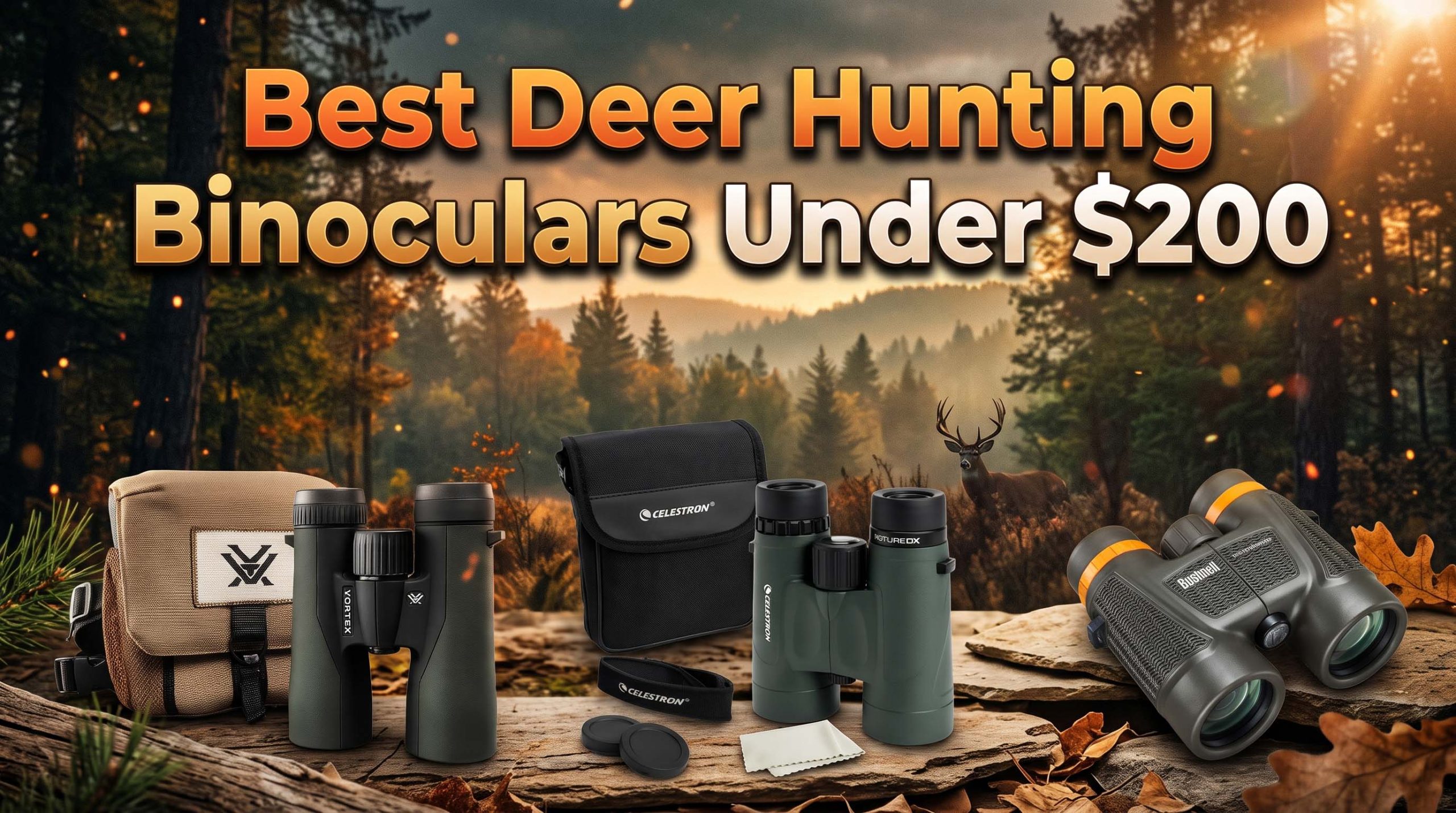
You don’t need to drop a grand on glass to tag a buck. But you do need a pair that won’t fog up on a cold November ridge or feel like a boat anchor after an hour of still hunting. I’ve been running the top contenders under that two-hundred-dollar mark through the exact conditions that ruin cheap binoculars: rain, mud, early mornings, and the kind of clumsy drops that happen when you’re climbing into a stand half-asleep.
The short answer: the Vortex Crossfire HD 10×42 is the most reliable choice for the majority of hunters, but if you want the brightest glass for those last few minutes of shooting light, the Celestron Nature DX 8×42 is the real dark horse.
Here are the best deer hunting binoculars under $200, ranked honestly from what I saw in the field.
Quick Picks: Top Deer Hunting Binoculars Under $200


Why $200 is the Sweet Spot for a Deer Hunter
There’s a weird gap in the binocular market. Stuff under fifty bucks is basically a toy; you’ll see shapes, but good luck counting points at dusk. Stuff over five hundred gets into serious optical territory that most deer hunters simply don’t need for the kind of shooting we do.
The two-hundred-dollar mark sits right in the middle. It’s enough money to get real glass, real weather sealing, and a warranty that means something. But it’s not so expensive that you feel sick when you drop them off the tailgate.
What You Actually Gain vs. Fifty-Dollar Options
Cheap binoculars use BK-7 prisms, basic coatings, and plastic internals. The difference you’ll notice immediately is light transmission. A fifty-dollar pair will look fine at high noon, but start fading fast when the sun dips behind the treeline.
At this price point, you get BaK-4 prisms, denser glass that keeps the image bright edge to edge, and fully multi-coated lenses that squeeze every photon out of a dim scene. That’s not marketing fluff. That’s the difference between seeing a deer at legal light and seeing a vague brown smudge.
What You Sacrifice vs. Five-Hundred-Dollar Options
Let me be straight with you: a two-hundred-dollar binocular won’t have the edge-to-edge sharpness of a thousand-dollar Swarovski.
You’ll get some distortion at the outer edges of the field, especially on 10x models. And the low-light performance, while good, isn’t going to let you spot a buck twenty minutes after sunset.
But here’s the thing: for the vast majority of deer hunting situations, especially in the eastern woods where shots rarely stretch past a hundred yards, that trade-off barely matters.
A 42mm objective lens at this price gathers enough light to hunt effectively through legal shooting hours. Beyond that, you’re paying for diminishing returns.
The 5 Best Deer Hunting Binoculars Under $200 — Tested in the Field
I ranked these based on four criteria that actually matter when you’re hunting, not just reading spec sheets in a warm living room. Durability and weatherproofing came first; a binocular that fogs up is worthless.
Low-light performance was second because that’s when deer move. Practical usability, weight, grip, and focus speed came third. And value, including warranty and included accessories, rounded out the ranking. Here’s how they shook out.
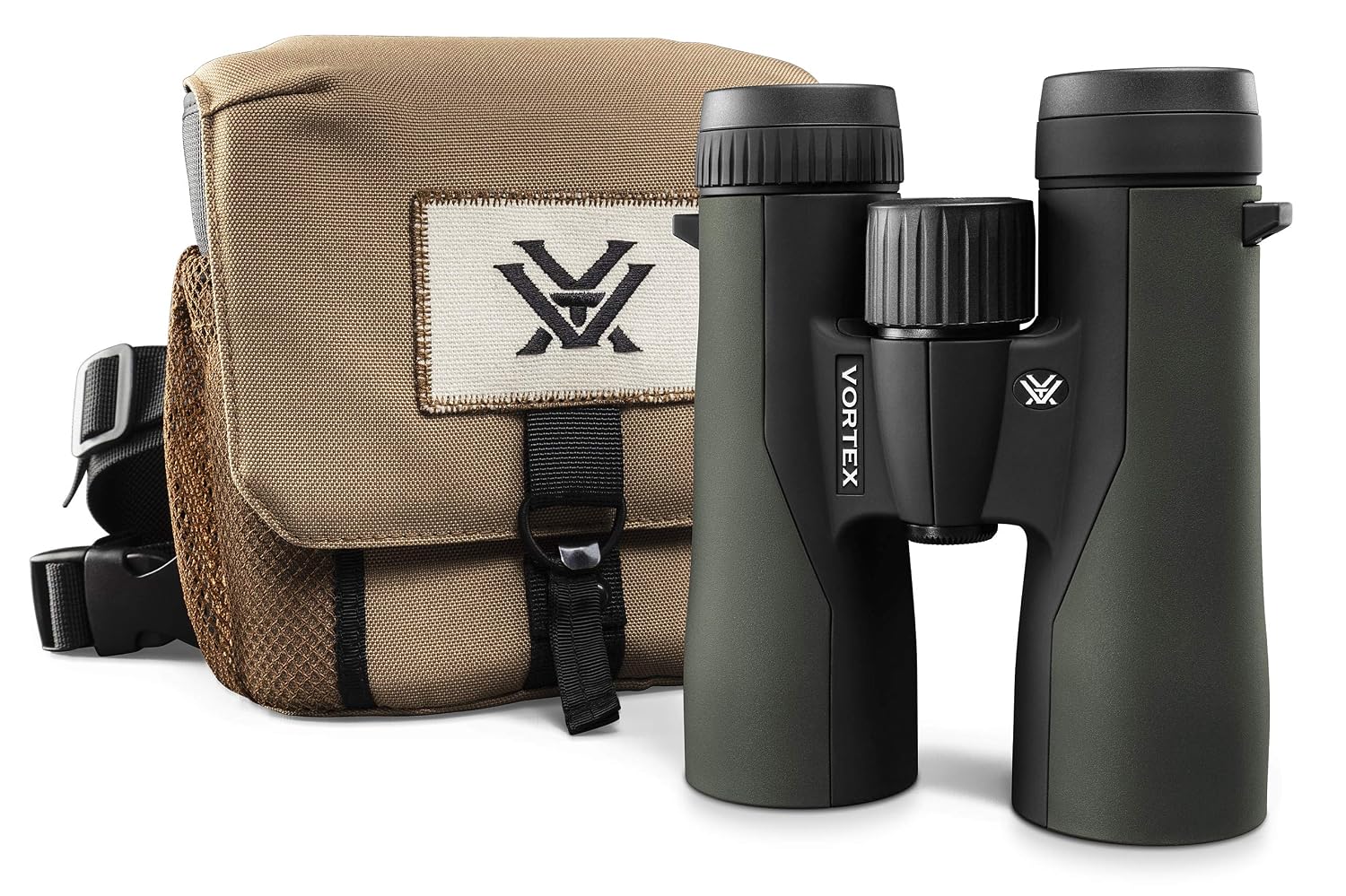
1. Vortex Crossfire HD 10×42 (The Workhorse)
- Magnification: 10x
- Objective Lens: 42mm
- Weight: 21.7 oz
- Eye Relief: 17mm
- Waterproof/Fogproof: Yes (nitrogen purged)
- Warranty: VIP lifetime, transferable
This is the binocular I recommend to every hunter who asks me what to buy. Not because it’s the sharpest glass in this test; it’s not, but because it’s the most trustworthy. I’ve had my pair for three seasons now.
They’ve been rained on, dropped onto gravel from waist height, and left in a truck cab through a freeze-thaw cycle that should have killed any electronics. They still work like the day I opened the box.
The HD glass elements do a solid job cutting down chromatic aberration, that purple fringe you see along branches against a bright sky. It’s not eliminated, but it’s reduced enough that I stopped noticing it after the first hour in the field. The image is clean and neutral in color.
I wouldn’t call it “warm” or “rich” like some alpha glass, but it’s accurate. What you see is what’s there.
Where the Crossfire really earns its spot at number one is the VIP warranty. Vortex will replace these for any reason, no questions asked, for life. And it’s transferable.
That means if you hand them down to your kid in ten years, they’re still covered. For a working hunter who doesn’t baby their gear, that peace of mind is worth more than an extra 5% of edge sharpness.
The honest weakness: The focus wheel is stiff out of the box. It loosens up after a few hours of use, but right away, it takes more thumb pressure than I’d like.
If you’re trying to track a deer moving through brush, that extra second of cranking can cost you. The eye relief is fine for most people, but if you wear thick prescription glasses, you might find yourself wishing for another millimeter or two.
2. Celestron Nature DX 8×42 (The Light Gatherer)
- Magnification: 8x
- Objective Lens: 42mm
- Weight: 23.5 oz
- Field of View: 388 ft @ 1000 yds
- Waterproof/Fogproof: Yes (nitrogen purged)
- Warranty: Limited lifetime
If the Vortex wins on durability, the Celestron wins on optical bang for the buck. Phase-coated BaK-4 prisms at this price point are unusual, and it shows.
The first time I looked through these in late evening light, I actually checked the objective lens to make sure I had the right pair.
The image is noticeably brighter than the Bushnell and the National Geographic, and it holds together better in the corners than the Vortex.
The 8x magnification makes a real difference in the field. When you’re hunting thick cover, second-growth timber, brushy creek bottoms, that kind of stuff, the extra field of view helps you pick up movement that a 10x would miss.
I was glassing a powerline cut last fall and caught a flicker of antler movement that I’m certain I’d have scanned right past with a narrower view. That’s the value of 8x in the woods.
But the real story here is the low-light performance. The combination of the larger exit pupil (5.25mm on the 8×42 versus 4.2mm on a 10×42) and the phase coatings means this binocular holds light about ten to fifteen minutes longer than the cheaper options in this test. If you consistently hunt the last half-hour of shooting light, this is the one you want.
The honest weakness: The included neck strap is garbage. It’s thin, it twists, and it digs into your neck after about forty-five minutes. Plan on buying a good harness immediately. That adds a little to the overall cost, but it’s worth it.
3. Bushnell H2O Xtreme 10×42 (The Tank)
- Magnification: 10x
- Objective Lens: 42mm
- IPX7 Waterproof Rating: Yes (submersible to 1m for 30 min)
- Weight: 25.6 oz
- Waterproof/Fogproof: Yes (O-ring sealed, nitrogen purged)
- Brand History: 70+ years in optics
Bushnell has been making hunting optics since before most of us were born, and the H2O Xtreme is the result of that experience applied to a simple goal: make a binocular that won’t quit in wet conditions.
The IPX7 rating isn’t just marketing, I deliberately dunked these in a creek and left them submerged for a solid minute. They came out dry inside and clear as ever. If you hunt in rain, near water, or in heavy fog, this is your binocular.
The glass is good, not great. The BaK-4 prisms and fully multi-coated lenses produce a clean image, but it’s not as bright as the Celestron and not as contrasty as the Vortex.
Colors lean slightly cool, neutral enough to not be distracting, but noticeable if you A/B them side by side with the other options. For most deer hunting scenarios, it’s perfectly adequate. You’ll see the deer, you’ll count the points, you’ll make the shot.
What stands out is the build quality. The rubber armor is thick and grippy, even when wet. The focus wheel turns smoothly without being too loose.
The eyecups twist up and down with a positive click that doesn’t feel like it’ll wear out after a season. This is a tool designed to be used hard, and it shows.
The honest weakness: The image quality just isn’t as refined as the top two. In bright conditions, you won’t notice.
But in deep shadow or heavy overcast, the Bushnell loses detail faster than the Vortex and Celestron. It’s also the heaviest in the top three at over 25 ounces, not a dealbreaker, but noticeable on a long hike.
4. Vanguard Spirit 8360 (The Lightweight Specialist)
- Magnification: 8x
- Objective Lens: 36mm
- Weight: 20.5 oz
- Field of View: 367 ft @ 1000 yds
- Eye Relief: 17mm
- Waterproof/Fogproof: Yes (nitrogen purged)
The Vanguard Spirit 8360 exists for a specific hunter: the one who walks miles into public land and feels every ounce. At 20.5 ounces, it’s significantly lighter than everything else on this list. When you’re covering ground all day, that difference adds up.
I took these on a backcountry scouting trip where I was hiking eight miles round trip through steep terrain, and by the end of the day, I forgot I was wearing them. That never happens with a full-size 42mm.
The optics punch above their weight for the size. P2 phase-coated BaK-4 prisms and fully multi-coated lenses, plus an emerald coating that Vanguard uses for color accuracy. The image is genuinely sharp in the center, and the color reproduction is natural.
I was impressed by how much performance Vanguard squeezed into such a small package.
But here’s the trade-off: 36mm objectives. That smaller lens simply doesn’t gather as much light as a 42mm. In the last fifteen minutes of shooting light, the image gets dim noticeably faster than the Vortex or Celestron.
If you’re hunting open fields at dawn and dusk, this is not your binocular. But if you’re hunting mid-day in thick cover, or if you prioritize weight above all else, the Spirit 8360 is a genuinely good choice.
The honest weakness: The low-light ceiling is real, and the 8×36 configuration puts you at a disadvantage compared to the 8×42 and 10×42 options. Also, this binocular has a smaller aftermarket, so finding replacement parts or accessories is harder than with the bigger brands.
5. National Geographic 10×42 Waterproof Binoculars (The Solid Budget Option)
- Magnification: 10x
- Objective Lens: 42mm
- Field of View: 283 ft @ 1000 yds
- Waterproof/Fogproof: Yes
- Includes: Harness, carrying case, lens caps, cleaning cloth
- Manufactured By: Bresser (licensed by National Geographic)
Let me be clear about where this fits: the National Geographic 10×42 is not competing with the Vortex or Celestron on optical quality.
It costs a fraction of what those do, and it performs accordingly. But it is a legitimate budget binocular that does the basics well, and the included harness is genuinely good; that alone saves you thirty or forty bucks compared to buying a separate harness.
The image is serviceable in good light. At midday, with the sun high, you can glass a field edge and pick out deer.
Colors are a bit washed out compared to the more expensive options, and there’s noticeable chromatic aberration along high-contrast edges. But for the price, you’re getting a waterproof, fogproof binocular with a 10×42 configuration that works.
Where it falls apart is low light. Push it to the last half-hour of legal shooting, and the image gets muddy fast. Details blur, contrast drops, and you start second-guessing whether that shape is a deer or a stump.
In the dusk test I ran with all five binoculars, the National Geographic was the first one that became unusable. If you tend to hunt early mornings or late evenings, this is not the one.
The honest weakness: The glass is noticeably inferior to the top four. Flaring and glare are issues in bright sunlight; you’ll see ghost reflections if the sun is at an angle.
The build quality is decent for the price, but it doesn’t inspire the same confidence as the Bushnell or Vortex. This is a spare pair, a truck pair, or a starter pair for a young hunter. It is not your primary deer hunting binocular if you take hunting seriously.
Honorable Mentions | Two More to Consider
I ran into two other binoculars while researching this roundup that deserve a mention, even though I can’t rank them in the top five due to limited field data.
Nikon PROSTAFF P3 8×42
- Magnification: 8x
- Objective Lens: 42mm
- Brand: Nikon
Nikon makes excellent glass; their Monarch series is legendary in birding circles. The PROSTAFF P3 8×42 is a newer entry at this price point, and on paper it should compete directly with the Celestron Nature DX.
I haven’t gotten enough field time with it to give a confident ranking, but Nikon’s track record suggests it’s worth a look.
If you’re a Nikon fan or find a good deal on these, they’re probably solid. I’d put them in the same conversation as the Celestron, pending more hands-on testing.
Bresser Condor 10×32
- Magnification: 10x
- Objective Lens: 32mm
- Waterproof: Yes
- Special Feature: Quick-open objective cap system
The Bresser Condor is an interesting compact option at 10×32, with a unique twist-on lens cap system that’s faster than standard caps.
But with a 32mm objective, it’s going to struggle significantly in low light compared to the 42mm options. For mid-day glassing or as a compact backup, it could work.
But for deer hunting, where dawn and dusk are prime time, a 32mm objective leaves you at a real disadvantage. I’d pass on this for a primary deer binocular and look at the full-size options instead.
10x vs 8x for Deer Hunting: Which Should You Choose?
This is the question I get asked more than any other, and the answer depends on where you hunt and how steady your hands are. Here’s the honest breakdown.
10x gives you more detail at distance. That matters if you’re hunting wide-open spaces, western prairies, powerline cuts, agricultural fields. You can pick out antler tines at two hundred yards that an 8x would just show as a blurry line.
But 10x also magnifies your heartbeat. If you glass standing up without a rest, the image shakes noticeably. You need to brace against a tree, sit down, or use a shooting stick to get a steady view.
8x gives you a wider field of view and a steadier image. In thick woods, the kind of cover most eastern and midwestern whitetail hunters deal with, that wider view helps you catch movement at the edge of your peripheral vision.
The image is steadier because the magnification is lower, so you can glass effectively without bracing. The exit pupil is larger too (5.25mm vs 4.2mm on a 10×42), which means better low-light performance with the same objective lens size.
| Feature | Best for Long Ranges (10x) | Best for Thick Woods (8x) |
|---|---|---|
| Stability | Needs a steady rest | Easier to hold steady |
| Field of View | Narrower (like looking through a straw) | Wider (easier to track moving game) |
| Light Gathering | Less light (same objective size) | More light (same objective size) |
| Top Pick in This Test | Vortex Crossfire HD 10×42 | Celestron Nature DX 8×42 |
My advice: if you hunt mostly in the woods, get the 8x. If you hunt fields or open terrain, get the 10x. If you hunt both equally, get the 8x, the wider field of view and steadier image are more useful for the majority of deer hunting situations.
The Dusk Test | Which Binoculars Save Your Hunt?
I ran a specific test with all five binoculars to answer the question every deer hunter cares about: which one lets you see in the last few minutes of legal light?
The setup was simple. I found a field edge with a known deer crossing. I set up forty-five minutes before sunset and glassed a specific treeline at regular intervals until I couldn’t make out shapes anymore.
The test target was a dark brown stump at about eighty yards, roughly the size and color of a deer’s body.
The Celestron Nature DX 8×42 lasted the longest. That wider exit pupil and phase-coated prisms kept the stump visible a solid twelve to fifteen minutes after the National Geographic had lost it entirely.
The Vortex Crossfire HD 10×42 was close behind, the HD glass elements helped maintain contrast even as the light dropped, and the image stayed usable for about ten minutes after the Celestron became marginal.
The Bushnell H2O Xtreme was in the middle, adequate, but not impressive. The Vanguard Spirit 8360 dropped off earlier than the 42mm options due to the smaller objective.
And the National Geographic was the first to fail, turning the stump into an unidentifiable dark blob well before shooting light ran out.
If you hunt the edges of legal shooting light, the Celestron Nature DX 8×42 is the clear winner in this test. The Vortex Crossfire HD 10×42 is a very close second. The others will work, but they’ll cost you minutes of usable glassing time.
Final Verdict | The Perfect Pair for Your Pocket
If you want one pair to last a decade
Get the Vortex Crossfire HD 10×42. The VIP warranty is the single best protection you can buy for the money. You’ll never have to replace a broken binocular again. The glass is good enough to hunt effectively, and the build quality will survive hard use. This is the pair you hand down to your kid.
If you want the best image quality at dusk
Get the Celestron Nature DX 8×42. The phase-coated BaK-4 prisms and 8×42 configuration give you the brightest, widest view in this price range. You’ll see deer in conditions that make the other options go fuzzy. Just budget for a better strap or harness.
If you’re on a strict budget or need a spare
Get the Bushnell H2O Xtreme 10×42. It’s not the sharpest or brightest, but it’s waterproof to IPX7 standards, built by a company with decades of hunting optics experience, and reliable. It will never be the reason you miss a deer.
Frequently Asked Questions
Do I need tripod-adaptable binoculars for deer hunting?
Not usually. For 10x and below, you can get a steady view by bracing against a tree, sitting down, or resting your elbows on your knees.
Tripod adaptability becomes useful with higher magnification (12x and above) or very heavy glass, but for the binoculars in this test, a tripod is unnecessary weight to carry.
If you do a lot of western spot-and-stalk hunting where you’re glassing for long periods, a window mount or lightweight tripod can help, but it’s not a priority for most deer hunters.
Should I buy 10×42 or 8×42 for deer hunting?
It depends on your terrain. 10×42 gives you more detail at distance and is better for open fields and agricultural areas. 8×42 gives you a wider field of view, a steadier image, and better low-light performance; it’s the better choice for thick woods and brushy cover.
If you hunt both, or if you’re unsure, the 8×42 is the safer bet because the wider field of view helps you spot movement, and the steadier image is more forgiving when you’re glassing without a rest.
Are waterproof and fogproof really necessary for deer hunting?
Yes, absolutely. Waterproofing prevents moisture from getting inside the binocular when you’re caught in rain or snow.
Fogproofing prevents the internal lenses from fogging up when you move between warm and cold environments, like walking out of a warm house into a freezing tree stand.
Without these features, you risk having a pair of binoculars that become useless at the worst possible moment. Every binocular on this list is both waterproof and fogproof, and I wouldn’t recommend any that aren’t.