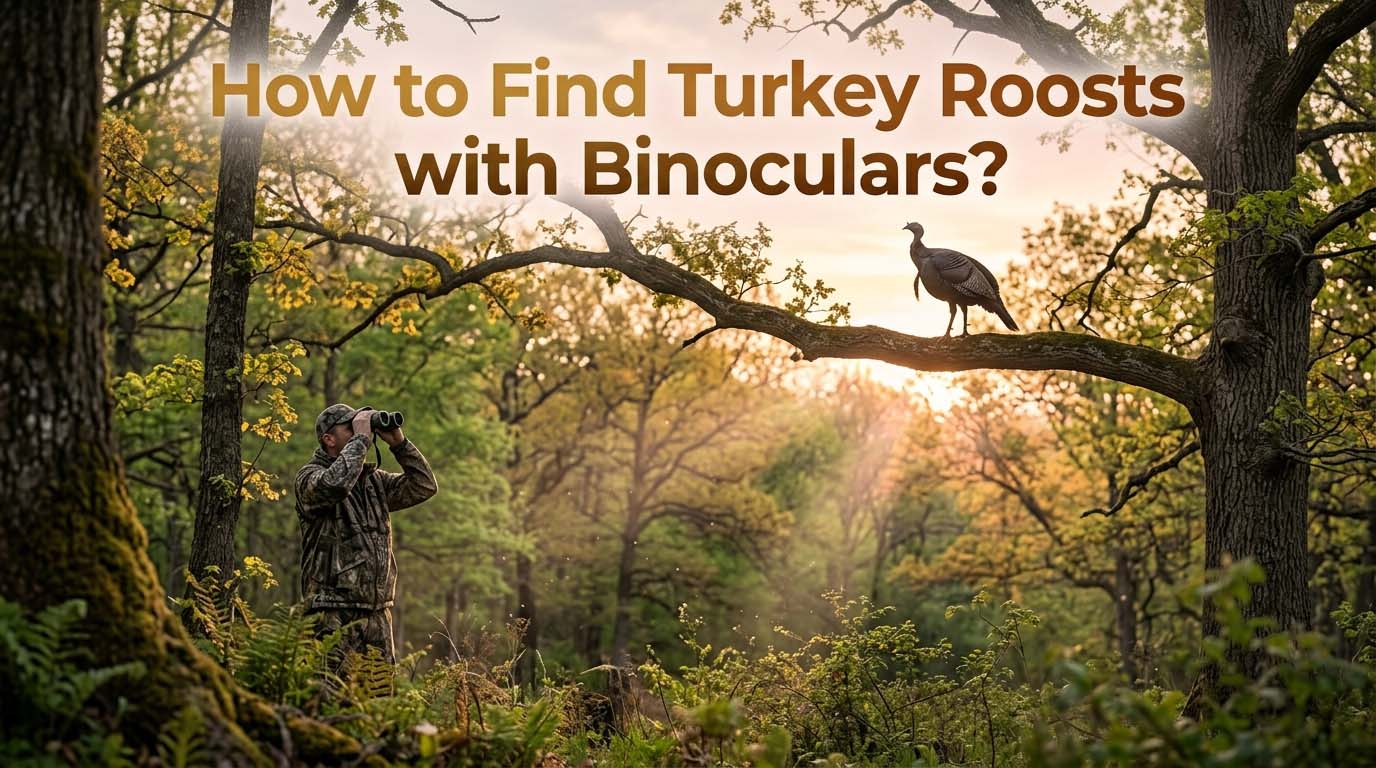
I remember sitting against a tree in the dark, listening to a crow, hoping a turkey would answer back. It didn’t. I had no real plan for the morning, and that hunt ended with me walking miles before light, busting a bird I never even saw.
I decided right then I needed a way to know where they slept without relying on them talking to me.
Most advice on roosting turkeys focuses on sound. You listen for a gobble at dusk and try to pin the tree. But turkeys don’t always gobble. A pressured bird, a rainy evening, or a quiet tom will leave you sitting in the dark with nothing but a guess.
That is where binocular scouting comes in. It is the proactive way to find the bedroom before the rooster ever flies up.
Why the Listen-and-Locate Method Falls Short
Sound is reactive. You wait for the bird to tell you where he is. By the time he gobbles and you try to close the distance in the dark, you are often pushing him off his limb because you misjudged the terrain.
Binoculars take the guesswork out of the equation. Instead of hoping for a gobble, you are actively searching for the bird or the habitat that holds him. You find the tree during daylight. You confirm the limb before dark.
In the morning, you walk straight to the setup spot without any noise or wandering. It turns a stressful evening into a simple information-gathering mission.
Start Your Search on the Ground, Not in the Trees
The biggest mistake I see is hunters walking through the woods randomly glassing the tops of trees. You cannot effectively scan an entire forest canopy. You have to narrow the search first, and the ground tells you exactly where to look.
I look for three specific signs before I ever pull my binoculars up. Here is what each piece of sign tells me:
| Sign Type | What It Tells You |
|---|---|
| Large droppings directly under a tree | Primary roost candidate. Focus scanning here. |
| Dusting bowls at timber edge | Roost is close. Look at the nearest big timber. |
| Flight feathers or wing drag marks | Bird used this tree very recently. |
Once I find heavy sign, I evaluate the tree itself. Not every big tree is a good roost tree. Turkeys want specific features.
They need horizontal branches thick enough to hold a bird comfortably. They need an open flight path to land and take off without hitting limbs. They also want a dense canopy above them for protection from owls and hawks.
Mature oaks with wide, spreading branches are the best. Pines are good for bad weather because the thick needles block wind and rain. If the tree has a wide trunk and horizontal limbs, it is worth scanning.
The Optical Playbook
Now you know which trees to watch. You pull your binoculars up. What are you looking for? If you don’t have a system, you are just looking at wood.
I break the last 90 minutes of daylight into three phases. Each phase requires a different scanning strategy.
Phase 1: The Silhouette Hunt (90 Minutes Before Sunset)
The sun is still bright enough to put turkeys against the sky. I stand so I can see the top third of the target tree against the brightest part of the sky.
I look for a break in that sky. A turkey looks like a dark, smooth oval pressed against a lit background. This is the easiest time to spot a bird if you are looking at the right spot.
Phase 2: The Movement Check (45 to 30 Minutes Before Sunset)
This is when the birds start flying up to their limbs. I switch my focus from looking for solid shapes to looking for movement.
A flapping wing, a branch that shakes suddenly, or a bird hopping from one limb to another is a dead giveaway. I lower my magnification slightly here to get a wider field of view, making it easier to catch motion in my peripheral vision.
Phase 3: The Trunk Scan (Last Light)
This is where most guys miss the bird. The sky goes flat and gray. Silhouettes disappear. You have to stop looking at the sky and start looking at the tree trunk.
Turkeys will press themselves tight against the main trunk to feel safe. You are looking for a dark bump against the darker bark.
I usually lower my binoculars and use my eyes first, then confirm the shape through the glass. If you stare too long, you will lose the shape.
Confirming the Roost Without Blowing the Hunt
Once you think you see a bird, do not stare at it. Turkeys can see the sun glint off a lens from a long way. I take a mental snapshot of the exact limb. I mark it relative to a unique tree feature like a broken top, a big fork, or a specific gap in the branches.
In the morning, I walk in quietly thirty minutes before first light. I do not walk right to the tree. I stop fifty to seventy yards away.
I want to be close enough to shoot when he flies down, but far enough that I do not spook him off the limb. I approach from a direction that keeps my movement hidden, not from the direction I was glassing.
If I did not see a bird but the ground sign was perfect, I still set up close to that tree. Turkeys use the same roost over and over if they feel safe. If the sign is there, the bird is usually not far.
Frequently Asked Questions
Can I use binoculars to roost turkeys in heavy rain or fog?
Heavy weather ruins optical clarity. You cannot effectively see silhouettes in fog or rain. When I face wet conditions, I change my strategy completely. I focus on mature pine stands with thick canopy coverage.
Turkeys consistently roost in pines during bad weather. I look for pines with visible lower branches and a dense top, and I set up close to them in the morning without even trying to confirm the bird visually the night before.
What magnification is best for roost scouting?
An 8x or 10x binocular is the sweet spot. Higher magnification like 12x or 15x seems good, but holding them steady on a tree canopy is very difficult without a tripod. Since you are walking and stopping frequently, keeping the glass light and wide is better.
A 10×42 configuration is the most versatile. You get enough power to see a turkey at 150 yards and a wide enough field of view to scan the canopy effectively.
How do I distinguish a roosted turkey from a squirrel nest at 150 yards?
This is the most common question I get. Look at the shape. A squirrel nest is a messy ball of leaves. It looks rough; it is usually wedged into a fork, and it does not move. A turkey is a smooth, clean oval.
Its head will be tucked into its chest, making it look like a neat football shape. If you see a shape with a distinct line separating the body from the branch, it is probably a turkey. If it looks like a pile of trash stuck in the tree, it is a squirrel nest.
Also, turkeys will occasionally resettle their wings or poke their head out. Watch for that subtle movement.
Should I glass from the same location where I plan to set up in the morning?
No. If you are close enough to see the individual shape of the turkey through your binoculars, you are likely too close to the tree for a morning setup. Your glassing spot should be 150 to 200 yards out.
Your setup spot should be 50 to 70 yards out, usually in a completely different direction. You want to approach the tree from a direction that keeps your movement hidden. The glassing spot is just for information gathering.
What time should I start binocular roost scouting in spring?
Start 90 minutes before sunset. If the sun sets at 7:00 PM, I am in position by 5:30 PM. The first thirty minutes I spend reading ground sign and confirming my target trees. The next thirty minutes are the prime time for seeing movement on the limbs.
The final thirty minutes are when the birds are landing and settling. Do not arrive too late. If you start scanning at 6:45, you have missed the transition phase where the turkeys are most visible.
Learning to find turkey roosts with binoculars changed my spring hunting completely. I stopped relying on a gobble to save my morning.
Instead, I go to bed knowing exactly which tree I will be leaning against the next morning. It turns the evening hunt from a guessing game into a recon mission.