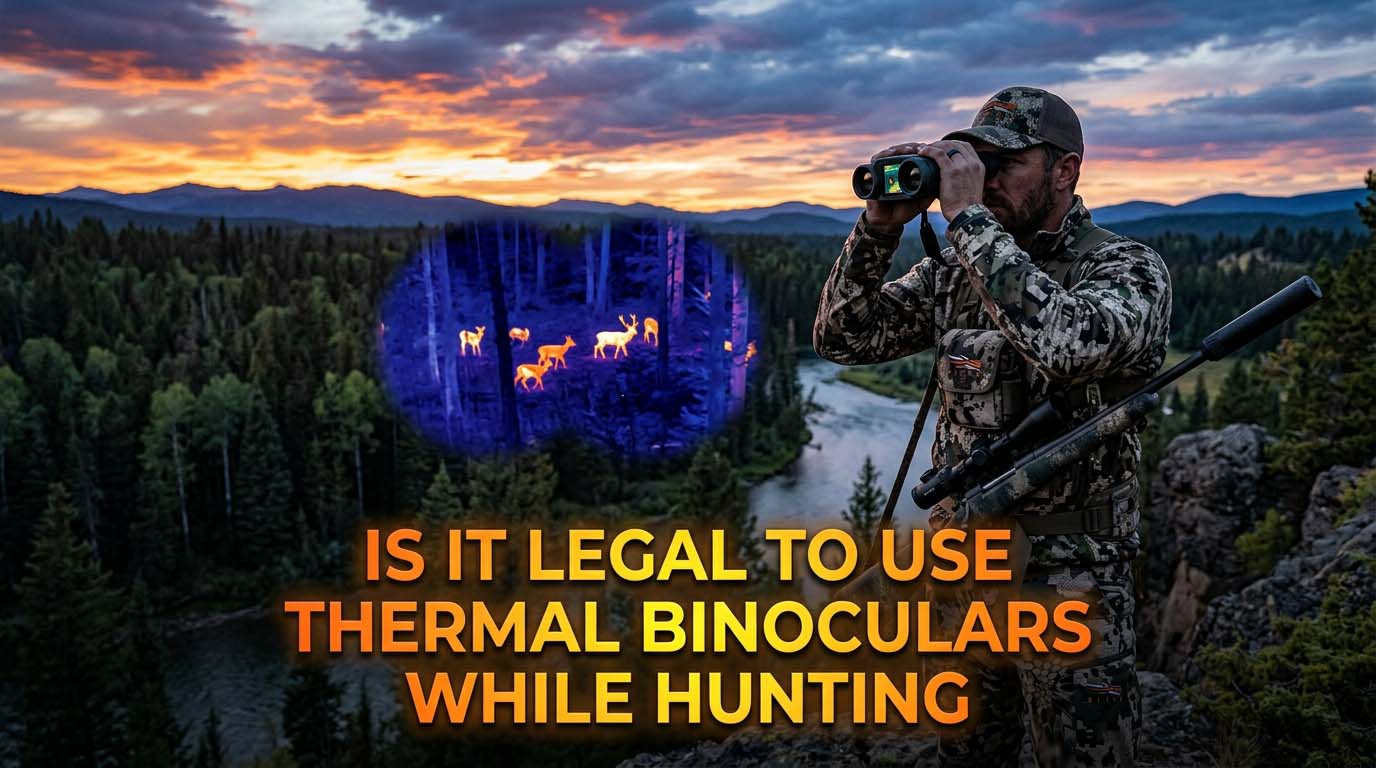
So, is it legal to use thermal binoculars while hunting? The honest answer is: it depends on your state, the species you are after, and how you use them. Most hunters assume thermal binoculars follow the same rules as thermal scopes. That assumption is wrong in several states, and it can cost you a fine, a court date, or your hunting license.
Thermal binoculars are observation tools. They help you find animals in the dark, in thick brush, or behind cover. They do not attach to your rifle. They do not emit light. They do not help you aim. Those three facts place them in a different legal category than thermal scopes in many states, and in a completely separate conversation from spotlighting laws.
This guide breaks down exactly where thermal binoculars are legal, where they are restricted, and where the law is so unclear that you should call your state game warden before you hunt. By the end, you will know what to check, what to carry, and what to leave at home.
Why Thermal Binoculars Are Different From Thermal Scopes in the Law
Thermal scopes are heavily regulated because they turn a standard rifle into a night-hunting weapon. Thermal binoculars do not. That sounds simple, but state laws are not always written with that logic in mind. Some states ban all thermal devices. Others ban only the devices that mount to a firearm. A few states never mention thermal at all, which leaves the rules open to interpretation.
Three legal differences matter most.
Mounting to a firearm. Many state hunting laws target optics that attach to guns. They use language like “mounted on a firearm” or “attached to a weapon.” Thermal binoculars are handheld. In states with that wording, the law does not actually cover them. California is the clearest example. Its restriction on thermal devices is aimed at firearm-mounted optics, not handheld observation tools.
Light emission. Spotlighting laws ban artificial lights for hunting at night. Thermal binoculars detect heat. They emit no visible light and no infrared beam. If a state only bans artificial light, thermal binoculars do not break that rule. Night vision binoculars with IR illuminators can break it, which is one reason thermal and night vision are treated differently in several states.
Observation versus aiming. The purpose of the device matters to wildlife agencies. They worry about devices that help you take a shot, not devices that help you find an animal. Thermal binoculars give you information. You still have to raise your rifle and aim with your own eyes or a separate optic. That “information gathering only” argument has kept many hunters out of legal trouble in states where thermal scopes are banned.
There is also no federal law that bans thermal binoculars outright. Hunting rules are set by the states. The U.S. Fish and Wildlife Service manages federal lands and migratory bird hunting, but it does not have a blanket rule against thermal devices. The Migratory Bird Treaty Act bans night hunting of migratory birds, which removes thermal from waterfowl hunting after dark, but that is a season and species rule, not a device ban.
None of this means thermal binoculars are automatically legal everywhere. Some states use broad language that covers any electronic night vision device, binoculars included. Arizona is the best example. Its law targets “electronic night vision equipment” for taking wildlife, which covers handheld thermal just as much as a mounted scope.
So the real question is not whether thermal binoculars are scopes. It is how your state defines the device it restricts.
State-by-State Thermal Binocular Legality
Here is the practical breakdown. For most states, thermal binoculars follow the same rules as thermal scopes. Where the state law creates a real difference, the table below explains it. Always confirm with your state wildlife agency before you hunt, because laws change and local enforcement can vary.
States where thermal binoculars are legal for predator and nuisance hunting: Alabama, Arkansas, Connecticut, Delaware, Florida, Georgia, Idaho, Illinois, Indiana, Kansas, Kentucky, Louisiana, Maine, Maryland, Massachusetts, Mississippi, Missouri, Montana, Nebraska, New Hampshire, New Jersey, New York, North Carolina, North Dakota, Ohio, Oklahoma, Pennsylvania, Rhode Island, South Carolina, South Dakota, Texas, Utah, Vermont, Virginia, Washington, West Virginia, Wisconsin, Wyoming.
States that ban thermal outright: Arizona, Iowa, Michigan, Minnesota, and Oregon. In those states, leave the thermal binoculars at home. States that ban night hunting entirely: Colorado, Hawaii, Nevada, and New Mexico. Thermal binoculars are not legal to use for hunting after dark in those states, even though the rule is about the time of day rather than the device itself.
Alaska allows thermal devices only for licensed trappers during trapping season. Tennessee generally bans thermal hunting but gives a narrow exemption to landowners with documented crop damage who receive written authorization.
States Where Thermal Binoculars Get Special Treatment
| State | What Makes It Different |
|---|---|
| California | The ban targets thermal devices mounted to firearms. Handheld binoculars are not covered by the same wording. |
| Kansas | A night vision permit is required for any thermal device, binoculars included. |
| Indiana | A visible safety light is required when hunting at night with any thermal device. |
| Georgia | A free night hunting permit is required before you can use thermal after dark. |
| South Carolina | You must notify the DNR and register the property before a night hunt. |
| South Dakota | Thermal hunting is allowed on private land only, with firearm caliber restrictions. |
| Nebraska | Thermal hunting is allowed on private land only, with written landowner permission. |
| Tennessee | Banned except for landowners with crop damage authorization. |
| Alaska | Licensed trappers only, during trapping season. |
| Vermont | The rule bans infrared light emission. Thermal emits none, so it passes. |
California deserves extra attention. The state’s wildlife code restricts night vision equipment used to take birds or mammals, and much of the enforcement focus lands on firearm-mounted optics. In practice, hunters have used handheld thermal binoculars for hog spotting on private land without issue. But because the law does not explicitly bless handheld observation devices, a quick call to your local warden is the smart move before you depend on them.
One more thing to understand: “legal for predators” does not mean “legal for everything.” Many states in the legal list restrict thermal hunting to coyotes, hogs, raccoons, and other non-game species. Hunting deer, elk, turkey, or any game animal at night is illegal in every state, no matter what device you carry.
The Pre-Hunt Legal Checklist for Thermal Binocular Users
Before you pack thermal binoculars for any hunt, run through this list. It takes five minutes and it can keep you out of a courtroom.
- Read the exact wording of your state rule. Search for “night vision” and “electronic device” in your state hunting regulations. Do not rely on a forum post. The law text tells you whether binoculars are included or not.
- Check if the restriction mentions firearms. If the rule says “mounted to a firearm,” handheld binoculars are likely outside the ban. If it says “electronic night vision device,” binoculars are inside the ban.
- Confirm the species you plan to hunt. A state may allow thermal for coyotes but ban it for any game animal. Matching your device to the legal species list is your responsibility.
- Check if possession alone is a problem. Some states ban carrying thermal devices during specific seasons, even if you never turn them on. Others only ban use. Know the difference before you pack.
- Call the local game warden. One phone call beats an afternoon in court. Wardens know how the rules are actually enforced in their district, and they are usually happy to answer.
Six Thermal Binocular Scenarios That Can Get You Cited
Here is where most hunters go wrong. These situations happen every season, and they are the difference between a legal hunt and a legal headache.
1. Spotting bedded deer during archery season. You glass a field with thermal binoculars and pick up a warm deer shape in the brush. Just looking is not automatically a crime, but in states that restrict electronic aids for hunting big game, a warden who sees you glassing with thermal during archery season can treat it as an electronic hunting aid. Know how your state defines “hunting” and “aid” before you scan for deer.
2. Carrying thermal binoculars while hunting a species that is not legal at night. You are coyote hunting, but deer share the same land. If a warden stops you and your rifle is in the vehicle, they can argue you were hunting with an electronic night vision device in an area where deer are present. Keep your hunt species-focused and your story consistent.
3. Glassing near a vehicle at night. Many states have spotlighting laws that ban artificial light from a vehicle or road. Thermal binoculars do not emit light, but a warden who sees you glassing from a truck at night may not care about the technical difference. Move away from the vehicle before you use them.
4. Handing your thermal binoculars to your hunting partner. If your partner then shoots an animal, constructive possession can apply. In states that ban electronic night vision devices, both of you can be charged, not just the person carrying the device. Keep the binoculars with the person who is not shooting, or check whether your state counts shared equipment as possession by both.
5. Hunting public land in a state that allows thermal on private land only. Nebraska and South Dakota restrict thermal hunting to private land with permission. Public land is off limits regardless of what your binocular shows. Hunters have lost privileges over this exact mistake.
6. Driving through a restricted state with thermal binoculars in your pack. Most possession laws are written for hunting activity, not transport. But if you are stopped during hunting season with a rifle and thermal optics in the same vehicle, the situation gets complicated. If you must travel through a restricted state, keep the binoculars locked in a case and the rifle locked in a separate container.
Legal Ways to Use Thermal Binoculars in the Field
Thermal binoculars shine in situations that have nothing to do with night hunting. Here is where they are most useful, and where the law is on your side in the vast majority of states.
Blood trailing after a shot. When the sun drops and the blood trail disappears, thermal binoculars let you pick up the body heat of a wounded animal bedded down in thick cover. This is one of the most ethical uses of the technology. Most states have no rule against recovering wounded game, and many wardens will tell you to do whatever it takes to avoid wasting an animal.
Predator calling during the day. Thermal works in daylight, and it works well. When a coyote hangs up at 300 yards in the brush, thermal binoculars let you see it without spooking it by raising a scope. This keeps you inside legal shooting hours and inside the law.
Scouting before legal shooting hours. If you are not carrying a weapon, thermal binoculars are a legal scouting tool in most states. Find where animals bed, then plan your approach for legal hours. The key is leaving the weapon behind. Once you carry a bow or rifle, the situation changes.
Species identification at dawn and dusk. When legal shooting light is low, it can be hard to tell a doe from a buck or a coyote from a fox. Thermal binoculars show you the heat shape at distance. That is information gathering, not targeting, and it makes you a more careful hunter rather than a more reckless one.
Frequently Asked Questions
Can I use thermal binoculars for hog hunting at night in states that ban thermal scopes?
Usually, yes, but it depends on the wording of the state law. If the ban targets firearm-mounted optics, handheld binoculars are not covered. If the ban targets all electronic night vision devices, they are. Texas, Florida, Oklahoma, and Louisiana allow thermal for hogs. Iowa, Michigan, and Oregon do not.
Do thermal binoculars count as artificial light under spotlighting laws?
No. Thermal binoculars detect heat and emit no visible light. Spotlighting laws ban artificial light sources, and thermal does not fall into that category in most states. The exception is when a state law specifically names thermal imaging or night vision as a banned device type.
Can I carry thermal binoculars in my pack during any hunt?
Not in every state. Some states ban possession of electronic night vision devices during specific hunting seasons, even if you never use them. Check the possession language in your state regulations. In unrestricted states like Texas and Pennsylvania, carrying is not an issue.
What is the difference between thermal binoculars and thermal monoculars under state law?
Almost nothing. State laws rarely distinguish between a binocular and a monocular form. If a state bans handheld thermal devices, it bans both. If it only bans firearm-mounted devices, both are legal to carry.
Can I use thermal binoculars to scout before sunrise if I am not carrying a weapon?
In most states, yes. Scouting without a weapon is not hunting. But carrying a bow or firearm while glassing with thermal during restricted hours changes the situation. Leave the weapon behind, and the legal picture becomes much clearer.
Do federal lands have separate rules for thermal binoculars?
Federal public lands follow the state rules where the land sits. There is no separate federal hunting law for thermal optics. The exception is specific national wildlife refuges or military bases with their own regulations. Check with the land manager before hunting.
Can I use thermal binoculars from a vehicle if I am not hunting from the vehicle?
This is risky. Many spotlighting laws are written broadly enough to cover any electronic viewing device used from a vehicle at night. If a warden sees you glassing from a vehicle with thermal, it looks like spotlighting regardless of your intent. Get out of the vehicle first.
What thermal binocular features should I avoid to stay legal?
Avoid built-in IR illuminators, laser rangefinders, and recording functions that a warden could classify as a night vision device with extra capabilities. A simple thermal observation tool is the safest choice. Keep any feature that emits light switched off in the field.
Can I use thermal binoculars to recover wounded game after dark?
Yes, and most wildlife agencies support this. Recovering wounded game is not hunting, it is an obligation. Even in states with strict thermal laws, responsible recovery efforts are generally protected. If you are unsure, call your warden and explain the situation.
Is it illegal to use a thermal scope while deer hunting in Wisconsin?
Wisconsin allows thermal devices for coyote and other predator hunting at night. Deer hunting has no such allowance. Using a thermal scope on a deer hunt is not legal because the state restricts thermal hunting to designated species, and deer are not one of them. Thermal binoculars used to spot deer during legal shooting hours are a separate question, but the deer hunt itself must happen in daylight.
The bottom line on thermal binocular legality: know your state, know your species, and know the difference between observing and hunting. When you can honestly answer all three, thermal binoculars are one of the most effective and ethical tools you can carry. When you cannot, leave them home and call your game warden first.