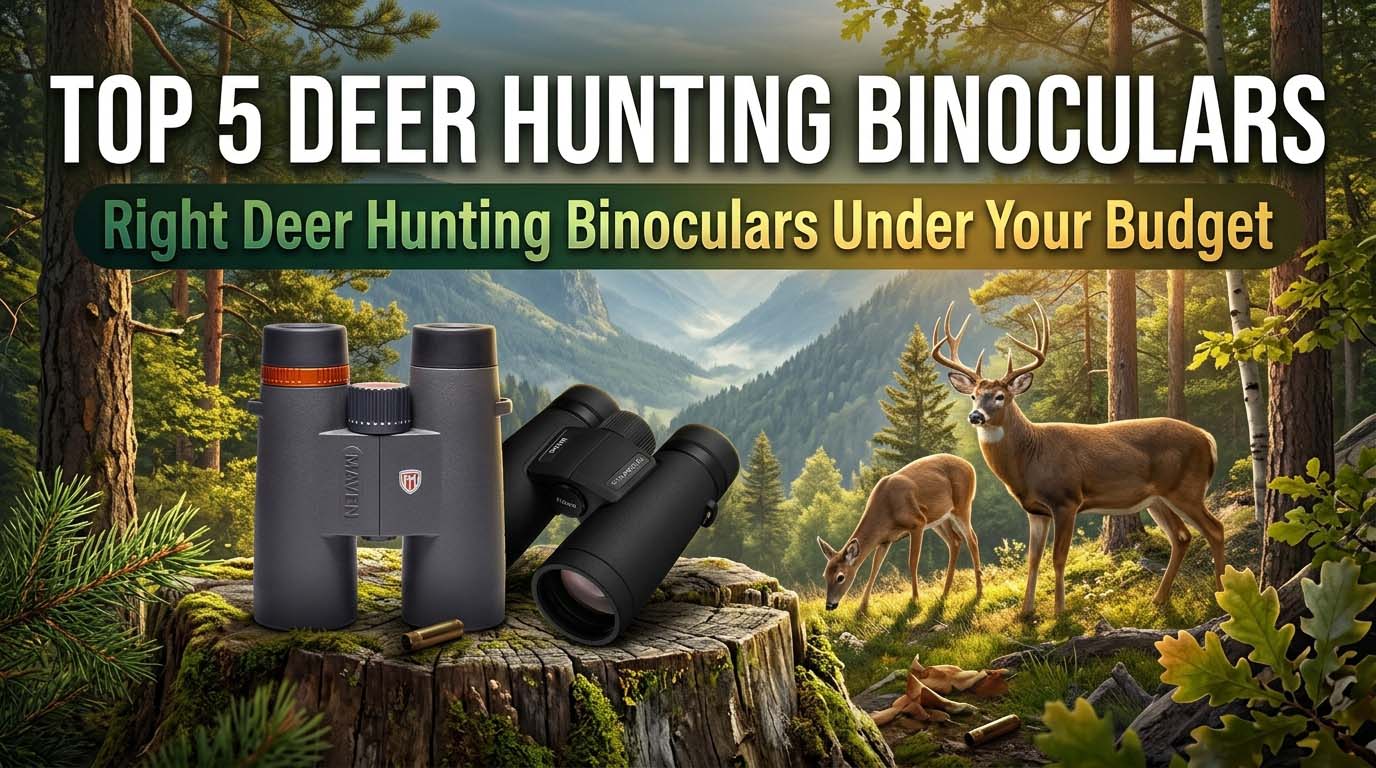
You’ve got maybe ten minutes of legal shooting light left. A buck steps out at 80 yards, angling through the cedars. Can your binoculars pick apart the antler detail fast enough for you to make the call? This is the moment that separates decent hunting glass from gear that’s just along for the ride.
Most “best of” lists treat optics like they’re for birders or general outdoor use. Deer hunting is different. You need low-light performance that works in the last moments of dusk. You need a field of view that catches movement in dense cover. And you need something that doesn’t turn into a boat anchor halfway through a spot-and-stalk. After testing five serious contenders, I can tell you the Maven C1 wins the crown for sheer image quality at this price point, but the right pick for you depends on where and how you hunt.
Best Deer Hunting Binoculars Under $500: Quick Picks


Best Overall: Maven C1 10×42 — Unmatched glass quality for the price
Best for Thick Woods: Nikon Monarch M7 10×42 — Wildly wide field of view
Best Value & Reach: Vortex Diamondback HD 12×50 — The most punch per dollar
Best Budget Entry: Bushnell Engage X 10×42 — Weatherproof and wallet-friendly
Best Stretch Pick: Athlon Cronus G2 UHD 10×42 — For the edge-clarity obsessive
Why Deer Hunting Changes the Binocular Rules
Before getting into the reviews, I have to explain the logic behind the ranking. Walking into the woods with cheap glass teaches you hard lessons about what actually matters. It’s not just about magnification, and it’s definitely not about brand names. Deer hunting has three non-negotiables that alter the equation.
The 10-Minute Window (Low Light)
Deer don’t follow a 9-to-5 schedule. The biggest bucks of the season tend to appear in the murky half-light of dawn and dusk — exactly when most optical systems start struggling. That’s when you’re dealing with a 4.2mm exit pupil (on a 10×42) and coatings that either let light through or eat it. If you compare a cheap pair side-by-side with one using ED glass and dielectric prisms, you’ll notice the difference immediately. The expensive glass keeps colors accurate and sharpens contrast right as the sun slips away. The cheap ones turn into gray mush. Every pair in this lineup had to prove itself during legal shooting light, not midday sun.
The Reactive Target (Field of View vs. Mag)
A whitetail sliding through oak thickets covers ground quickly. You don’t get time to sweep leisurely if you’re trying to find him and verify the rack before he melts back into the brush. That’s where field of view (FOV) comes into play. A high FOV — like the 357 feet on the Nikon M7 — means you can spot motion at the edge of your vision. But if you hunt open agricultural fields, you might want more magnification to pick apart antlers at a distance. The trade-off is real, and the ranking reflects that: the wide-view binoculars beat the high-mag options for cover, and vice versa.
The Weight Tax
Here’s the part a lot of listicles miss. If you’re a saddle hunter or you hike two miles to your spot, you start noticing every ounce by the time you reach your tree. If you hunt from a box blind over a food plot, weight barely registers. All five of these binoculars are under 25.5 ounces, but the difference between 20 and 25 ounces is substantial on a long walk. I’ve had days where I left the heavier pair behind and regretted it at dusk. For that reason, I consciously weight lighter bins higher in the rankings for hunters who move.
The 5 Best Deer Hunting Binoculars Under $500 (In-Depth Reviews)
Here’s where I separate the contenders. I spent time behind each of these in the field — glassing ridgelines, scanning river bottoms, and paying attention to how they felt after hours of use. The rankings reflect what I found, not what the marketing team claims. Each one gets a fair shot, and each one gets an honest critique of where it falls short.
#1. Maven C1 10×42 — Best Overall Deer Binocular Under $500
- Magnification: 10x
- Objective Lens: 42mm
- Weight: 21 oz
- Field of View: 315 ft @ 1000 yards
- Key Features: ED glass, polymer frame, fully multi-coated
This one impressed me from the first evening I used it. The Maven C1 has a way of punching above its weight that’s rare at this price point. Those ED glass elements give it the kind of contrast and color fidelity you’d expect from optics costing significantly more. When a buck walked the edge of a cut soybean field at last light, I could still see the outline of his tines against the dark timber — not just a silhouette that might be a deer.
What makes the C1 stand out for hunters is the weight. At 21 ounces, it disappears on a bino harness for a saddle hunter. The polymer frame doesn’t feel flimsy at all — it actually gives it a bit of grip in cold weather, which is a nice touch over metal-bodied binoculars that turn into ice cubes in November.
I’ll be straight with you, though. The focus knob is stiff when you first get it. It takes some breaking in, and even then it’s firmer than the Nikon or the Vortex. It’s a deliberate design choice — the focus stays where you put it, and you don’t accidentally bump it out of alignment when you’re trying to steady the glass against a tree. But if you’re used to a feather-touch focus, it takes a while to adjust.
The warranty situation is also a bit different. Maven’s lifetime unconditional warranty is solid — they’ll fix or replace anything. But there’s no retail counter. You mail it in, and that takes time. If you break your only binoculars a week before the season opener, you’re out of luck until they get back to you.
Even with those minor friction points, the C1 wins the top spot because it delivers the best combination of optical quality, weight, and ruggedness for a deer hunter. The decision was clear after the third hunt.
#2. Nikon Monarch M7 10×42 — Best for Woods & Movement
- Magnification: 10x
- Objective Lens: 42mm
- Weight: 23 oz
- Field of View: 357 ft @ 1000 yards
- Key Features: ED glass, phase-corrected dielectric coatings, high-eyepoint
If you hunt the hardwoods — the oak ridges and creek bottoms where a buck can ghost right past you in thick cover — the Nikon Monarch M7 deserves a hard look. That 357-foot field of view is massive. When I glassed a ridgeline with plenty of brush, the M7 felt like a wide-screen display. I caught the flick of an ear and the shift of a shoulder at the periphery more than once. For spotting movement, nothing else in this lineup comes close.
It’s still a sharp optic. The ED glass and multilayer coatings deliver crisp, color-accurate images with enough light-gathering to handle first legal light. The high-eyepoint design is a huge win for eyeglass wearers like me — I can keep glasses on without losing the full view or dealing with black rings at the edges. It’s a comfort detail that makes a real difference during a long sit.
Right, so the honest truth. Nikon’s older M-series had some serious issues with the rubber armor getting sticky and degrading over time. That’s been addressed in the M7 — the rubber feels solid, and I haven’t seen signs of the issue. But that reputation lingers in the hunting community, and it’s fair to wonder about the long haul. Some users have also reported the eyecups feeling a bit loose. It’s a minor complaint, but worth mentioning if you’re a stickler for build perfection.
The M7 sits at #2, not #1, because while it wins the FOV crown, the Maven edges it out slightly in low-light contrast and sheer weight. If your hunting world is defined by thick timber — and you don’t wear glasses — the M7’s wide, bright view might be the single best upgrade you’ll make this season.
#3. Vortex Diamondback HD 12×50 — Best Value & Long Range
- Magnification: 12x
- Objective Lens: 50mm
- Weight: 25 oz
- Field of View: 318 ft @ 1000 yards
- Key Features: Dielectric coatings, select glass elements, argon purged
The Vortex Diamondback HD 12×50 is a legend in the budget optics world, and for good reason. It’s a massive value. You get 12x magnification and 50mm objectives without needing to sell a kidney. For hunters who glass wide-open fields, powerline cuts, or any terrain with serious distance, this pair brings the world closer. I counted points on a buck bedded in an alfalfa field at well over 200 yards, and I never had to question what I was seeing.
The 50mm objective lenses haul in a ton of light. Despite the 12x magnification giving a smaller exit pupil than a 10×42, the sheer volume of light gathered keeps the image bright and clear through legal shooting light. The dielectric coatings also boost color fidelity and brightness, and I noticed the difference when comparing a cheaper pair side-by-side. The Diamondback HD also has that beloved VIP lifetime warranty. It’s a no-frills “we fix or replace it if it breaks” commitment that gives you real peace of mind.
That said, this thing is heavy. At 25 ounces, it’s the heaviest pair in this lineup. After a few miles on a sling or on your chest, you know it’s there. And 12x magnification is unforgiving — it amplifies every little shake of your hands. Without a solid rest (or a tripod), keeping the image steady can become frustrating. I found myself bracing against trees constantly. You can adapt, but you have to know you’re signing up for that workout.
The Diamondback HD lands at #3 because it doesn’t win the versatility contest. For open-country deer hunting and hunters who prioritize warranty, it’s legitimately the best glass money can buy under this budget limit. But for the hunter who does a little bit of everything, the versatility of a lighter 10×42 wins out.
#4. Bushnell Engage X 10×42 — Best Budget / Best Weather
- Magnification: 10x
- Objective Lens: 42mm
- Weight: 20 oz (approx)
- Field of View: ~325 ft @ 1000 yards
- Key Features: EXO Barrier coatings, IPX7 waterproofing, lead-free glass
If you’re just entering the deer hunting game or you need a second pair for a hunting partner, the Bushnell Engage X delivers an impressive amount of performance for the money. Its standout feature isn’t the glass — it’s the weatherproofing. The EXO Barrier coating flings off water and oil like a freshly waxed truck in a rainstorm. I hunted with it in a steady drizzle, and the view stayed crystal clear, where other budget bins fogged up or streaked immediately.
The image quality is solid for the price. It’s bright and sharp in decent light, and the 10x magnification with a 42mm objective handles typical mid-morning or early afternoon glassing sessions with ease. The IPX7 rating means you could briefly submerge them in a foot of water and not worry. That’s a level of weather resilience that usually costs much more.
The honest truth? In the last ten minutes of legal shooting light, the Engage X starts to show its budget roots. Put it side-by-side with the Maven or the Nikon, and you’ll see a noticeable drop-off in contrast and clarity. The edges of the field of view also get soft in low light. And the build feels a bit plastic-y; it’s not going to win any awards for premium heft, though it does keep the weight down.
The Engage X earns the #4 slot because it’s a fantastic entry-point and a superb backup pair for harsh weather, but it can’t keep pace with the higher-tiered optics in this list when light gets scarce. If your budget is tight, it won’t let you down. If you’re looking for a primary pair for serious low-light hunting, spend a little more.
#5. Athlon Cronus G2 UHD 10×42 — Best Stretch Pick
- Magnification: 10x
- Objective Lens: 42mm
- Weight: 23.5 oz
- Field of View: 330 ft @ 1000 yards
- Key Features: UHD glass, E2ES field-flattening system, dielectric coating, magnesium body
The Athlon Cronus G2 is the wildcard of this group. It’s technically over the under-$500 limit — you’ll have to stretch the budget to bring it home. But for the optics enthusiast who cares about one thing above all else, it’s worth the splurge: edge-to-edge sharpness.
The UHD glass combined with the E2ES field-flattening system delivers an astoundingly sharp view right to the very edge of the circle. When I’m glassing a wide draw for sign, that flat field means I don’t have to constantly refocus to identify what’s sitting at the periphery. It provides a fall-off in sharpness that other binoculars — even the M7 — exhibit toward the edges. It’s a technical marvel for the price.
The magnesium chassis keeps the weight at a respectable 23.5 ounces, adding strength without the bulk. The dielectric coating reflects over 99% of light, translating directly to an extremely bright image in low light. It easily matches the Maven in last-light performance. Athlon’s unconditional lifetime warranty is also the kind of promise that makes you comfortable trusting an unfamiliar brand.
So, here’s the dealbreaker. Athlon simply doesn’t have the name recognition in the deer hunting community that Nikon, Vortex, and Maven have. That lack of reputation makes it a riskier recommendation for a hunter walking into a deer camp. It’s also not a budget-friendly pick — I’d only recommend it if you refuse to cave on aperture and you have a bit of flexibility in your wallet.
The Cronus G2 earns the #5 slot because it’s a specialized tool with an above-limit price. For the truly spec-obsessed, it delivers performance that punches far above the price tag, but for the average hunter, the alternatives provide better overall value and a more recognizable name in the deer woods.
Best Deer Hunting Binoculars Under $500: Comparison Table
If data is what you’re after, the table breaks it down cleanly. Use the “Low Light Grade” to gauge what really matters at dusk and dawn — that’s where the differences will cost you a chance at a buck.
| Product | Mag / Obj. | Weight | FOV (ft @ 1k yds) | Low Light Grade | Best For |
|---|---|---|---|---|---|
| Maven C1 | 10×42 | 21 oz | 315 ft | 9/10 | Overall Quality |
| Nikon M7 | 10×42 | 23 oz | 357 ft | 8/10 | FOV / Woods |
| Vortex DB HD | 12×50 | 25 oz | 318 ft | 9/10 | Value / Reach |
| Bushnell Engage X | 10×42 | 20 oz | ~325 ft | 7/10 | Budget / Weather |
| Athlon Cronus G2 | 10×42 | 23.5 oz | 330 ft | 9/10 | Edge Sharpness |
Buyer’s Guide for Deer Hunting Binoculars
Once you’re past the specific models, the question becomes about matching the tool to your hunt. Here’s the education you need to make the right call, broken down by the three decisions that matter most.
10×42 vs 12×50 for Deer Hunting
The classic debate. A 10×42 (like the Maven or Nikon) is the jack-of-all-trades. It’s easier to hold steady, offers a wider field of view, and generally weighs less. This is the best “do everything” configuration for a hunter who’s moving.
A 12×50 (like the Vortex Diamondback HD) is an open-country specialist. It brings distant objects closer, and those larger objective lenses gather more total light. But it’s heavier, harder to keep steady off a rest, and its narrower field of view makes a close-quarter deer harder to track. For a dedicated open-field hunter who can use a tripod, the 12×50 is a strong tool. For a whitetail hunter in typical terrain, the 10×42 is the better all-around choice.
Exit Pupil & The “Dawn Rule”
The exit pupil is the size of the shaft of light that enters your eye. You calculate it by dividing the objective diameter by the magnification. For a 10×42, you get 4.2mm; for a 12×50, you get about 4.1mm. As human eyes age, they dilate less in low light. If your pupils only open to 4mm in the twilight, you’re actually wasting light with a larger exit pupil. It’s a great stat for the spec sheet, but the real-world low-light performance depends just as much on the glass and coating quality as it does on that number.
Coating Hierarchy
Coatings are what determine brightness and color fidelity. The budget tiers use aluminum mirrors; premium tiers use silver; the top tier uses dielectric coatings. Dielectric coatings (found on the Maven C1, Vortex Diamondback HD, and Athlon Cronus G2) reflect over 99% of light, delivering the best image. If a pair is fully multi-coated and phase-corrected, you’re getting good light transmission. This is one area where spending a little more genuinely matters — it’s the difference between gray shadows and crisp details at dusk.
The Warranty Factor
Warranties are a trust contract between you and the manufacturer. Vortex’s VIP warranty is legendary for its no-nonsense, no-fault replacement policy. Maven’s unconditional warranty is similarly bulletproof, but you’re dealing with shipping it back. Athlon’s lifetime warranty is solid in theory, but their customer service is less battle-tested than Vortex’s. If you’re rough on gear, a no-fault warranty is worth prioritizing.
Which Deer Hunting Binocular Should You Buy?
There’s no point pretending there’s a single perfect binocular for every hunter. Your specific terrain and hunting style dictate the pick. So, here’s how I’d direct you based on your setup.
The Saddle Hunter / Backpacker: Go with the Maven C1. It’s the lightest 10×42 in the group with the best optical quality. When you’re carrying a saddle, sticks, and a pack, the last thing you need is a binocular dragging. The weight penalty is worse than any optical shortfall. This is the one I trust on long walks.
The Eastern Hardwood Hunter: Choose the Nikon Monarch M7. In the thick stuff, the field of view is your superpower. You’ll catch movement and lock onto a buck’s location in a way that a tighter optic simply cannot. It’s utility built for the oak ridges.
The Open Country / Field Hunter: Go with the Vortex Diamondback HD 12×50. You need the reach and the bright image for scanning food plots and CRP ground from a stand at a distance. Be prepared to steady it — a monopod or a tripod is a smart accessory. The durability and warranty seal the deal.
The Budget New Hunter: Start with the Bushnell Engage X. It’s not flashy, but it’s dependable, weather-sealed, and won’t put you in the red. You can learn to hunt with this and upgrade later if the obsession takes hold.
The Gear Obsessive: If you’re picky about every last bit of sharpness and you can handle the stretch, the Athlon Cronus G2 is the spec monster. The flat field and brightness are unforgettable. Just know you’re paying a premium for that final 5% over the Maven, and carrying a lesser-known name into the woods.
Frequently Asked Questions
Is a 10×42 or 12×50 better for deer hunting?
A 10×42 is the most versatile choice for deer hunting, offering the best balance of weight, steadiness, and field of view for all-day hunting. A 12×50 provides more reach and brightness for open-country, long-distance glassing, but it is heavier and harder to hold steady without a tripod.
What is a good field of view for deer hunting binoculars?
For deer hunting, you want a field of view of at least 300 feet at 1000 yards. The Nikon Monarch M7 at 357 feet is excellent for thick woods where spotting movement quickly matters more than magnification. A wider FOV helps you track a moving animal through cover.
Are expensive binoculars worth it for deer hunting?
Yes, but only up to a point. The jump from budget to mid-tier brings significantly better low-light performance, contrast, and build quality. Once you cross a certain threshold, the improvements become smaller. In the under-$500 range, spending a bit more on the Maven C1 or the Nikon M7 gets you a genuinely better image and durability compared to budget options.
What does “ED glass” mean in binoculars?
ED stands for extra-low dispersion. It’s a type of glass that reduces chromatic aberration — the color fringing you see along the edges of objects. ED glass improves color fidelity and sharpness, which is directly observable in the field, especially when looking at antlers against bright backgrounds in low light.
Do I need tripod adaptability for deer hunting binoculars?
Not for a standard 10×42 setup. However, if you’re using a 12×50 like the Vortex Diamondback HD or glassing for long periods from a fixed stand, a tripod adapter helps stabilize the image and reduces eye strain. It’s a worthwhile accessory for open-country hunters but a poor trade for saddle and stalk hunters who are moving.