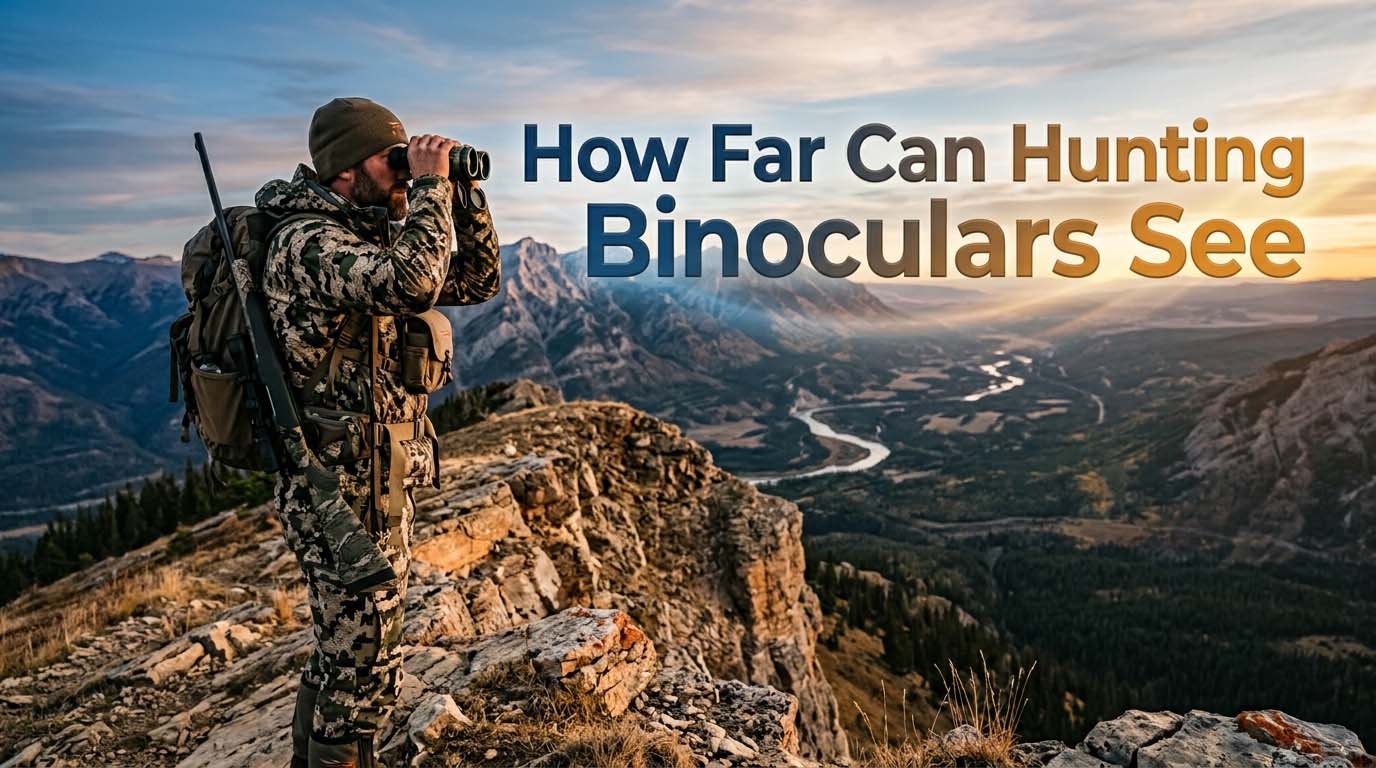
Point a hunting binocular at the moon and you will see craters from 240,000 miles away. Point it at a mountain ridge ten miles off and individual trees come into view. In that literal sense, a binocular has no distance limit.
But that is not what a hunter is really asking. The question behind the question is simple: how far can hunting binoculars see a deer, an elk, or a coyote and actually tell what it is?
For deer-sized game in daylight, the honest answer is: an 8x binocular will identify a deer at 200 to 400 yards. A 10x will stretch that to 400 to 600 yards. A 12x reaches 500 to 800 yards.
And a 15x on a tripod pushes confident identification out to 700 to 1,000 yards or more. Those are the numbers that matter when you are deciding what to pack on your back.
What a Hunting Binocular Actually Sees?
A binocular does not “reach out” to an object. It magnifies light that has already traveled from that object to your eye. That is why distance alone never stops a binocular. The real limits are set by four things: how much detail the glass can resolve, how steady you can hold it, what the air between you and the animal is doing, and how sharp your own eye is.
Because of this, “how far can hunting binoculars see” is the wrong mental model. The right one is: at what distance can this binocular magnify an animal enough that my eye can still tell what I am looking at? The moon works because it is huge.
A deer at 800 yards is tiny, and no matter how much magnification you add, the atmosphere and your own vision eventually stop delivering useful detail.
Here is the practical result. A whitetail at 200 yards through an 8x binocular is easy to identify. The same deer at 800 yards through that same glass is a brown shape. At 1,200 yards, in average daylight, even a 15x binocular mounted on a tripod will leave you guessing whether that dark patch is an animal or a rock.
What Magnification Really Does to the Distance
Stand at the edge of a 100-yard clearing. The tree line at the far end is 100 yards away. Lift a 10x binocular, and that tree line now looks like it is 10 yards in front of you. The distance did not shrink. The scene simply got bigger. That is all magnification ever does.
Every hunter should know the rule of ten. Divide the distance to the animal by the magnification number, and you will know exactly what the view looks like.
A deer at 500 yards through a 10x binocular appears the same size as a deer at 50 yards with a naked eye. Through a 12x, that same deer looks like it is 42 yards away. Through an 8x, it looks like 62 yards. Run that math before you commit to a power.
The first number on a binocular tells you the binocular magnification. A 10×42 is a 10-power glass with 42mm objective lenses. Hunting binoculars usually land between 8x and 15x. Higher power does bring more detail at long range, but it also brings hand shake, a narrower field of view, and a dimmer image in low light. There is no free lunch.
The Difference Between Seeing a Deer and Identifying a Deer
Every hunter knows the feeling. You catch movement on a far ridge. Through the glass, the shape is brown and roughly deer-sized. But it could be a coyote, a stump, or another hunter. This is where “seeing” stops being useful.
There are four levels of visual confirmation, and every binocular has a different distance for each one.
- Detection. You notice something that does not belong. It may be movement, a patch of color, or an odd shape. At this level, you have no idea what it is. A 10x binocular can detect a bedded buck at 1,200 yards, but only as a suspicious bump.
- Recognition. You can tell the general class of animal. That is big game. That is a bird on a fence post. Recognition of a deer-sized animal through a 10x binocular typically happens at 700 to 900 yards in good light.
- Identification. You know the species. That is a mule deer, not an elk. That is a coyote, not a fox. Identification requires clear body shape, head profile, and movement. For a whitetail through a 10x, that lands at 400 to 600 yards.
- Detail confirmation. You can see antler points, tine length, body condition, and whether the animal is alert. This is what you need before a shot. A buck must be confirmed legal. Detail confirmation often cuts the usable distance in half compared to identification.
Hunters who skip this framework make mistakes. The person who spots a “big dark animal” at 600 yards and starts ranging it has not decided whether he is watching an elk or a cow moose. Treat the four levels as a checklist, and the distances in the next section will make sense.
The Practical Range of a Hunting Binocular by Target Size
The table below gives confident identification distances in yards for common hunting targets. These numbers assume daylight, average humidity, and a steady hold. A tripod pushes every value toward the top of its range. Handholding drags them down, especially above 10x.
| Target | 8x | 10x | 12x | 15x on tripod |
|---|---|---|---|---|
| Whitetail | 250–350 | 400–550 | 550–700 | 700–900 |
| Mule deer | 275–375 | 425–575 | 575–725 | 725–925 |
| Elk | 300–400 | 450–600 | 600–800 | 800–1,000+ |
| Coyote | 100–150 | 150–250 | 250–350 | 350–450 |
| Turkey | 75–125 | 125–200 | 200–275 | 275–375 |
| Human figure | 275–375 | 425–575 | 575–725 | 725–950 |
Detection distances are always farther than identification distances. A 10x will detect a coyote crossing a frozen hay field at 500 yards, but it will not tell you with confidence that it is a coyote until it gets inside 250. As a rule of thumb, expect detection at roughly double the identification numbers above, and expect recognition to sit somewhere in between.
Target size matters more than most hunters realize. An elk at 700 yards through a 12x binocular is a much easier read than a turkey at 250 yards through the same glass. Large bodies give the eye more detail to lock onto. Small animals disappear into the terrain long before big ones do.
Why the Human Eye Sets Your Maximum Viewing Distance?
Here is the part most hunters never hear. Your eye can only resolve detail down to a certain angular size. When magnification gets high enough that your eye can already see every bit of detail the objective lens is delivering, adding more power does not help. It just makes that same detail bigger and wobblier.
Think of the binocular as a projector and your eye as the screen. A 10×42 lens delivers a certain amount of real detail to your eye. A 15×56 lens can deliver more, but only if the glass is high quality and the image is perfectly still.
If the image is shaking, all that extra magnification does is turn a small blur into a big blur.
That is why a 15x binocular held by hand will often show less useful detail at long range than a 10x binocular resting on a solid pack. The 10x image is stable enough for your brain to piece together. The 15x image is not.
Exit pupil explains part of this. To find the exit pupil, divide the objective lens diameter by the magnification. A 10×42 has a 4.2mm exit pupil. A 15×56 has a 3.7mm exit pupil. In the dim light of dawn, when your pupils open to 5 or 6mm, the 10×42 delivers a brighter, easier-to-read image. That one number decides how well you see into dark timber.
Glass quality also sets a ceiling on usable magnification. Two binoculars with the same 10x power can perform wildly differently at 500 yards. Better glass means better contrast, truer color, sharper edges, and more light reaching your eye through anti-reflective coatings.
Cheap glass at high magnification often shows a muddy, washed-out image at the very distances where you need it most. The magnification number is the same; the useful detail is not.
The Atmosphere Limits Every Hunting Binocular at Long Distance
Picture an October afternoon on a sagebrush flat. A mule deer buck is bedded at 900 yards. The air above the ground shimmers like water.
Through a 12x binocular, the buck’s outline ripples and warps with every heat wave. You know he is there. But you cannot tell if he is a fork-horn or a heavy 5-point. You cannot trust what you are seeing.
That shimmer is a mirage, and it is the quiet killer of long-distance hunting binoculars. By mid-morning on a sunny day, heat waves rolling off bare ground can turn a 12x view into a boiling mess at 1,200 yards.
The image dances so badly that even a tripod-mounted binocular cannot settle it. Your glass is fine. The air is not.
Fog and humidity scatter light like a dirty windshield, washing out contrast and softening edges. Dust, smoke, and blowing snow do the same. In flat, bright light on a hazy day, a deer at 600 yards can look like a ghost.
This is why two hunters with identical binoculars can have completely different experiences on different days: the atmosphere is part of the optical system, and it is the most unpredictable part.
The practical conclusion is this: your maximum effective range is often set by weather and terrain, not by your binoculars. Learn to read mirage. If the air above a ridge is dancing violently, the detail will not be there no matter how good your glass is.
Wait for a cloud to pass and cool the ground, or shift your glassing to the windward side of the basin where air moves more cleanly.
Long-distance glassing belongs in the morning and evening hours. The air is cooler, the thermals are calmer, and the low sun rakes across the terrain, making every bedded animal cast a shadow. Midday glassing on a hot flat is where ambition goes to die.
Choosing the Right Hunting Binocular for the Distance You Need
There is no single best magnification for every hunter. The right power depends on the country you hunt and the distances you actually glass. Be honest about both.
Eastern Hardwoods and Thick Timber: 8x
An Eastern whitetail hunter who sits in hardwoods at 60 yards does not need 12x. He needs a wide field of view to catch movement between the trees. An 8×42 is the right call: bright, steady in the hands, and forgiving in low light. The extra power of a 10x is wasted on country where shots never leave the timber.
Western Mountains and Canyons: 10x
A mountain hunter who glasses across canyons needs reach. A 10×42 is the standard for a reason. It splits the difference between field of view and detail, and it stays usable in the hands. For an elk hunt in the Rockies, where a 500-yard glassing session is normal, the 10×42 earns its place on the pack every day.
Open Prairies and Big Country: 12x
Hunters working open prairies, desert basins, or large agricultural country should look at 12×50. In those places, glassing and shots both stretch past 500 yards, and the extra magnification pays for itself. Plan on using a rest or a tripod, because 12x is where hand shake starts to bite.
Long Glassing Sessions on a Tripod: 15x
For the hunter who is glassing from a ridge for hours, a 15×56 is a legitimate tool. On a solid tripod, it delivers spotting-scope-level detail with both eyes, which makes long sessions far less tiring.
It is heavy, and it is miserable to hold freehand. But when your whole hunt is about reading a hillside from a mile away, there is no better companion.
Matching objective lens size matters as much as magnification. A 42mm objective is the all-around standard for good reason: it balances weight, brightness, and cost. A 50mm or 56mm objective gathers more light for dawn and dusk hunting, but it adds weight that punishes you on a long pack-in. For most hunters, 42mm is the sweet spot.
How to Maximize the Effective Range of Your Hunting Binocular?
Whatever binocular you already own, you can push its useful range further. None of these steps cost much, and all of them are worth more than buying a higher-power model.
- Put it on a tripod. This is the single best upgrade you can make. A cheap binocular mounted on a steady tripod will out-see a premium binocular held in your hands at long distance. The image stops shaking, and your eye starts pulling out detail it never found before. Use a window mount, a trekking pole, or a real tripod. Anything that stops the shake.
- Learn to brace yourself. When you do not have a tripod, you have your body. Sit down and plant your elbows on your knees. Lie prone and rest the binoculars on a backpack. Lean against a tree and press the binoculars into the trunk with your shooting hand. Every one of these techniques removes shake without adding gear.
- Adjust the diopter for your eye. The diopter ring, usually on the right eyepiece, fine-tunes the focus to match the difference between your eyes. Set it once: cover the right lens, focus with the left eye, then switch and adjust the diopter until the image is sharp. A diopter that is off will blur long-distance detail in one eye without you realizing why.
- Scan in disciplined strips. Do not sweep the binocular wildly across a basin. Pick a starting point and scan slowly in overlapping horizontal strips, working from your position outward. Pause for a few seconds on every patch of cover. Bedded animals hold still, and a fast sweep passes right over them.
- Glass the edges and the shadows. Animals in the open are easy to spot. The ones you miss are bedded in shade, half hidden behind brush, or lying at the base of a tree. Let your eye wander to the edges of clearings and the dark pockets where a buck waits out the midday sun.
- Protect the glass. A clean lens transmits more light and more detail. Keep the caps on when the binocular is around your neck, and clear the objective lenses with a lens brush or a microfiber cloth before extended glassing. A smudge across a lens can erase a trophy at 800 yards.
All of these habits compound. Steady the image, sharpen the focus, calm the scan, and the same binocular that lets you identify a deer at 400 yards will start showing you details at 600. The glass never changed. You did.
Frequently Asked Questions
Can binoculars see farther than a rifle can shoot?
Yes, for most hunters. A 12x binocular can identify a deer at 600 yards, which is well beyond the effective range of most hunting rifles and most shooters. This is why long-distance glassing is usually about animal behavior, legal identification, and waiting for the right shot, not about simply reaching the target.
Do expensive binoculars actually see farther than cheap ones?
No, and this surprises hunters. A $150 10x binocular and a $2,000 10x binocular have the same magnification. What expensive glass does is resolve more detail at the same distance.
Better contrast, truer color, sharper edges, and better low-light performance mean a premium 10x can show you a buck’s brow tine at 500 yards while a budget 10x only shows a brown shape. The magnification is identical. The useful detail is not.
How does field of view affect long-distance hunting?
Field of view is measured in feet at 1,000 yards. A wide field lets you cover a basin or a ridgeline in fewer sweeps, which makes finding animals much easier. A narrow field can hide a bedded buck simply because you never sweep over it.
High magnification narrows the field, which is why a 15x binocular on a tripod is a terrible tool for initial scanning. Use low power to find the animal, then dial up to study it.
Why does every distance feel shaky at 12x without a tripod?
Magnification multiplies hand tremor. The natural shake in your hands is roughly the same whether you hold an 8x or a 12x, but the 12x magnifies that shake about 50 percent more.
The image jitters across your retina, and your brain cannot assemble a sharp picture. A 12x binocular in the hands is a handicap. The same 12x on a tripod is a long-range machine.
Should a long-distance western hunter buy 8x or 10x?
For mountain hunting across canyons, 10x is the standard choice. It gives enough detail to read a slope at 500 yards while staying steady enough to hold freehand.
An 8x is better only if your hunting is mostly in heavy timber, where field of view and dim light matter more than reach. A 12x or 15x becomes viable only when you accept the weight of a tripod.
At what distance do hunting binoculars stop being useful?
Around 1,500 yards for deer-sized game in average conditions. At that distance, the atmosphere and your own eye resolution combine to defeat even a 15x binocular on a tripod.
You can still detect an animal, and maybe recognize it as big game, but confident identification of species and sex fades well before that mark. Past a mile, a quality spotting scope is the only tool that still delivers.
Can a rangefinding binocular help with long-distance hunting?
Yes. It removes the guesswork between “I can see it” and “How far is it?” When a buck is standing at 700 yards, the difference between an ethical shot and a poor decision is often a measurement you cannot judge by eye.
A rangefinding binocular gives you both the identification and the distance in one tool, and that combination is hard to beat in open country.
The real range of a hunting binocular is measured not in yards, but in the confidence you have in what you’re looking at before you ever take the shot.