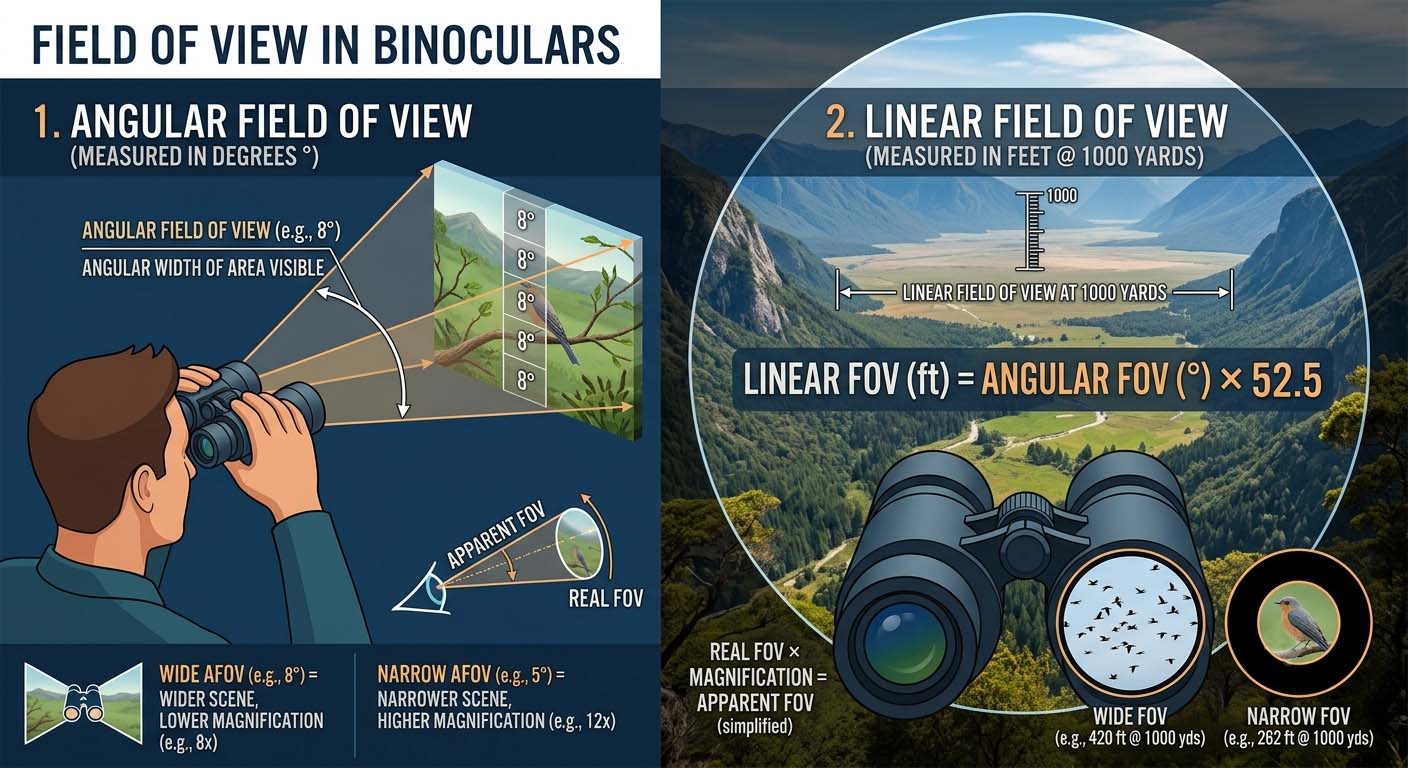
When you pick up a pair of binoculars and look through them, the first thing you notice is how much of the scene you can see without moving your head. That’s the field of view. It’s the width of the area visible to you at a given distance. A wider field means you see more landscape, trees, or sky. A narrower field feels like looking through a tunnel.
Field of view is one of the most important specs you can check, but it’s also one of the most misunderstood. Most online guides explain the math but never answer the real question: what does this number mean for how you actually use binoculars? This article bridges that gap.
What Field of View Means in Binoculars?
There are two ways to measure field of view. Knowing both will help you read a spec sheet with confidence.
Real Field of View (Angular Field)
Real field of view is the angle of the scene your binoculars capture, measured from the center of the objective lens. It’s expressed in degrees. A real field of 7.0° means you’re seeing a 7-degree-wide slice of the world. Larger numbers mean a wider view. You’ll see this written as “real FOV” or “angular FOV.”
Apparent Field of View
Apparent field of view is what your eye actually perceives when you look through the binoculars. It’s the magnified angle. This number is always larger than the real field because the binoculars are zooming in. Apparent FOV is what makes the view feel immersive or cramped. If the apparent field is above 60°, manufacturers often call it a “wide field” design.
Here is the practical relationship. An 8x binocular with a 7.0° real field gives you an apparent field of about 52°. That’s a standard, comfortable view. But an 8x binocular with a 9.0° real field pushes the apparent field close to 65°, and the view feels noticeably bigger and more open.
Field of View at 1,000 Yards or Meters
Some brands list field of view as a linear measurement: “367 feet at 1,000 yards” or “122 meters at 1,000 meters.” This is just another way of saying the same thing. The number tells you the width of the visible area from that distance. You can convert between angular degrees and linear feet with a simple formula, but for most people the degree number is easier to compare across models.
How Magnification and Eyepiece Design Determine Field of View
Two main things control how wide your view will be: magnification and the eyepiece design.
Magnification Narrows the True Field
Higher magnification always shrinks the real field of view. A 10x binocular will show a narrower slice of the world than an 8x binocular, assuming everything else is the same. This is physics. When you zoom in, you see less area but with more detail. That’s why a 10×50 often has a real field of 5.5° to 6.0°, while an 8×42 can reach 7.0° or higher.
The Eyepiece Field Stop
Inside the eyepiece, there is a physical ring called the field stop that limits how wide the view can go. A larger field stop lets more light and more of the scene into your eye. But the field stop has a maximum size based on the diameter of the eyepiece barrel. Manufacturers who want a wider field use a larger field stop, which requires bigger eyepiece lenses.
Prism Type Plays a Role
Porro prism binoculars often achieve wider fields than roof prism binoculars of the same size and magnification. The optical path in a porro design allows more room for a larger field stop. However, modern roof prism binoculars with complex eyepieces can match or exceed porro designs, but they cost more to build.
The Trade-Offs of a Wide Field of View
A wider field sounds like a pure upgrade, but it comes with real compromises. Here is what you give up when you chase a big number.
Shorter Eye Relief
Wide-field eyepieces often push the exit point closer to the lens. If you wear glasses, that means you cannot see the full field without pressing your glasses against the binoculars. Many birders who wear glasses prefer moderate fields with longer eye relief.
Larger and Heavier Optics
A wide apparent field requires bigger eyepiece lenses, bigger prisms, and a wider barrel. That adds weight and bulk. A 10×42 with a 60° apparent field feels compact. A 10×42 with a 72° apparent field is noticeably heavier and longer.
More Edge Distortion
Wide fields are harder to correct for sharpness at the edges. You may see blurring, curvature, or color fringing in the outer 20% of the view. Premium binoculars fix this with expensive aspherical lenses, but that adds cost. A moderate field often gives a sharper image edge to edge.
Lower Brightness in the Outer Field
Some wide-field designs lose light toward the edges, especially at low magnifications. The center stays bright, but the sides look dimmer. This is called vignetting. High-end models correct it, but it is common in cheaper wide-field binoculars.
Higher Cost
Complex eyepieces with multiple elements, large field stops, and advanced coatings are expensive. A binocular with a 72° apparent field will cost two to three times more than a similar model with a standard 55° field.
What Is a Good Field of View for Your Activity
“Good” depends entirely on what you are doing. Here is how to match the numbers to your use.
| Activity | Real Field of View (Target) | Apparent Field of View (Target) | Why |
|---|---|---|---|
| Birding in dense forests | 6.5° to 8.0° | 60° or higher | You need to track fast-moving birds through branches. Wide field helps you find and follow them. |
| Open-field birding or waterfowl | 6.0° to 7.5° | 55° to 65° | You scan long distances. A very wide field is less critical than for forest birding. |
| Astronomy | 4.5° to 6.5° | 65° to 80° | Apparent field matters most for immersive sky views. Real field is often narrow because magnification is high. |
| Hunting (deer, elk) | 5.0° to 6.5° | 50° to 60° | You look at specific spots for long periods. A moderate field reduces glare and improves focus. |
| Sports or concerts | 6.0° to 7.5° | 60° to 70° | You want a big view but need enough eye relief for glasses. Look for models with both wide apparent field and 18mm+ eye relief. |
| General hiking and sightseeing | 6.5° to 7.5° | 55° to 65° | A 7.0° real field is a versatile sweet spot. It works for landscapes and quick wildlife spotting. |
Common Myths About Binocular Field of View
Myth: Wider Is Always Better
Wider is better only if you need to scan a wide area. For long-range hunting or astronomy, a narrower field with better edge sharpness and glare control is often preferred. A 9° field is great for close-range forest birding but annoying for stargazing because the edges get blurry.
Myth: Bigger Objective Lens Means Wider Field
Objective lens diameter affects brightness and exit pupil, not field of view. A 10×50 can have a narrower field than an 8×25 because the higher magnification overrides the size of the glass. Field of view comes from the eyepiece and magnification, not the front lens.
Myth: All Binoculars with the Same Magnification Have the Same Field
This is false. Two 8×42 binoculars can have real fields ranging from 6.0° to 8.5° depending on the eyepiece design. A cheap 8×40 may claim a wide field, but the edges will be so blurry that the usable field is much smaller. Always check the actual spec, not just the magnification.
Myth: You Can Calculate Apparent Field by Multiplying Real Field and Magnification
That old formula gave inflated numbers for any field above about 60°. The modern ISO standard uses a tangent formula that gives accurate results. A 10x binocular with a 6° real field does not have a 60° apparent field, it is actually about 54°. The old method overstates wide fields.
Questions You Might Have
What is the field of view at 1000 yards?
You can convert degrees to feet at 1,000 yards using this formula: feet = 2 × 1,000 × tan(degrees ÷ 2) × 3. For example, a 7.0° real field equals about 367 feet at 1,000 yards. Most manufacturers list this number, so you rarely need to calculate it.
Can I trust manufacturer FOV specs?
Most reputable brands give honest numbers because they follow the ISO standard. Cheap or generic binoculars often inflate the field of view by using the old multiplication method. If a $50 binocular claims a 75° apparent field, be skeptical. The view will likely be dim, blurry, and distorted at the edges.
How does field of view relate to exit pupil?
Exit pupil is the diameter of the beam of light leaving the eyepiece. It affects brightness, not field width. You can have a large exit pupil and a narrow field simultaneously. They are independent specs. A 10×50 has a 5mm exit pupil but often a narrow real field of 5.5°.
Why do some cheap binoculars claim very wide FOV?
Cheap binoculars use simple eyepieces that produce a wide field but with heavy distortion, poor sharpness, and short eye relief. The view may look wide in the center, but the edges are unusable. You get what you pay for. A premium 8×42 with an 8° field will be sharp across most of the view.
Does lens coating affect field of view directly?
No. Coatings reduce glare and improve light transmission, but they do not change the angle of view. A fully multi-coated binocular will look brighter and more contrasty than an uncoated one, but the field width stays the same if the eyepiece is identical.