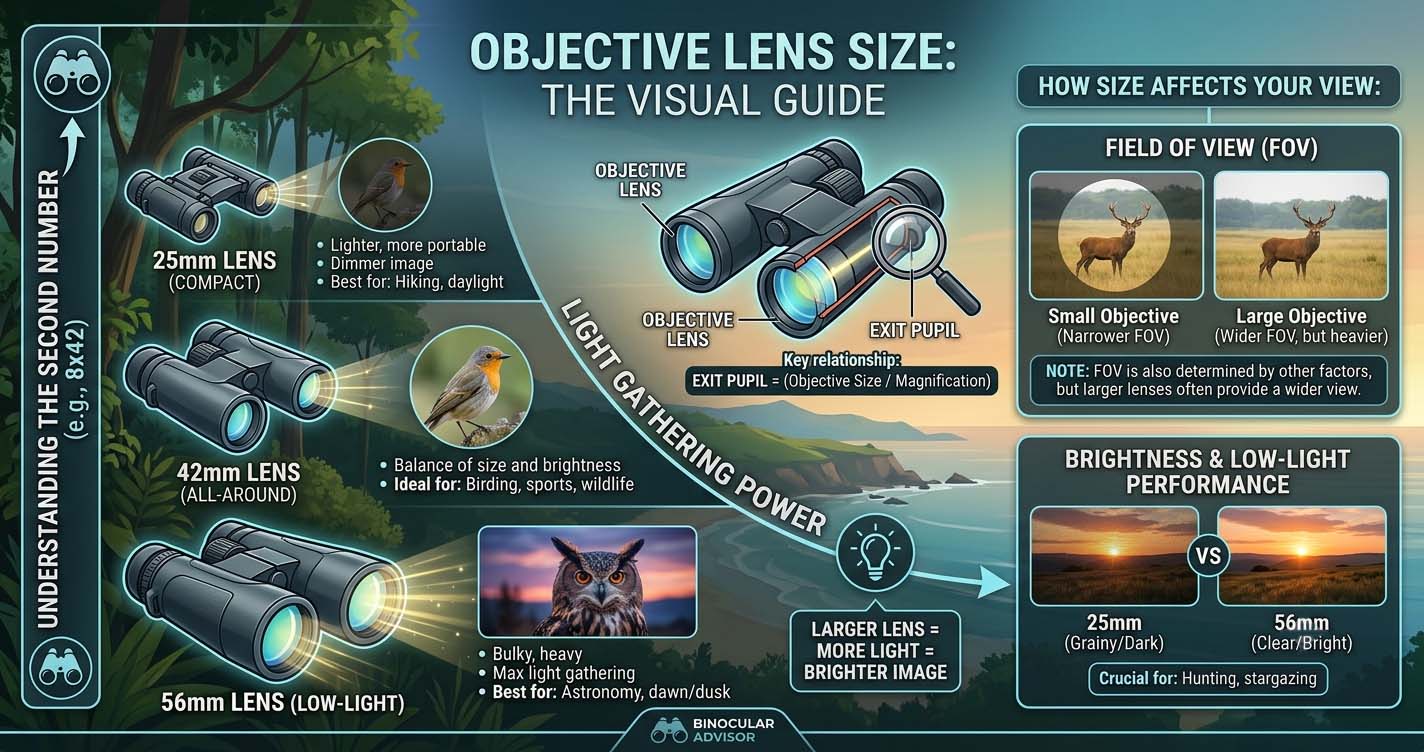
Objective lens size is the diameter of the front lenses in millimeters. It controls light gathering, brightness, and weight. Learn how to choose the right size for your needs.
If you’ve ever looked at binocular specs and seen something like 8×42 or 10×50, the second number is the objective lens size. It tells you the diameter of the front lenses in millimeters. A 42mm objective means each front lens is 42 millimeters wide.
That number determines how much light enters the binocular, which directly affects how bright the image looks in low light. It also controls how big and heavy the binocular will be.
But here is what most articles leave out: objective lens size alone doesn’t tell you everything. You need to pair it with magnification to get the exit pupil – the actual beam of light that reaches your eye.
And you need to know how much weight you are willing to carry. This article walks you through the real trade-offs so you can pick the right size for what you actually do.
What Objective Lens Size Actually Means
The objective lenses are the lenses at the far end of the binocular – the ones facing the object you are looking at. The size is always given in millimeters. In a 7×35 binocular, the objective size is 35mm. In a 10×42, it’s 42mm. Simple enough.
Think of it like a window. A 42mm window lets in more light than a 25mm window. That extra light means a brighter image, especially when the sun is low or you are looking into shade. It also means you can see more detail in dim conditions because the eye receives more photons to work with.
But a bigger window also means a heavier frame. Every 10mm increase in lens size adds roughly 100 to 150 grams of weight and an inch or two of length. A 50mm binocular is noticeably bulkier than a 32mm one. You have to decide whether you need that extra light badly enough to carry the extra weight all day.
Why Objective Lens Size Matters for Light and Brightness?
Light-gathering ability scales with the area of the lens, not the diameter. A 50mm lens has about 40% more surface area than a 42mm lens. That means it collects 40% more light. The math is simple: area = π × (radius squared). Doubling the diameter quadruples the area, but a jump from 42mm to 50mm is a modest but noticeable increase.
In practical terms, a 50mm binocular can show you details in twilight that a 32mm binocular simply cannot. But during bright daylight, your eye’s pupil is only about 2 to 3mm wide anyway.
The extra light from a large objective gets wasted because your eye physically cannot accept it. That is why you don’t need a big objective for daytime birding or landscape watching.
There is also a ceiling effect: once the exit pupil (more on that next) exceeds the size of your eye’s pupil, the extra light does nothing. For night use, the human pupil dilates to roughly 5 to 7mm depending on age. A binocular with an exit pupil larger than that just throws light away.
The Exit Pupil Connection: The Missing Link
Exit pupil is the diameter of the beam of light that leaves the eyepiece and enters your eye. You calculate it by dividing the objective lens size by the magnification. For example, an 8×42 binocular has an exit pupil of 42 ÷ 8 = 5.25mm. A 10×50 binocular has 50 ÷ 10 = 5.0mm.
This number is the real predictor of low-light performance, not the objective size alone. A 7×50 binocular gives a 7.1mm exit pupil – huge and great for astronomy. A 10×32 gives only 3.2mm – fine for daytime but dim at dusk.
Here is the practical takeaway:
- Exit pupil above 5mm: excellent for low light, dawn/dusk, and stargazing. Example: 7×50, 8×56.
- Exit pupil between 4mm and 5mm: good for general use, works well in overcast conditions. Example: 8×42, 10×50.
- Exit pupil between 3mm and 4mm: fine for daytime, acceptable in bright shade. Example: 8×32, 10×42.
- Exit pupil below 3mm: only for bright daylight. Example: 10×25, 12×30.
Notice something interesting: a 10×42 and an 8×32 have nearly identical exit pupils (4.2mm vs 4.0mm). But the 10×42 is heavier and more expensive. If you only use binoculars during the day, the 8×32 gives you the same brightness at half the weight. That is exactly the kind of trade-off that spec sheets do not tell you.
Comparison Table: Specs and What They Mean for You
| Specification | Objective Size | Magnification | Exit Pupil | Weight Class | Best For |
|---|---|---|---|---|---|
| 8×32 | 32mm | 8x | 4.0mm | Light | Daytime hiking, travel |
| 10×42 | 42mm | 10x | 4.2mm | Medium | All‑purpose with extra reach |
| 8×42 | 42mm | 8x | 5.25mm | Medium | Low‑light birding, wider view |
| 10×50 | 50mm | 10x | 5.0mm | Heavy | Low‑light with reach |
| 7×50 | 50mm | 7x | 7.1mm | Heavy | Astronomy, marine |
Choosing the Right Objective Lens Size for Your Use
There is no single best size. The right choice depends on where and when you use the binoculars. Here is a practical guide based on activity:
Daylight Hiking and Travel (25–32mm)
Keep it light. A 25mm or 32mm objective gives you enough brightness for sunny days without weighing your neck down. Compact binoculars fit in a jacket pocket. For backpackers and casual day hikers, this is the sweet spot. You’ll rarely need more.
General Purpose and Daytime Birding (42mm)
The 42mm size is the jack‑of‑all‑trades. It works well in most conditions and is not too heavy for a neck strap. Many birders choose 8×42 because the wide exit pupil (5.25mm) handles overcast skies and forest shade nicely. If you only own one binocular, 8×42 is the safest bet.
Low‑Light Birding and Dawn/Dusk Watching (50–56mm)
When you want to see birds just after sunrise or just before sunset, a 50mm objective makes a real difference. It gathers enough light to show feather detail that a 42mm cannot.
The downside is weight: a 50mm roof‑prism binocular often weighs over 800 grams. Porro prism versions are even heavier and bulkier. Only go this route if you know you’ll be using it in dim light regularly.
Astronomy (50mm and above)
For stargazing, you want the biggest objective you can hold steady. 7×50 is the classic astronomy binocular because the 7.1mm exit pupil matches a dilated eye. 10×50 adds magnification but narrows the exit pupil slightly. For serious star viewing, 56mm or even 70mm objectives are common, but you will need a tripod to hold them still.
Marine and Boating (50–70mm)
At sea, you need bright images in all conditions and stability even with boat motion. Large objectives like 50mm or 70mm are standard. The added weight is less of an issue because you are not hiking. Look for waterproof and fog‑proof bodies with rubber armor.
The Physical Reality of Larger Objective Lenses
Bigger lenses mean bigger prisms inside the binocular. That changes physical dimensions in ways that matter for everyday use:
- Porro vs roof prisms: A 50mm porro prism binocular is much wider and heavier than a 50mm roof prism because the lenses are offset. Roof prisms are more compact, but they need premium phase‑correction coatings to avoid losing light. Cheap large‑objective roof binoculars often perform worse than decent porros of the same size.
- Eye relief: Large objectives sometimes force the eyepiece to sit further from the prism housing. This can reduce eye relief – the distance you can hold the binocular from your eyes. If you wear glasses, look for an eye relief of at least 15mm, regardless of objective size.
- Lens hood: The metal or plastic ring around the objective adds 10–15mm to the external width. A 42mm objective binocular may have a housing that is 52mm across. Do not confuse the housing measurement with the actual lens size.
Also note that a larger objective requires higher quality glass to avoid chromatic aberration (color fringing) and distortion. Cheap 50mm binoculars often suffer from soft edges and purple fringing because the manufacturer skimped on the lens design. A premium 32mm binocular with ED glass can easily outperform a budget 50mm.
Frequently Asked Questions
Does a larger objective lens always mean better image quality?
No. Image quality depends on lens coatings, prism quality, and glass type. A 42mm binocular with premium ED glass and fully multi‑coated lenses will outperform a 50mm budget binocular with cheap coatings, especially in daylight. Bigger is not automatically better.
Can I use a 50mm binocular for birding during the day?
Yes, but you will be carrying extra weight for no benefit. In bright daylight your eye only needs a small exit pupil. A 32mm or 42mm binocular is more practical and comfortable for all‑day birding. Go to 50mm only if you consistently bird in low‑light conditions.
What is the minimum objective lens size for stargazing?
For handheld stargazing, 50mm is the minimum recommended. A 7×50 or 10×50 gives enough light gathering to see stars and star clusters. For serious deep‑sky astronomy, 56mm or 70mm is better, but you will need a tripod to manage the weight and prevent shaky views.
Is objective lens size measured with or without the protective housing?
It is measured as the actual diameter of the glass lens element, not the outer housing. The housing always adds 5–10mm to the external diameter. The spec number (42mm, 50mm, etc.) refers to the glass itself.
Why do some compact binoculars with 25mm objectives cost more than 42mm ones?
Price is driven by glass quality, coatings, and build precision, not just objective size. A compact 25mm with premium ED glass, fully multi‑coated lenses, and a waterproof magnesium body can easily cost more than a basic 42mm with standard glass and a plastic body. Never judge quality by lens diameter alone.