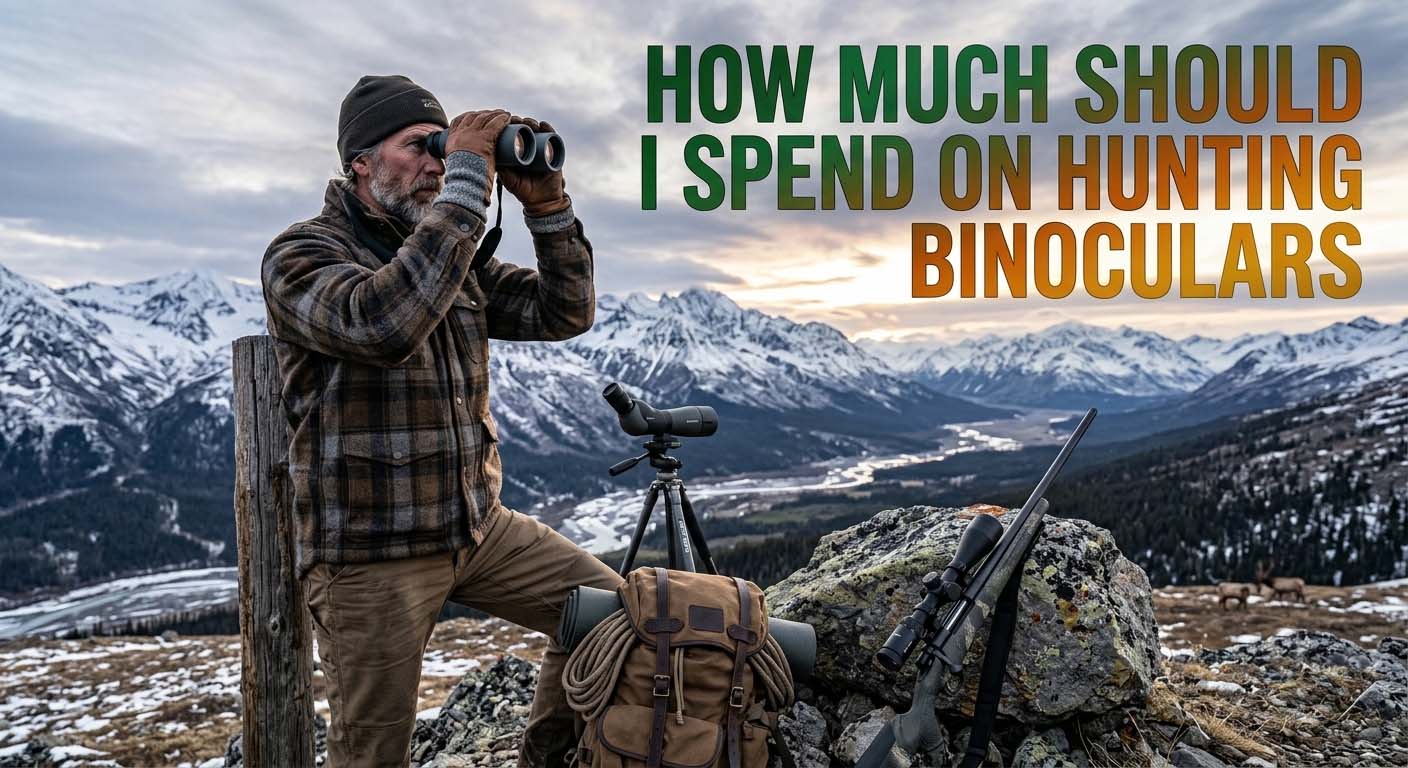
The amount you should spend on hunting binoculars ranges from $200 to $3,000+, with the sweet spot for most serious hunters falling between $600 and $1,200, but your exact number depends on three factors: how often you hunt, what you hunt, and how much you value comfort and clarity.
Here’s a quick way to match your budget to your situation:
- Occasional whitetail stand hunter (few days per year, under 100 yards) → $200–$400 is enough.
- Weekend spot-and-stalk hunter (elk, mule deer, 10+ days per year) → $600–$1,000.
- Hardcore backcountry hunter (2+ weeks, glassing for hours, trophy evaluation) → $1,200–$2,500.
- Competitive or obsessive glasser (Alaska, sheep, international) → $2,500+.
What your money actually buys at each price tier
When you spend more on binoculars, you’re paying for better optics, not just a brand name. Here’s what improves as the price goes up:
- Lens coatings – cheaper glass uses single-coated or uncoated lenses. At $300, you get multi-coated. At $800 you get fully multi-coated with dielectric prism coatings. At $1,500 you get proprietary coatings that cut glare and boost light transmission.
- Phase correction – this fixes color fringing in roof prism binoculars. Cheap roof prisms lack it. Most $400+ bins have it.
- Chassis material – budget bins use polycarbonate or cheap aluminum. Mid-range uses magnesium alloy (lighter, stronger). High-end uses titanium or carbon fiber.
- Eye relief – important for eyeglass wearers. Cheap bins often have short eye relief. $600+ models usually have enough.
- Field of view – wider glass costs more to manufacture. A $300 10×42 might have a 300-foot field of view at 1,000 yards; a $1,200 model can give you 340 feet.
- Waterproofing and fog proofing – cheap bins often fog up after a few seasons. Quality bins use argon or nitrogen purging and O-ring seals that last decades.
- Warranty – budget bins have one- or two-year warranties. Premium bins often come with lifetime transferable warranties.
Matching budget to your hunting style
The most common mistake I see is buying binoculars that are overkill for the actual hunting you do, or worse, underspending and suffering through a hunt. Here’s how to match your budget to your style.
Archery vs. rifle
If you hunt with a bow, you rarely need more than 8x magnification. You’re shooting inside 60 yards most of the time. An 8×42 in the $300–$500 range works perfectly. Rifle hunters benefit from 10x or even 12x to judge antlers at 300+ yards.
That extra magnification demands better glass, so plan on spending at least $600 for a decent 10×42.
Open country vs. timber
In thick woods or swamps, you rarely glass more than 100 yards. A $250 pair of 8x32s is fine. But out west in open country, you’ll be scanning ridges and basins for hours. That’s where good glass pays off. You need high resolution and excellent low-light performance, which starts around $800.
Frequency of use
Think about cost per hunt. If you spend $1,000 on binoculars and take them on 30 hunts over ten years, that’s $33 per hunt. If you spend $300 and only use them for five hunts before you want an upgrade, that’s $60 per hunt.
The cheap pair actually costs you more per use. I’ve seen this happen to plenty of guys who bought entry-level bins, hated them, and bought again within two years.
Physical demands
Weight matters more than most people admit. A cheap 10×50 can weigh 30 ounces. A premium 10×42 might weigh 25 ounces. That five ounces doesn’t sound like much, but after a 10-mile day with a pack, it adds up.
If you’re a backcountry hunter, spend extra to save weight. I run a 24-ounce 10×42 that cost me $1,100, and I’ve never regretted the weight savings.
The hidden cost of cheap glass
I started hunting with a $150 pair of binoculars. Within three years I had thrown them away and bought a $700 pair. Here’s why cheap glass can cost you more than premium glass in the long run.
- Eye strain and headaches – cheap binoculars often have misaligned prisms or poor coatings. Your eyes work harder to focus. After a full day of glassing, you’ll feel it. I’ve had migraines from bad bins.
- Missed opportunities – the last 15 minutes of legal light are when game moves. Cheap bins get dark and blurry fast. You’ll miss a buck that a $1,000 pair would have shown you clearly.
- Short lifespan – I’ve seen cheap bins fog up inside after a few rainy hunts. The internal seals fail. Shocks from drops knock the prisms out of alignment. You’ll be buying again sooner than you think.
- Zero resale value – try selling a used $200 binocular. You’ll be lucky to get $50. A premium pair like a Swarovski or Leica can sell for 60–70% of retail after five years. That effectively lowers your cost of ownership.
Where you can safely cut corners?
Not everyone needs alpha glass. Here’s where you can save money without regret.
- Buy last year’s model – glass technology changes slowly. A two-year-old flagship from a major brand is often 90% as good as the latest model, but costs half as much.
- Choose a reputable mid-range brand – brands like Vortex, Nikon, Athlon, and Maven offer excellent performance in the $400–$800 range. You don’t need Swarovski or Zeiss to kill a deer.
- Skip the tripod – if you hunt under 10x magnification, you can handhold all day. A tripod costs $100–$300. Spend that money on better glass instead.
- Pick magnification over objective lens size – a 10×42 is usually cheaper than a 10×50 and lighter. Unless you hunt mostly in deep twilight, the 42mm objective is plenty.
- Use a bino harness – a $30 harness prevents your binoculars from swinging and banging against your chest. It also stops them from dropping. That’s cheap insurance.
Budget trade-offs with other optics
If you have a total optics budget of $1,500, where should the money go? My rule of thumb: binoculars should be the most expensive optic you own. You use them 90% of the time. Your rifle scope is used for maybe 30 seconds per hunt. Your rangefinder is used a handful of times.
Here’s how I’d split a $1,500 budget:
- $900 on binoculars, $400 on a rifle scope, $200 on a rangefinder.
- Or $1,100 on binoculars, $300 on a scope, $100 on a simple rangefinder.
A $400 rifle scope will kill an elk at 300 yards just fine. A $400 binocular will leave you squinting in low light. Put your money where your eyes spend the most time.
What happens when you overspend?
I’ve also seen guys drop $2,500 on binoculars for a single annual whitetail hunt. That money could have bought a better ground blind, a warm sleeping bag, or a quality pack. If you hunt only a few days a year and don’t obsess over antler points, you don’t need alpha glass.
Overspending steals money from other gear that would improve your hunt more. Be honest with yourself about how much glassing you actually do.
The warranty factor
Premium binoculars often come with lifetime transferable warranties. That means if you buy a used pair, the warranty still applies. It also means you can pass them down to your kids. Cheap bins have one- or two-year warranties.
After that, a repair costs nearly as much as a new pair. Over a decade, the warranty difference alone can justify spending $800 instead of $300.
Used and refurbished
You can save 30–50% by buying used binoculars. Look on forums like Rokslide, or on auction sites. What to check:
- Scratches on lenses – minor ones don’t affect image quality much. Deep scratches do.
- Collimation – look through the bins at a distant object. If the images don’t merge into one clear circle, the prisms are misaligned. Avoid.
- Fogging – hold the bins up to a bright light. If you see dust or fog inside, skip them.
- Warranty transferability – ask the seller if the warranty transfers. Many premium brands say yes.
Questions People Ask
Should I spend more on binoculars than on my rifle scope?
Yes. Binoculars are used 10 times more often than a scope. A $400 scope is adequate for most hunting. A $400 binocular is entry-level. Spend more on the tool you use constantly.
Are $100 binoculars good enough for a beginner?
Only if you hunt under 100 yards in good light. For anything else, you’ll outgrow them quickly and end up buying twice. Better to start with a $300 pair.
Do I need a tripod for my binoculars?
Not if you use 10x or lower. For 12x and above, or for extended glassing sessions, a tripod reduces fatigue. But it’s an extra $100–$300.
How much should I spend on a bino harness?
$20–$60. A harness extends the life of your binoculars by preventing drops and keeping them secure. It’s one of the cheapest upgrades you can make.
Does higher price always mean better low-light performance?
No. Exit pupil and objective lens size matter more than price. A $400 10×50 can outperform an $800 10×32 in low light because the 10×50 has a larger exit pupil. But the $800 bin will have better clarity and color.
Can I save money by buying a monocular instead?
Only if you hunt alone. Monoculars are cheaper but lack depth perception and cause eye strain over time. For most hunters, binoculars are worth the extra cost.
The bottom line: spend enough to get clear, comfortable glass that matches your hunting style. Buy once, and don’t look back.