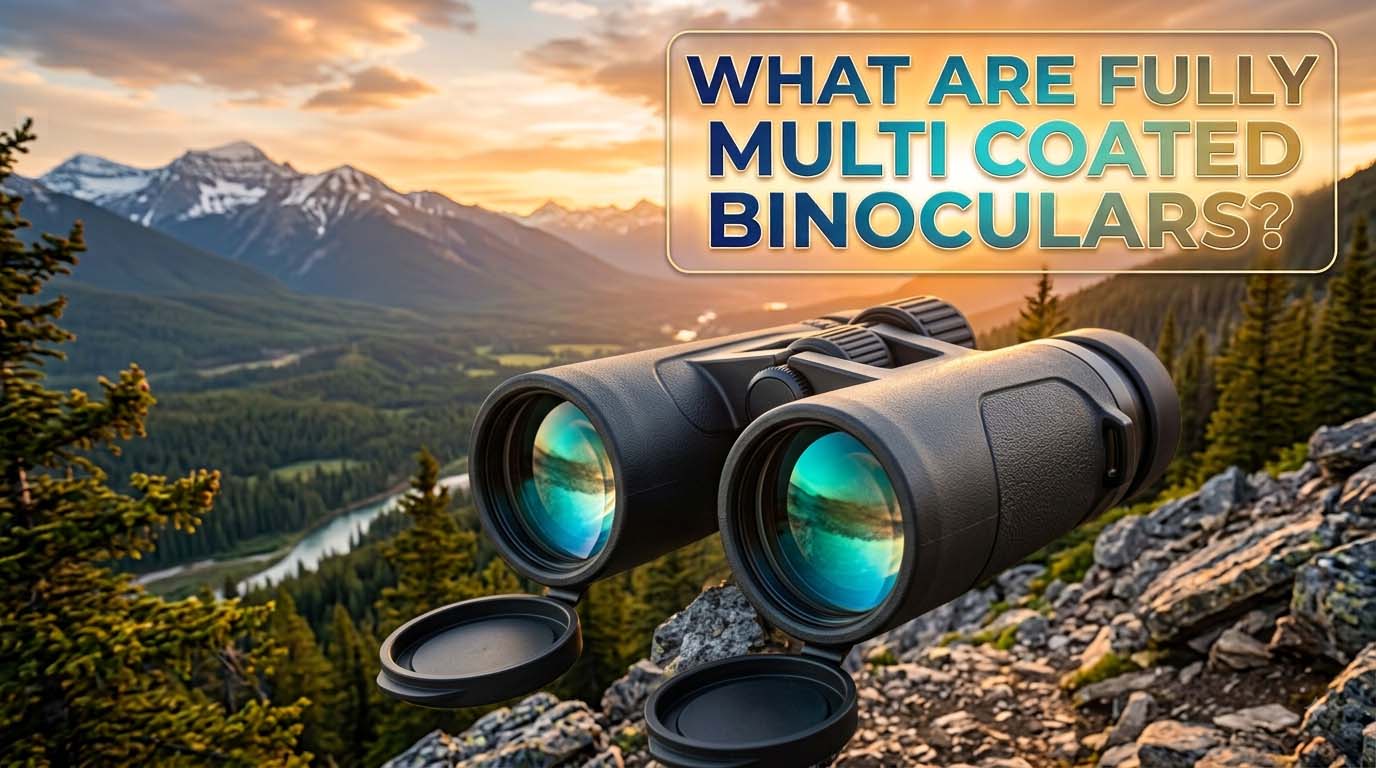
Fully multi coated binoculars have multiple layers of anti-reflective coating applied to every air-to-glass surface in the optical path, including all lenses and prisms. That means every place where light enters or exits a piece of glass inside the binoculars has been treated with several thin layers of material that reduce reflection.
The result is more light reaching your eyes and fewer internal bounces that wash out the image.
What Fully Multi Coated Means in Practice
To understand fully multi coated, you need to know what happens to light inside binoculars. Every time light hits a glass surface, some of it reflects off that surface instead of passing through. A single uncoated glass surface reflects about 4–5% of light.
With ten or more air-to-glass surfaces inside binoculars, those reflections add up quickly. You lose a significant amount of light, and the reflections that bounce around inside create haze and reduce contrast.
Coating a lens with a thin layer of magnesium fluoride or other compounds changes how light behaves.
The coating uses destructive interference to cancel out reflected light waves, letting more light through. A single coating cuts reflection to about 1.5% per surface. Multiple coatings can bring that down below 0.2% per surface.
Fully multi-coated means this treatment happens on every surface, not just some of them. It is the highest standard of anti-reflection coating available in standard binoculars. Some manufacturers abbreviate it as FMC in their specifications.
How Fully Multi Coated Optics Improve Your View
The benefits of fully multi-coated binoculars show up clearly when you look through them. Here is what you get:
More brightness. A fully multi-coated binocular transmits 90–95% of the light that enters the front lens. Compare that to a single-coated binocular that might pass 80–85%. That extra 10–15% makes a huge difference at dawn, dusk, or under a forest canopy. You see details that would otherwise disappear into shadow.
Better contrast. Reflections inside the optical path create a veil of stray light that washes out colors and reduces sharpness. By eliminating nearly all of those reflections, fully multi-coated optics produce blacks that look black and whites that look white. Colors appear more saturated and natural.
Less glare. When you point binoculars toward the sun or a bright light source, reflections scatter and create flare. Fully multi-coated optics suppress this significantly. The image stays usable in challenging lighting conditions.
Sharper image. Reduced internal reflections also mean less light scatter between adjacent details. The edges of objects look crisper, and fine details like feather patterns or distant text stand out more clearly.
Comparing Fully Multi Coated to Other Coatings
Binocular coatings are not all the same. Here is how the different levels compare:
Coated means at least one major lens has a single coating on at least one surface. This is the bare minimum you will find on modern binoculars. Some cost savings come here, but the performance is mediocre.
Fully Coated means every glass surface has a single layer of coating. Light transmission improves across the board, but each surface still loses around 1.5% of light. These binoculars work fine in bright daylight but struggle in low light.
Multi-Coated means at least one lens has multiple layers of coating. The other surfaces might still be single-coated or uncoated. This creates inconsistency in the image. Some surfaces reflect more than others, and the light transmission is not uniform across the optical path.
Fully Multi Coated means all surfaces have multiple layers. This is the gold standard. You get the highest transmission and best contrast.
Fully Broadband Multi Coated is a step beyond standard fully multi coated. It uses coatings optimized to work across the entire visible spectrum evenly, rather than favoring certain wavelengths. This prevents color casts and gives the most neutral color reproduction.
For most uses, fully multi-coated is the level to aim for. Fully broadband is ideal if you want the most accurate color you can get.
Common Misconceptions About Lens Coatings
The blue lens myth. Many people believe that if a binocular lens has a blue or green reflection, it must be high quality. The color of the reflection depends entirely on the specific coating formula and which wavelengths of light the coating is designed to cancel.
A blue reflection is not better than a green one. What matters is how dim the reflection is. A truly well-coated lens produces a very faint reflection regardless of color.
More layers always mean better. After a certain point, adding more layers gives diminishing returns. Most high-quality binoculars use between 6 and 10 layers per surface.
Beyond that, the gain in transmission is negligible. The quality of the coating process matters more than the raw number of layers.
Phase coatings are the same as anti-reflective coatings. They are not. Phase coatings are a separate treatment applied to roof prisms only. They correct a phenomenon where light waves get slightly out of phase as they pass through a roof prism, which would otherwise make the image look muddy. Phase coatings and anti-reflective coatings work together but solve different problems.
How to Identify Fully Multi Coated Binoculars?
You can check coatings without a spec sheet, but it takes a careful look.
Hold the binoculars so you can see the reflection on the objective lens size (the big lens at the front). Look at the color and brightness of the reflection.
A fully multi-coated lens should show a very dim reflection, often green, purple, or a mix of colors. A bright, prominent reflection indicates a single coating or no coating.
Shine a flashlight at the lens from an angle. The reflections should be faint and colored. If you see a bright white or blue-white reflection, the coatings are minimal.
Check the exit pupil, the small circle of light you see when holding the binoculars at arm’s length with the lenses pointed toward a light source. A fully multi-coated binocular will show a bright, sharp exit pupil with no haze around the edges.
Look at the specifications. Reputable brands clearly state the coating level. Watch for vague terms like “advanced optics” or “lens coatings” without specifics. If the manufacturer avoids saying “fully multi coated,” the coatings are probably not full.
Beware of false claims. Some budget binoculars market themselves as fully multi-coated when they actually use a multi-coated front lens and fully coated everything else. If the price seems too good, check independent reviews or optical bench tests.
Choosing the Right Coating for Your Needs
Your choice depends on how and when you use binoculars.
Casual daytime use. If you only use binoculars in full sunlight for activities like watching sports or sightseeing, fully coated binoculars might be enough. You will see a decent image, though contrast will be lower than premium options.
Birding and nature viewing. Birds are often active at dawn and dusk. They hide under leaves and in shadows. Fully multi-coated binoculars give you the extra brightness and contrast to pick out details in these conditions. This is the minimum level I would recommend for serious birders.
Astronomy. Night sky objects are extremely faint. Every photon counts. Fully multi-coated binoculars are essential. You will see more stars, more nebula detail, and better contrast against the dark sky. Combine this with a high-quality phase coating on roof prisms for the best result.
Hunting and tactical use. Low-light performance is critical. Fully multi-coated optics, preferably with waterproofing and rugged construction, are worth the investment.
Brands like Celestron, Nikon, and Vortex clearly label their coating levels and stand behind their products. A good pair of fully multi-coated binoculars can last decades if cared for properly.
Frequently Asked Questions
Can I add coatings to my existing binoculars?
No. Coatings are applied during the lens manufacturing process using vacuum deposition chambers. Adding them after the lenses are assembled is not possible. If you want better coatings, you need to buy binoculars that already have them.
Do fully multi-coated binoculars fog up more easily?
Not directly. Coating type does not affect fogging. Fogging depends on the internal sealing and whether the binoculars are nitrogen-purged for waterproofing. Some high-end coatings include hydrophobic layers that reduce fogging, but that is a separate feature.
What does FMC stand for on binocular specifications?
Fully Multi-Coated. It is the standard abbreviation used by manufacturers in product descriptions and marketing materials.
Are fully multi-coated binoculars worth the extra cost for casual use?
If you value sharpness, contrast, and using your binoculars in less than perfect light, yes. For very occasional use in bright daylight, a good multi-coated pair might serve you well for less money.
But the jump in image quality from coated to fully multi-coated is the biggest single upgrade you can make in binocular performance.