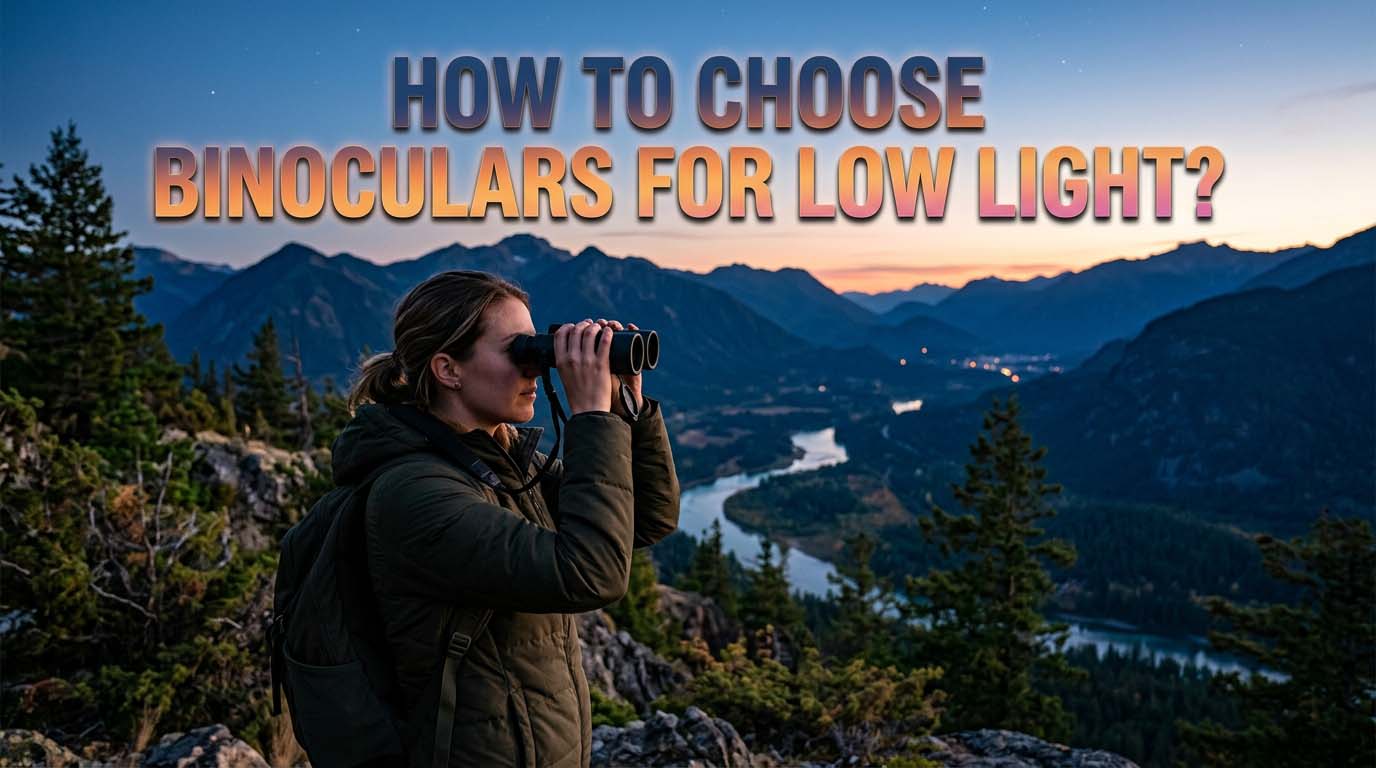
If you have ever tried to spot a deer at dusk or watch birds just after sunrise with a small pair of binoculars, you already know the frustration. The image goes dark, details blur, and you end up guessing instead of seeing.
Low-light observation is a completely different game from daytime use, and the binoculars that work great in bright sun often fail you when the light drops.
The most important thing to know upfront is the exit pupil. Take the diameter of the objective lens (the big lens at the front) and divide it by the magnification. If the result is 5 mm or larger, you have a usable low-light pair.
Seven millimeters is the ideal, matching a young person’s fully dilated pupil. This rule alone will filter out most wrong choices before you even look at price or brand.
But exit pupil is only the starting point. Your age, the kind of low light you actually face, the quality of the lens coatings, and the type of prism all matter more than most shoppers realize.
Let me walk through what I have learned from years of testing binoculars in real field conditions, so you do not waste money on specs that look good on paper but underperform when it counts.
Expert Opinion: Exit Pupil Matters Most for Low Light
According to Lizzie, an optics advisor featured in Jessops’ buying guide, an exit pupil of 5mm or above is ideal for low-light viewing, since it makes the image noticeably brighter and easier to see clearly. In daylight, this number matters far less, since most binoculars already offer 2mm+ exit pupils, which is enough for bright conditions.
Why Low Light Is Not a Single Condition
I made the mistake early on of thinking “low light” means one thing. It does not. The binoculars that work for scanning the horizon during an overcast afternoon are different from what you need for spotting animals in a dense forest at last light, which is again different from looking at the stars.
Broadly, there are three types of low light you need to consider:
- Twilight and dawn – This is the classic hunting and birding window. Light levels drop fast, but there is still enough to see colors and shapes. Here you need a balance of brightness and contrast. A 7 mm exit pupil helps, but good coatings matter just as much.
- Deep forest canopy or heavy overcast – The sun is up, but thick leaves or clouds cut light dramatically. In this situation, contrast becomes more important than raw brightness. A coated 8×42 can outperform a cheap 8×56 because you see detail against dark backgrounds, not just a washed-out bright image.
- Nighttime or moonlit observation – For astronomy or nocturnal wildlife, you want as much light as possible. Here, a 7 mm exit pupil is nearly mandatory, and you will likely appreciate the extra weight of a 56 mm objective because it gathers every photon available.
Think about where you will use the binoculars most. If you only hunt at legal shooting light, a 42 mm objective with premium coatings is plenty. If you watch owls after midnight, go for the big glass.
How Your Eyes Change the Selection Criteria?
Here is something most guides skip: your own eyes determine the maximum exit pupil you can actually use. A 20-year-old with healthy vision can dilate their pupils to about 7 mm in complete darkness. A 50-year-old typically reaches only 5 mm. By age 70, it drops to around 4 mm.
If you buy an 8×56 binocular with a 7 mm exit pupil but your eyes can only open to 5 mm, you are carrying extra weight and size for light that you cannot receive. The binocular’s image will look no brighter than an 8×42 with a 5.25 mm exit pupil, because your eye simply stops down the excess light.
To find your own maximum pupil size, stand in a completely dark room for ten minutes. Use a mirror and a ruler to measure the diameter of your pupil.
Or you can simply estimate: if you are over 40, treat 5 mm as your upper limit; over 60, use 4 mm. Match the exit pupil of the binoculars to your own pupil, not to the theoretical ideal of 7 mm.
This is why many experienced older hunters choose 7×42 or 8×42 binoculars. They get all the light their eyes can handle, and they save half a kilogram of weight around their neck.
The Core Specifications Explained
Objective Lens Diameter
The number written on the front of the binocular, like 42 or 50 or 56, tells you how much light the binocular can potentially collect. Bigger is better for brightness, but there is a steep price in weight and bulk.
A 56 mm objective gathers roughly 78% more light than a 42 mm objective, based on the area of the lens. But going from 56 mm to 63 mm only adds about 13% more light. The extra size and weight rarely pay off except for dedicated astronomy.
In practical terms: a 42 mm binocular weighs around 700-900 grams. A 56 mm binocular typically weighs 1000-1300 grams. That difference becomes very real after an hour of glassing.
Magnification
Low light and high magnification do not mix well. The reason is that higher magnification spreads the same amount of light over a larger image, making it dimmer. A 10×42 has a 4.2 mm exit pupil, which is borderline for twilight. A 7×42 has a 6 mm exit pupil and looks much brighter.
My own rule of thumb: 8x is the sweet spot for almost everyone. It gives enough reach to identify animals or birds at moderate distances, but the exit pupil stays generous. 7x is a great choice for older eyes or for maritime use where stability on a rocking boat matters. 9x and 10x are viable only if you plan to use a tripod or have very steady hands.
I have seen many hunters buy 10×56 binoculars thinking more power equals more ability, then struggle with shaky views and dimmer images than an 8×56 would provide.
Exit Pupil as a Predictor, Not a Promise
I already mentioned the formula. Here is how to interpret the numbers in real use:
| Exit Pupil | Performance in Low Light |
|---|---|
| Less than 4 mm | Poor. Only works in full daylight or bright overcast. |
| 4-5 mm | Fair. Okay for early morning golden hour, but disappointing in deep woods. |
| 5-6 mm | Good. Suitable for most twilight situations if coatings are decent. |
| 6-7 mm | Excellent. Bright image in all but the darkest conditions. |
| 7 mm or more | Theoretical maximum. Only useful if your pupils can dilate that wide. |
But here is the catch: exit pupil alone does not guarantee a good image. A cheap binocular with a 7 mm exit pupil but poor coatings and cheap glass can look dimmer and have worse contrast than a premium 6 mm exit pupil binocular. The next section explains why.
Why Lens Coatings Matter More Than Objective Size?
Every glass surface in a binocular reflects some light. Uncoated glass loses 4-5% of light at each air-to-glass surface.
A typical binocular has around 10 to 16 such surfaces. Without coatings, you could lose half the light before it reaches your eye.
Modern coatings reduce this loss dramatically. The progression in quality is:
- Single coated – One layer on some surfaces. Common in cheap binoculars. Light transmission around 70-75%.
- Multi-coated – Several layers on some surfaces. Transmission around 80-85%.
- Fully multi-coated – Several layers on every air-to-glass surface. This is the minimum I recommend for any low-light use. Transmission 85-92%.
- Dielectric coatings – Special high-reflection coatings on roof prism surfaces. These push transmission above 92% and sometimes over 95%.
I have tested this directly. A 42 mm binocular with top-tier dielectric coatings will show you more detail at dusk than a cheap 56 mm binocular with single coatings.
The 42 mm pair gives a clearer, more contrasty image because it rejects stray light and passes useful wavelengths efficiently. The 56 mm pair may be technically brighter in a lab test, but in the field the image looks hazy and washed out.
The trick manufacturers use is to publish a single “light transmission” number measured at the peak wavelength, often 550 nm (green-yellow), where human eyes are most sensitive.
That number can be 95% even if the average transmission across the visible spectrum is only 85%. Look for reviews that publish transmission graphs, not single numbers.
Porro vs. Roof Prisms in Low Light
Binoculars use prisms to flip the image right side up and to fold the light path so the binoculars are not as long as a telescope. The two main types affect low-light performance differently.
Porro prisms are the classic offset design with the objective lenses wider apart than the eyepieces. They transmit light very efficiently because they reflect light by total internal reflection, which loses almost nothing.
Porro binoculars are usually heavier and bulkier, but for low light they offer excellent brightness at lower cost. Most marine binoculars use Porro prisms.
Roof prisms have the objective and eyepiece in a straight line. They are more compact and easier to hold steady. But they require mirror coatings on the prism surfaces because the light does not fully reflect internally.
Lower-cost roof prisms (Schmidt-Pechan type) lose more light and need extra dielectric coatings to catch up. High-end roof prisms (Abbe-Koenig type) use a different design that reflects light internally just like Porro prisms, and they perform superbly.
Here is the practical advice:
- For under $800, a Porro prism binocular will typically outperform a roof prism binocular in low light. You get better transmission for the same money.
- Between $800 and $1500, good roof prisms with dielectric coatings can equal or slightly beat Porro designs.
- Above $1500, Abbe-Koenig roof prisms (found in Zeiss, Swarovski, and some models from Noblex) offer the best combination of compact size, light weight, and excellent transmission.
How to Prioritize When Your Budget Forces Compromise?
Unless you have unlimited money, you will have to make trade-offs. Here is the hierarchy I use, from most to least important:
- Coatings quality – Spend your money here first. A well-coated binocular with 90%+ transmission will outperform anything else.
- Exit pupil – Get at least 5 mm, but do not go over your own pupil dilation.
- Prism type – Porro for budget, good roof for mid-range, Abbe-Koenig for high end.
- Objective size – Only go big after you have satisfied the first three priorities.
- Magnification – Stick with 7x or 8x for low light.
Apply this to your specific situation:
- Younger user on a tight budget ($150-400): Get a 7×50 Porro with fully multi-coated optics. You get a 7.1 mm exit pupil and good transmission for the price.
- Mid-budget general use ($400-800): An 8×42 with fully multi-coated roof prisms. This is the best compromise for weight, size, and low-light ability.
- Serious hunter with higher budget ($800-1500): Move to an 8×56 with good dielectric coatings, or an 8×42 with exceptional coatings.
- High-end professional or enthusiast ($1500+): 8×56 with Abbe-Koenig prisms. This is as good as it gets.
- Older user or anyone weight-sensitive: Spend up on an 8×42 with premium dielectric coatings. The light weight saves your neck, and the exit pupil still matches your eyes.
Matching Binoculars to Your Primary Activity
Different uses call for different priorities beyond pure low-light brightness.
Hunting: If you hunt from a stand and can handle weight, 8×56 is king. For spot-and-stalk hunting where you walk miles, an 8×42 with top coatings is smarter.
Birding at dawn and dusk: Go for 8×42 or 10×42 with a wide field of view. Weight matters here because you will hold them up for long periods. Dielectric coatings are worth the extra cost.
Marine or nautical use: 7×50 Porro is the classic for a reason. It gives the widest possible exit pupil, a stable image on moving water, and Porro prisms withstand occasional drops better than roof designs. Make sure it is nitrogen-purged and waterproof.
Astronomy: 10×50 is a good entry point, but 15×70 or 20×80 tripod-mounted binoculars will show you far more stars and deep-sky objects. For astronomical low light, a bigger objective is almost always better, and tripod use eliminates hand shake.
General observation: 8×42 is the universal answer. It works for 90% of low-light situations with minimal compromise.
3 Myths About Low Light Binoculars That Waste Your Money
Myth 1: Bigger objective always means better low-light performance
This is only true if coatings and glass quality are equal. In the real world, a premium 42 mm binocular with dielectric coatings will beat a cheap 56 mm binocular every time. You get better contrast and clarity even though the raw light gathering is lower.
Myth 2: You need a 7 mm exit pupil regardless of age
Your eyes cannot use light they cannot receive. If your pupils only dilate to 5 mm, a 7 mm exit pupil gives you no extra brightness over a 5 mm exit pupil, but you carry a heavier, bulkier pair of binoculars. Match the exit pupil to your actual physiology.
Myth 3: Expensive binoculars are only for professionals
Premium coatings benefit everyone in low light. The difference between a $300 binocular and a $1500 binocular is most visible exactly when light is scarce. If you often observe at dawn or dusk, the upgrade is not just luxury; it directly improves what you can see.
How to Test Low Light Performance Before Buying?
You cannot judge low-light performance under fluorescent lights in a store. Here is what I do before buying any pair:
- Take them outside at the same time of day you plan to use them. If you hunt at dusk, test them at dusk. Do not trust a 2-minute look in a parking lot.
- Mount them on a tripod to remove hand shake. Then judge the true optical quality, not your own stability limits.
- Look at a dark object against a slightly darker background, like a tree branch against the night sky. Good low-light binoculars will show you the branch outline. Poor ones will lose it in the background.
- Check for chromatic aberration by looking at a bright edge (like a roofline against the sky) in low light. Purple or green fringing indicates lower quality glass.
- If you wear glasses, verify the eye relief is at least 15 mm to see the full field of view without black rings.
Frequently Asked Questions
Can I use daytime binoculars for low light if I am on a budget?
Yes, but with limits. A standard 8×42 with fully multi-coated optics will outperform an entry-level 8×56 with single-coated optics. Prioritize coating quality over objective size. You lose some brightness but gain better contrast.
Why do many hunters prefer 8×56 over 7×50?
Both give about a 7 mm exit pupil, but 8×56 offers slightly higher magnification for better detail at distance. The brightness difference is negligible to most eyes. Modern 8×56 binoculars also tend to have better ergonomics and field of view.
Do I need tripod-adaptable binoculars for low light?
If you observe for more than 30 minutes at a time, or use 10x or higher magnification, a tripod makes a big difference. Many 8×56 models include a tripod adapter socket under a cap on the central hinge. Check before buying if you plan to use one.
What is the difference between nitrogen and argon purging?
Both prevent internal fogging. Argon uses larger molecules and tends to stay inside longer, which matters in extreme cold below -20°C. For most users, nitrogen is perfectly fine. This only becomes a priority for professional use in arctic conditions.
Can I use low light binoculars during the day?
Absolutely, and safely. They may appear slightly dimmer than daytime-specific binoculars because they optimize for contrast rather than peak brightness. Many hunters use an 8×56 as their only pair for all conditions, accepting the weight for the versatility.