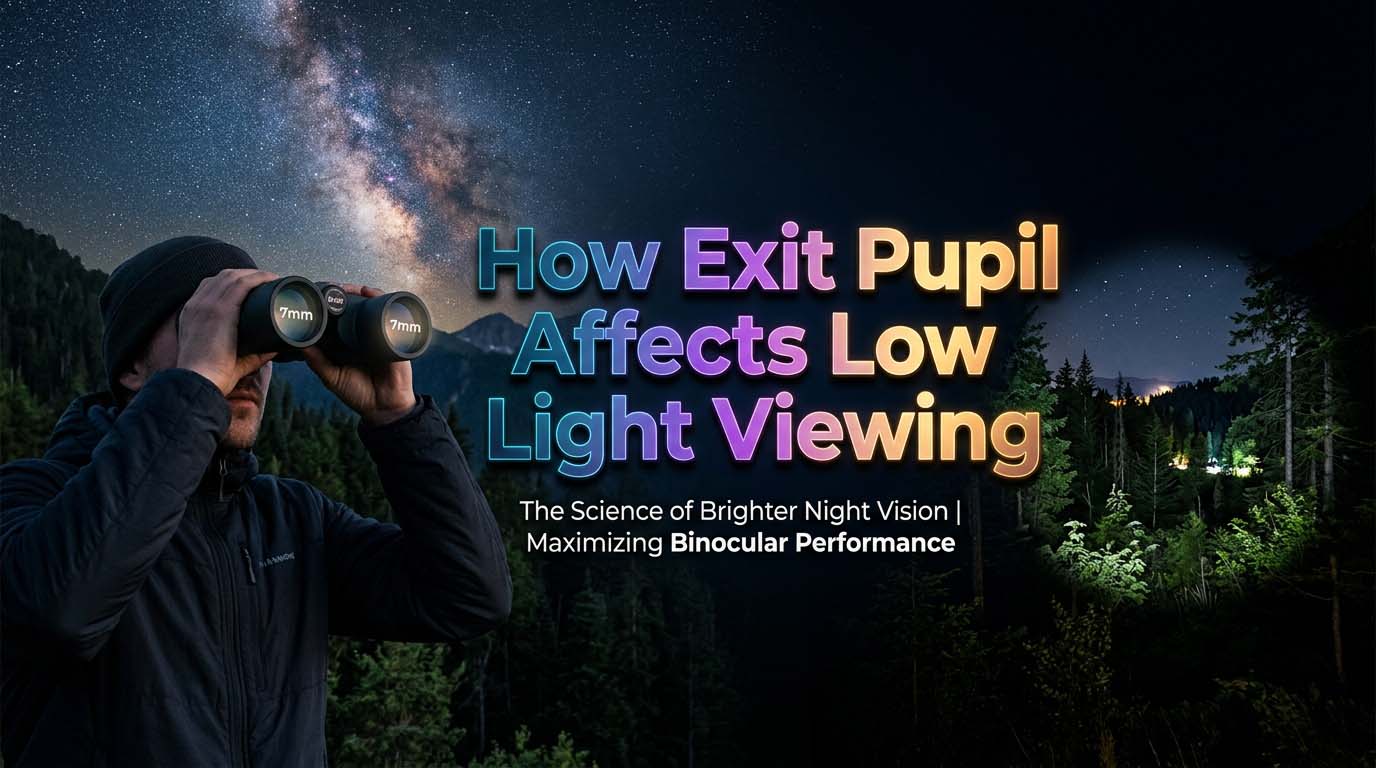
I have spent enough hours behind binoculars in fading light to know that the numbers on the barrel only tell part of the story. The exit pupil is the most misunderstood spec in optics, and it can make or break your view when the sun drops.
Here is what actually happens. The exit pupil is the beam of light that leaves the eyepiece and enters your eye. It is not just a math problem. It is the physical column of light that carries the image. If that column is smaller than your eye’s pupil, you lose brightness. If it is larger, your iris blocks the extra light. The key is matching them.
How Exit Pupil Controls Light Transmission to Your Retina
To get the exit pupil, divide the objective lens diameter by the magnification. A 10×42 binocular gives you 4.2mm. An 8×42 gives you 5.25mm. A 7×50 gives you 7.1mm. That number tells you the diameter of the light beam that hits your eye.
Think about your own pupil. In bright sunlight it shrinks to about 2mm. In a dark room it opens to 6 or 7mm if you are young. The exit pupil matters only when your eye’s pupil is open wide enough to accept the full beam. If the exit pupil is 7mm but your pupil is only 4mm, you are wasting light. Your iris cuts off the edges. The image brightness you actually see is limited by your own pupil size, not the binoculars.
This is why a 10×50 in broad daylight looks no brighter than a 10×30. Your eye is already stopping down the light. The real test comes at dawn and dusk.
The Dawn-and-Dusk Window Where Exit Pupil Matters Most
Your eye works in three lighting zones. In photopic light (bright day) your pupil is 2-3mm. Exit pupil is irrelevant. In scotopic light (full darkness) your pupil opens to maximum but there is almost no light to gather. The sweet spot is the mesopic zone, that thirty minutes before sunrise and after sunset when most wildlife moves.
In that mesopic zone, your pupil dilates to about 4-5mm. This is where exit pupil pulls its weight. A 4.2mm exit pupil feeds your eye all the light it can handle. A 5.25mm exit pupil gives a little extra, but the difference shrinks as your pupil gets smaller with age.
What matters is the relative jump. Going from a 3.2mm exit pupil (10×32) to 4.2mm (10×42) gives about 40% more light on your retina. Going from 4.2mm to 5.25mm gives only about 25% more. There are diminishing returns. The biggest improvement comes when you move from a small exit pupil to a decent one.
Why Larger Exit Pupil Does Not Always Mean Better Low-Light Performance
I have used cheap 7x50s that looked dimmer than a good 10×42. The reason is that exit pupil is a theoretical number. It assumes perfect light transmission through the glass. In reality, every lens surface, every prism, every coating robs some light.
An uncoated lens loses 4-10% per surface. A 7×50 with four uncoated surfaces and a basic BK-7 prism might transmit only 70% of the light that enters. A premium 10×42 with multi-coated lenses and BaK-4 prisms can transmit 95%. The smaller exit pupil on the 10×42 actually delivers more usable light to your eye because less is wasted inside the binocular.
There is another metric called twilight factor: square root of magnification times objective diameter. That number predicts resolution in low light better than exit pupil does. For identifying a deer at 200 yards in dim conditions, twilight factor matters more than raw brightness. Exit pupil handles how bright the image looks. Twilight factor handles how sharp the details are. Neither one works alone.
So do not chase the biggest exit pupil without considering glass quality. A 4mm exit pupil with premium coatings will outperform a 5mm exit pupil from a budget line every time.
How Age Changes Your Ideal Exit Pupil
This is the part most articles skip. Your pupil does not stay the same across your life. At age 20, a healthy eye can dilate to 7-8mm. At 40, that drops to 5-6mm. At 60, you max out around 4-5mm. At 80, maybe 3-4mm.
That means a 7×50 with 7.1mm exit pupil is wasted on a 60-year-old. Their eye can only accept 4-5mm. The extra light beam is blocked by the iris. They get no brightness benefit over a 10×42 with 4.2mm exit pupil. In fact, they might see a darker image because the 7×50 is heavier to hold steady and the lower magnification reduces detail.
If you are over 50, stop assuming you need big objectives. A 10×42 or even a 12×42 with good glass will give you more usable performance than an 8×56. Put your money into coatings and prism quality, not raw objective size.
Exit Pupil Position Tolerance | Why Eye Relief Matters
The exit pupil is not just a size. It has a location in space behind the eyepiece. That distance provides actual eye relief. If your eye is not exactly at that spot, you lose effective exit pupil. The beam gets clipped.
This is why two binoculars with identical specs can feel very different in low light. One has generous eye relief and deep eye cups that hold your eye in place. The other has tight positioning that forces you to search for the sweet spot. If you wear glasses, you need longer eye relief, usually 15-20mm, or the exit pupil sits too close to the eyepiece for you to see the full beam.
Here is a quick test at home. Look through your binoculars at a distant object in dim light. Slowly pull them away from your eyes. If the image darkens quickly, the exit pupil position is tight and you may be losing brightness without realizing it. Good binoculars let you move your eye a few millimeters without noticeable darkening.
Exit Pupil in Variable Magnification and Spotting Scopes
Zoom optics change the exit pupil as you change magnification. A spotting scope with a 20-60×80 objective has a fixed 80mm front lens. At 20x, the exit pupil is 4mm. At 60x, it falls to 1.33mm. That is too small for any low-light viewing.
I have watched hunters cranking their spotting scope to 60x at dusk and wondering why the image looks like a murky mess. The exit pupil dropped below 2mm, and no amount of glass quality can fix that. The rule of thumb is that an exit pupil below 2.5mm becomes unusable in twilight. 3mm is barely acceptable.
For low-light spotting, stay at the lowest magnification that gives you the view you need. If you know you will be glassing at last light, consider buying a fixed eyepiece around 30x for a 80mm scope. That gives you 2.67mm exit pupil, which is workable with good coatings. Zoom is convenient, but it destroys low-light performance at the high end.
The same logic applies to zoom binoculars. A 10-30×50 binocular at 10x gives 5mm exit pupil. At 30x, it drops to 1.67mm. Do not use the high end in dim conditions.
Calculating Your Personal Exit Pupil Needs
Here is how I help people decide. First, identify your primary viewing conditions. If you hunt or bird in open fields at dawn, you need magnification for reach and enough exit pupil for light. If you work the timber edge, an 8×42 is hard to beat.
Second, know your age bracket and estimate your maximum pupil. Under 35, you can use up to 6mm. 35-50, cap at 5.5mm. Over 50, 5mm is your limit. Do not buy a 7×50 expecting a benefit.
Third, decide your minimum acceptable performance. For most hunters, a 4mm exit pupil is the floor. For birders who do not push last light, 3.5mm can work with top-tier glass.
Here is a quick reference table for common configurations:
Configuration and Exit Pupil
8×32: 4.0mm. Good for daylight, marginal at dawn for young eyes, poor for older eyes.
8×42: 5.25mm. Excellent mesopic performance, best for woods and forest.
10×42: 4.2mm. Balanced for mixed conditions, good reach with adequate light.
10×50: 5.0mm. Strong low light, heavier, better for open country.
12×50: 4.17mm. Maximum reach, acceptable low light for younger users.
7×50: 7.1mm. Maximum theoretical low light, but only beneficial to young eyes in near-darkness.
For most people, the 10×42 is the sweet spot. It gives you enough magnification to see details and a 4.2mm exit pupil that matches the mesopic pupil of most adults. If you mostly hunt in dense woods at dawn, the 8×42 gives you a brighter, wider view. If you glass wide-open fields at last light, a 10×50 is worth the weight.
Remember, the numbers are only the starting point. A well-built binocular with high transmission glass will always outperform a poorly built one with a bigger exit pupil.
Frequently Asked Questions
What exit pupil size is too small for low-light hunting?
An exit pupil below 3mm will make details difficult to see in anything less than full daylight. Below 2.5mm, usable vision in twilight becomes nearly impossible no matter how good the glass is.
Does exit pupil affect image sharpness or just brightness?
It mainly controls brightness, but perceived sharpness drops when light is low because your eye receives less contrast. The image looks soft, even though the optics are still resolving the same detail.
Can I compensate for a small exit pupil with electronic amplification?
Digital night vision and image-stabilized binoculars can help, but they add battery dependency, lower resolution, and sometimes lag. For pure optical clarity, matching exit pupil is still the best approach.
Why do my binoculars seem dimmer in low light than the exit pupil suggests?
Check for dirty lenses, fogged internal surfaces, or poor coating quality. Also confirm your eye position relative to the exit pupil. Age-related pupil shrinkage might also be cutting off light.
How does exit pupil affect astronomical viewing differently than terrestrial?
Astronomy demands the largest possible exit pupil because your eyes are fully dark-adapted with pupils at 6-7mm. For stargazing, aim for 5-7mm exit pupil. For terrestrial low-light use, 4-5mm is plenty.