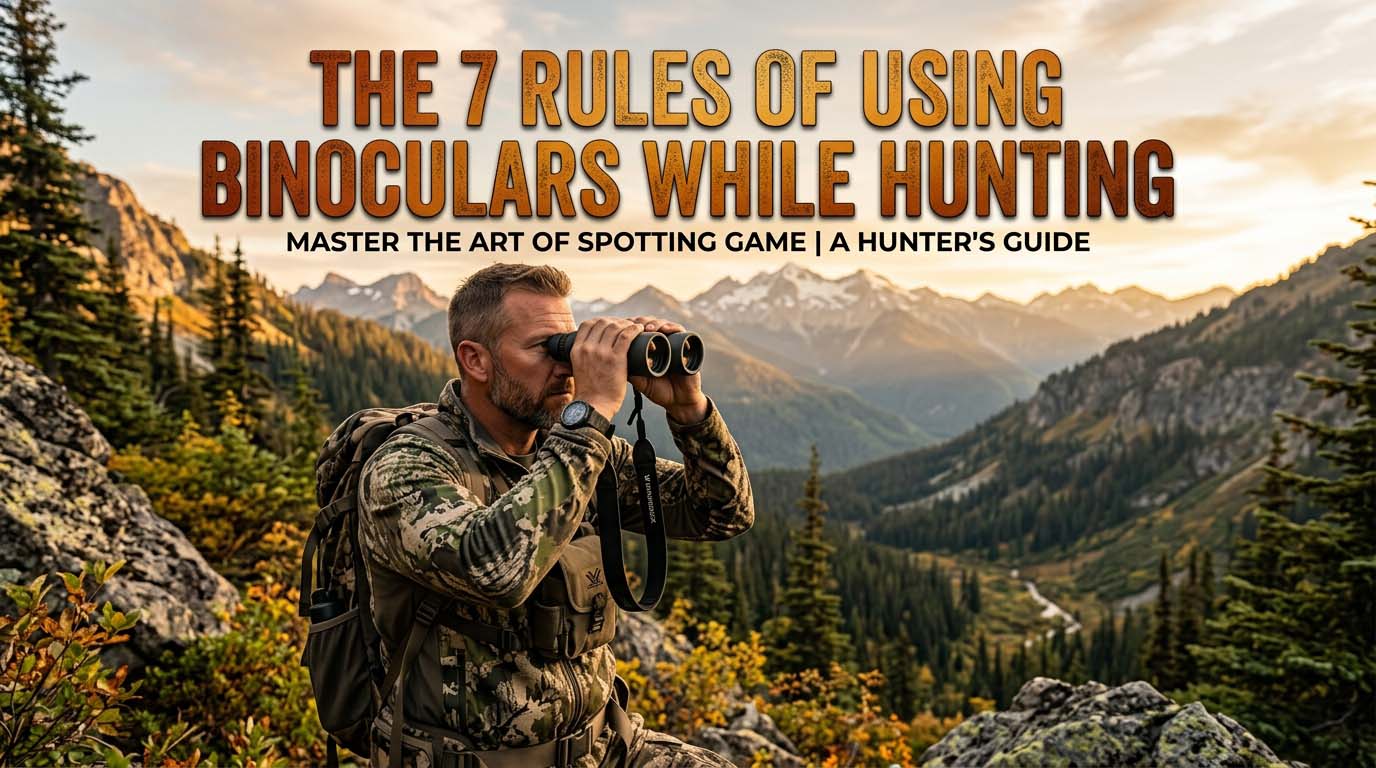
Using binoculars in the field is governed by a set of rules that cover legality, ethics, safety, and effectiveness; break them, and you risk a ticket, a ruined hunt, or worse. Here are the seven rules that every hunter should know before they glass.
Rule 1 – Know the Law Before You Glass
Laws about binoculars vary by state and even by wildlife management unit. Some places prohibit glassing during closed hunting hours, even with daylight. Others restrict the use of optics from vehicles.
And while binoculars aren’t spotlights, some regulations consider any optical aid that enhances vision after dark as illegal “spotlighting.” Always check your state’s fish and game code before you head out. Ignorance won’t keep you from a ticket.
Rule 2 – Always Maintain Situational Awareness
Binoculars narrow your actual field of view and block your peripheral vision. Never walk with them to your eyes, even on a flat trail. Always stop fully before glassing. Watch for other hunters in your area, use your binoculars to scan for blaze orange, not to stare at people. Also, avoid angling your lenses toward the sun; the glare can flash and spook game or alert other hunters to your position.
Rule 3 – Choose the Right Magnification for the Terrain
This is a rule, not a suggestion. For thick woods and tight cover, stick with 8x or 10x magnification. High magnification (12x or 15x) magnifies your shake and makes it nearly impossible to hold steady without a tripod.
In open country, 12x or 15x can help you pick apart distant ridges, but only if you have a solid support. The universal “do it all” magnification is 10x. It offers enough reach for most situations without becoming a shaky mess.
Rule 4 – Master the Focus and Diopter Setup
Every pair of binoculars has a diopter adjustment, usually a ring on the right eyepiece. The rule: set it for your dominant eye first. Close your right eye, focus the center wheel until the image is sharp with your left eye.
Then close your left eye, and use the diopter ring to sharpen the image for your right eye. Once set, you can rely on the center focus. Re-check this setup whenever light conditions change drastically, your eyes adjust, and the sharpness can drift.
Rule 5 – Never Glass Into Another Hunter’s Space
It’s rude, and it can start conflicts. Even if you’re just trying to see what’s over that next ridge, pointing binoculars at another person’s camp, vehicle, or stand feels like spying. Keep your glassing directed at the landscape, trees, rocks, terrain features, not at people. If you accidentally sweep over another hunter, lower the binoculars and look away. Respect their privacy and their hunt.
Rule 6 – Use a Tripod When Stillness Matters
If you’re planning to glass the same area for more than 30 seconds, use a tripod. Handheld binoculars introduce enough shake to miss small details, an antler tip, a flicking ear, a dark shape behind brush. A tripod turns your binoculars into a spotting scope.
Even in light wind, a tripod with a fluid head can dampen movement. For western hunters or anyone covering big country, this rule separates those who find deer from those who walk past them.
Rule 7 – Respect the Animal’s Home
Binoculars let you see game from a distance, but that doesn’t mean you should harass bedded animals. Once you spot a deer or elk, make a plan or move on. Don’t glass from the same spot for hours; game will notice that you are there and may abandon the area.
Rotate your glassing positions. If you find a group of does and a shooter buck is bedded, note the location and back out quietly. The goal is to hunt, not to stare them into hiding.
The One Rule That Transforms Your Glassing
After years of hunting, I learned that the most effective glassers don’t look for deer; they look for things that don’t belong. Call it Rule 8 if you want: Look for anomalies. An oddly shaped “log” with a straight edge, a “rock” that is too white, a “dark spot” that seems too faint, or a “branch” that is perfectly uniform.
Your eyes will tell you something is off. Trust that feeling. When you spot an anomaly, stop and study it. That’s where the deer are.
Common Mistakes That Break the Rules
- Using 12x binoculars in thick brush. Breaks Rule 3. You’ll have too much shake and too narrow a field of view to find deer close in.
- Forgetting to adjust the diopter. Breaks Rule 4. Your binoculars will never be sharp, and you’ll blame the glass instead of your setup.
- Glassing into the sun. Breaks Rule 2. You’ll get glare and eye strain, and you’ll miss shadows where game hides.
- Walking with binoculars to your eyes. Breaks Rule 2. A trip or a fall can ruin your hunt—or worse, your body.
- Staring at the same spot for too long. Breaks Rule 7. You alarm game and waste time that could be spent scanning fresh terrain.
Frequently Asked Questions
Are 12×50 binoculars good for deer hunting?
They work well for open country where you can use a tripod or solid rest. In dense woods, the high magnification and weight make them a poor choice. For most deer hunts, 10x is more versatile.
What is the binocular trick?
The binocular trick is the diopter setup combined with the “hat bill” stabilization. After setting your diopter, pinch the brim of your hat and use the tension to steady the binoculars against your face. It reduces shake without a tripod.
What is a good magnification for binoculars for deer hunting?
10x is the standard all-purpose magnification. It balances reach with stability. For thick cover, 8x is often better. For wide-open plains, 12x or 15x can help, but only with support.
Are 10×42 binoculars good for deer hunting?
Yes. 10×42 is one of the most popular configurations. It offers enough light gathering for low-light dawn and dusk, and 10x is strong without being too shaky. Perfect for most hunts.
Can I use binoculars to legally locate game on public land?
In most places, yes. But check your local regulations regarding hunting hours and artificial light. Never use binoculars after legal shooting light to locate game; it can be considered illegal spotting.