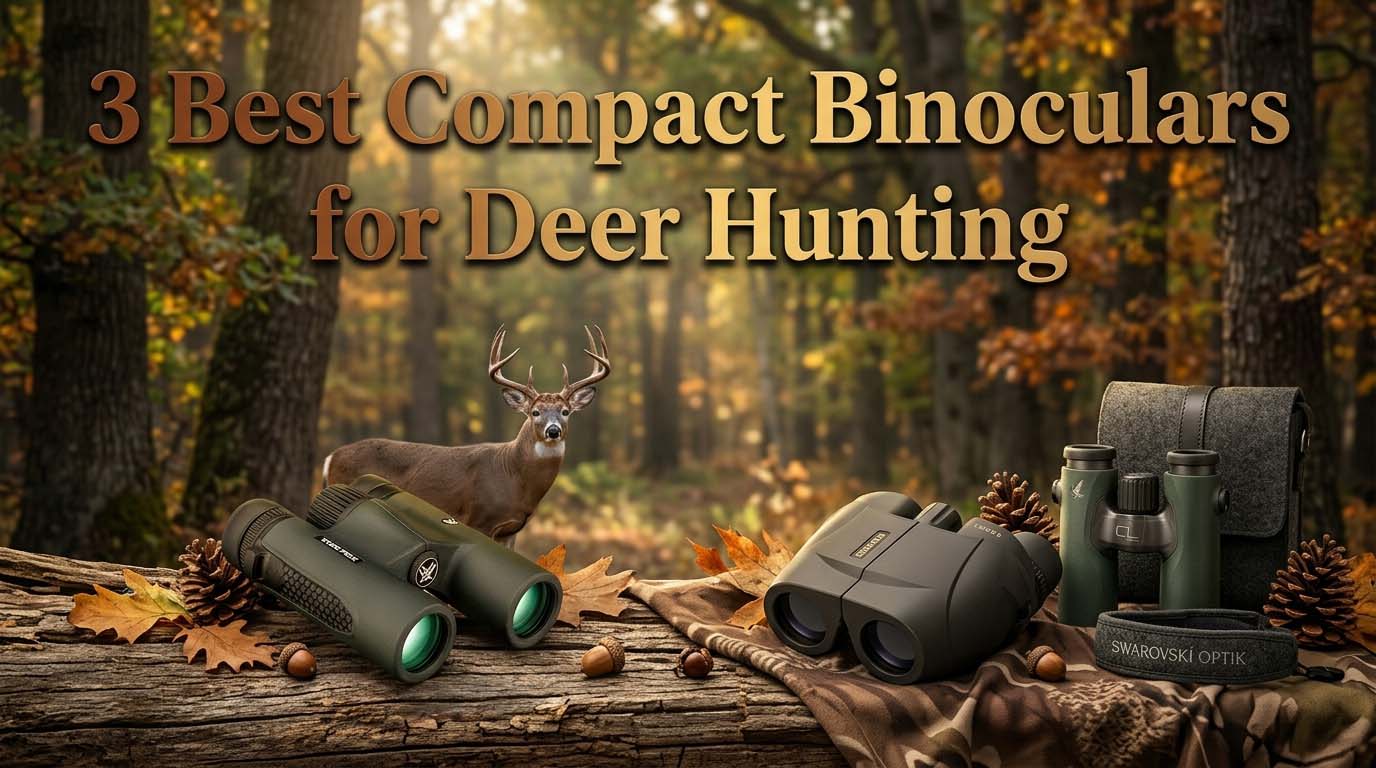
Every deer hunter wants quality binoculars they can forget are in their pack, until a buck slips through the shadows at last light. That’s the moment compact glass proves itself or gets left at home next season.
I’ve carried all three of these compacts through real whitetail country, and the truth is that compact binoculars are built on trade-offs. You give something up no matter what. The trick is giving up the right thing.
For most hunters, the Vortex Triumph HD 10×28 is the best all-around pick. It balances a 28mm objective, crisp HD glass, and a lifetime warranty at a price that won’t wreck your gear budget.
If you’re watching every dollar, the Leupold BX-1 Rogue 10×25 is the proven safe choice. And if you already own a full-size 42mm and want a premium compact companion, the Swarovski CL Companion 8×30 deserves a look, with real caveats. So, what are the best compact binoculars for deer hunting for you? Let’s break it down.
The Best Compact Binoculars for Deer Hunting, Ranked
Here’s the short version before I get into the weeds. I ranked these three from the pick I’d buy first to the one I’d only recommend in specific situations.


| Pick | Best For | Editorial Rating | Why |
|---|---|---|---|
| Vortex Triumph HD 10×28 | Best All-Around | 4.6/5 | Brightest compact for the money, lifetime warranty. |
| Leupold BX-1 Rogue 10×25 | Best Budget | 4.5/5 | Proven reliability and extreme packability. |
| Swarovski CL Companion 8×30 | Best Premium | 3.9/5 | Beautiful glass, but a niche fit for deer hunting. |
Why Go Compact for Deer Hunting?
Before you spend a dime, you need to understand why compact binoculars are a compromise. You’re not buying a smaller version of a great 42mm. You’re buying a different tool with a different strength, and knowing that difference is the key to choosing well.
The Exit Pupil Equation
Here’s the part most buyers skip: exit pupil. It’s the diameter of the beam of light that actually reaches your eye, and you figure it out by dividing the objective lens diameter by the magnification.
- Leupold 10×25: 2.5mm exit pupil.
- Vortex 10×28: 2.8mm exit pupil.
- Swarovski 8×30: 3.75mm exit pupil.
That number matters because deer hunting happens in low light. Legal shooting light is dim, and a 2.5mm beam of light is fine at noon but tough at dusk.
A 3.75mm beam is noticeably brighter in the same conditions, which is why I always put brightness ahead of magnification when choosing a compact.
Where Compact Excels and Falls Short
Compacts shine when you’re moving. Saddle hunting, bowhunting, still-hunting public land, anywhere you’re climbing, walking, or trying to keep weight down.
These three run somewhere between 9 and 18 ounces depending on the model, while a typical 42mm binocular is roughly double that. On a long hike into public land, that difference sits right on your neck.
But they fall short during long glassing sessions. If you spend hours scanning a field edge in fading light, a compact will leave you wanting more. That’s why many hunters, including me, carry a compact for the hike and a larger pair for the sit.
Why the Prism Type Matters
The Leupold uses an inverted Porro prism design. It’s a different form factor that folds into a very thin package, and it’s known for excellent center sharpness.
The Vortex and Swarovski use roof prisms, which gives them a slimmer, more traditional barrel shape and typically a more rugged build. Neither is wrong for hunting. But the Porro design is one reason the Leupold feels so small in a pack.
The Three Contenders, Reviewed in Detail
I judged all three on the same five points: low-light performance, sharpness, build quality, portability, and value. Here’s how they stack up.
Vortex Triumph HD 10×28 Review
Key Specs:
- Magnification: 10x
- Objective Lens: 28mm
- Prism Type: Roof
- HD optical system, fully multi-coated
- Waterproof and fogproof (nitrogen purged)
- Shockproof polycarbonate chassis with rubber armor
- Tripod adaptable
The Vortex Triumph HD 10×28 sits at the top of my list for one reason: it gives you the most brightness per ounce at a price that won’t hurt.
The 28mm objective produces a 2.8mm exit pupil. That doesn’t sound like a huge jump over the Leupold, but I noticed it almost immediately. At dusk, I could pick out a buck’s body lines a few minutes longer before the image got too gray to trust.
The glass is solid too. The HD optical system and fully multi-coated lenses deliver a clean, neutral image.
It’s not alpha-level sharpness, but for the price, the clarity surprised me. Colors look natural, and there’s no obvious edge distortion unless you really go looking for it.
Build quality punches above its weight. The polycarbonate chassis is wrapped in rubber armor, and it survived a couple of rough trips in my pack. Nitrogen purging means no fogging, and it’s waterproof if you get caught in a downpour.
But the real reason I rank this first is the Vortex VIP warranty. It’s unlimited, transferable, and doesn’t require a receipt. If I drop these off a saddle platform or the truck tailgate, I’m covered. For a compact that costs this little, that kind of protection is tough to beat.
The honest weakness: this newer model doesn’t have the decades of crowd verification that the Leupold carries.
It hasn’t been through ten seasons in a thousand packs yet. I can only tell you that after a full season of use, mine are still going strong.
Who it’s for: The deer hunter who wants a compact that handles low light well and wants total peace of mind. If you hike deep into public land with a lightweight pack, this is the one.
Who it’s NOT for: Anyone who needs alpha-glass sharpness for long-range field judging, or hunters who prefer a deeper 32mm objective. This is a compact, not a full-size replacement.
Leupold BX-1 Rogue 10×25 Review
Key Specs:
- Magnification: 10x
- Objective Lens: 25mm
- Prism Type: Inverted Porro
- Waterproof and fogproof
- Rubber armor coating
- Compact, lightweight design
The Leupold BX-1 Rogue 10×25 is the safe bet, and there’s a reason so many hunters trust it. Leupold has a long history of reliable optics, and this compact fits that reputation perfectly.
The inverted Porro design makes it incredibly thin. It’s the easiest of the three to slide into a jacket pocket or pack pocket, and you’ll honestly forget it’s there until you need it.
Optically, the center sharpness is impressive. I could count points on a buck at 200 yards without any struggle.
The image stays crisp across the center of the view, which is exactly what you want from a 10x compact. Leupold’s quality control is also top-notch, so the odds of getting a dud are low.
Build quality is solid. It’s waterproof, fogproof, and the armor coating gives a secure grip even with wet hands. The whole package feels durable enough for years of hard hunts.
Here’s the honest weakness: the 25mm objective is the dimmest of the three. With a 2.5mm exit pupil, the image starts to gray out earlier in the evening than the Vortex does. If you’re the kind of hunter who stays in the stand until the final minutes of legal light, this is a real trade-off you’ll feel.
Who it’s for: The budget-conscious hunter who wants a proven, reliable compact. It’s also a fantastic backup binocular for saddle hunters who want something small and trustworthy.
Who it’s NOT for: Hunters who regularly glass in deep dusk or who plan to use a compact as their only optic. The small objective simply can’t keep up at last light.
Swarovski CL Companion 8×30 Review
Key Specs:
- Magnification: 8x
- Objective Lens: 30mm
- Prism Type: Roof (BAK4)
- Proprietary coating system
- Compact design
The Swarovski CL Companion 8×30 is the one I wanted to love. The glass is stunning. Colors pop, edges stay sharp, and light transmission feels effortless.
The 30mm objective gives it a 3.75mm exit pupil, making it the brightest of the three in the woods at dusk. If you’re bowhunting in thick cover, that bright, wide view is genuinely nice.
The build quality is legendary. You can tell it’s premium the moment you pick it up. The focus wheel is smooth, the eyecups are comfortable, and everything feels precise and solid.
So why is it ranked third? For deer hunting specifically, there are real problems.
First, the 8x magnification. Most deer hunters, myself included, prefer 10x for glassing at distance. At 200 yards, 8x leaves you guessing on antler details that a 10x would show clearly. That makes this a niche tool, great for thick-cover bowhunting, less ideal for open field glassing.
Second, the value gap. This binocular costs fifteen times more than the Vortex. Is it fifteen times better? No. The image is better, sure, but not by that margin. For the price of this one, you could buy the Vortex and a quality 42mm primary binocular.
Third, expectations are enormous at this price. When a product costs this much, it needs to feel perfect in every hunting scenario. The CL Companion didn’t blow me away the way a premium optic should. It’s a great compact, but it’s not a magical one.
Who it’s for: The hunter who already owns a premium 10×42 and wants a compact companion for close-range hunting. If you’re a turkey hunter or a walk-and-stalk bowhunter, this might be your perfect fit.
Who it’s NOT for: Most deer hunters. If you’re choosing between this and a full-size 42mm for your primary hunting optic, buy the 42mm every time.
How to Choose the Right Compact Binocular for Deer Hunting
If you’re still torn, use this simple scorecard. I gave each binocular a rating for the hunter-specific factors that matter most.
| Factor | Leupold 10×25 | Vortex 10×28 | Swarovski 8×30 |
|---|---|---|---|
| Low Light Power | ★★ | ★★★ | ★★★★ |
| Long Range Detail | ★★★ | ★★★ | ★★ |
| Packability | ★★★★ | ★★★ | ★★★ |
| Price Value | ★★★★ | ★★★★★ | ★ |
| Crowd Confidence | ★★★★★ | ★★★ | ★★ |
A few other things worth considering. If you wear glasses, check the eye relief before you buy; all three have twist-out eyecups, but your mileage will vary. Warranty matters too: the Vortex VIP warranty is the easiest to live with, and Leupold’s is solid but requires following their process.
And think honestly about 8x versus 10x. For deer hunting, 10x is the default for a reason: antlers are small details at distance.
Honestly, the best compact binoculars for deer hunting are the ones that fit how you actually hunt. Every hunter’s neck, pack, and hunting style are different. Choose the trade-off that works for you.
Which Binocular Belongs in Your Pack?
Here’s my final call after using all three.
Best All-Around: The Vortex Triumph HD 10×28. It’s the best balance of brightness, price, and warranty. If I could only pick one compact for a deer hunt, this is it.
Best Value (Safe Bet): The Leupold BX-1 Rogue 10×25. It’s the proven workhorse. You’re giving up some low-light performance, but you’re getting a reliable tool that won’t let you down.
Best Premium (with Caveats): The Swarovski CL Companion 8×30. Only buy this if you know exactly why you want it. It’s a beautiful compact for close-range hunting, but for the money, most deer hunters will be happier with the other two.
Buy the trade-offs that fit your hunt. Your neck will thank you on the long hike in, and your eyes will thank you at last light when the right choice is in your hands.
Frequently Asked Questions
What is the best compact binocular for deer hunting?
For most deer hunters, the Vortex Triumph HD 10×28 is the best compact option. It offers the best combination of low-light capability, price value, and warranty protection, and its 28mm objective lens performs noticeably better at dusk than 25mm compacts.
Is 8x or 10x better for deer hunting binoculars?
For deer hunting, 10x is generally the better choice because antler details at distance matter. 8x is brighter and easier to hold steady, but it leaves you wanting more when glassing at 200 yards. If you primarily bowhunt in thick cover, 8x works fine.
What is a good exit pupil for low-light hunting binoculars?
A good exit pupil for low-light hunting is 3mm or larger. You calculate it by dividing the objective lens diameter by the magnification. For example, a 10×28 gives 2.8mm, while an 8×30 gives 3.75mm. Bigger always means brighter in the woods.
Are compact binoculars worth carrying for deer hunting?
Yes, if you’re hiking, saddle hunting, or bowhunting. They save significant weight and are easy to carry all day. The trade-off is reduced low-light performance compared to full-size binoculars, so think about when and how you glass before buying.
Should I buy a compact or full-size binocular for deer hunting?
If you spend long hours glassing field edges at dawn and dusk, a full-size 42mm is worth the weight. If you’re mobile and want something that disappears in your pack, a compact with a 28mm objective is a better compromise.