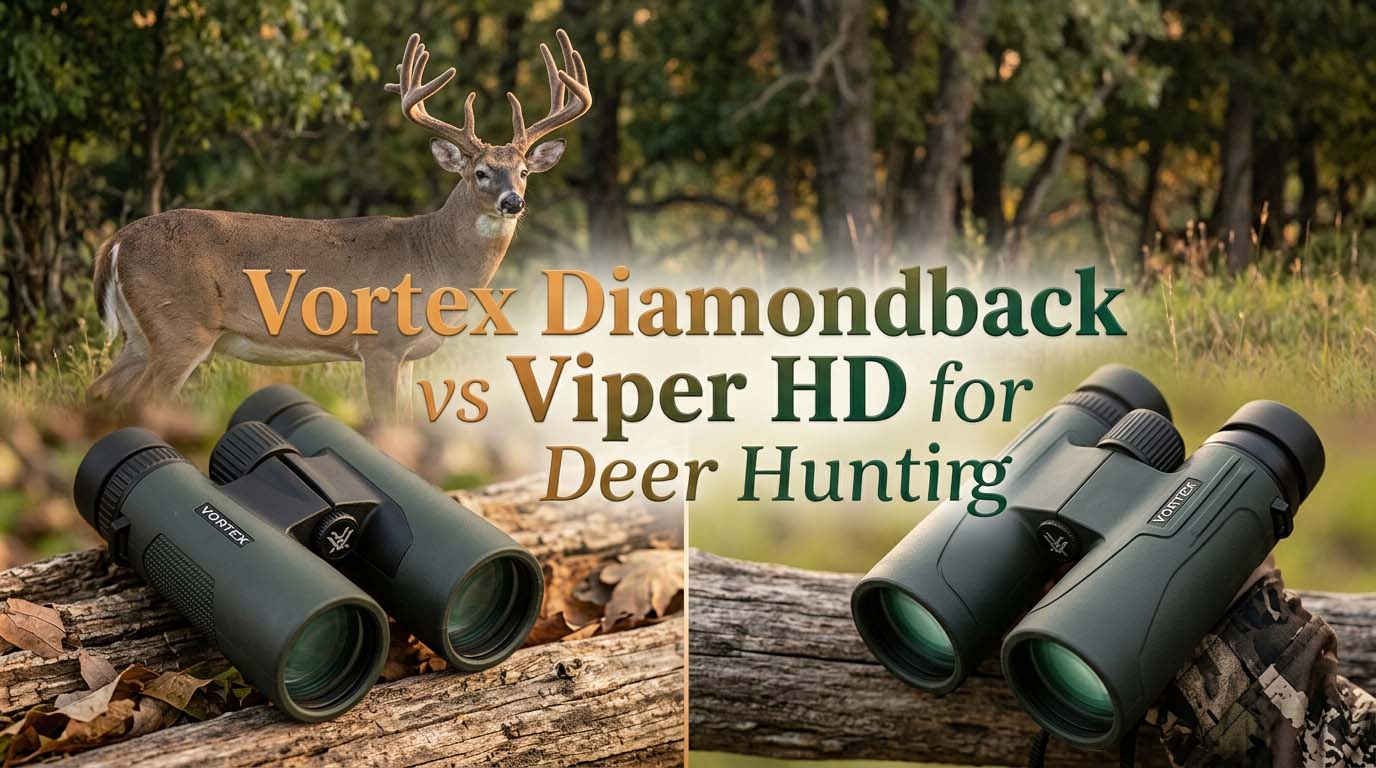
Let me save you the headache of flipping between spec sheets for the next three hours. You’re looking at these two Vortex binoculars because you already trust the brand. You know the VIP warranty is bulletproof. The real question isn’t which one looks better on paper. It’s which one you’ll actually want to carry on a cold November morning when the woods are dark and you’re trying to make out a set of antlers against the trees.
I’ve spent seasons with both the Vortex Viper HD and the Vortex Diamondback HD strapped to my chest. I’ve made the mistake of skimping on glass when I needed better, and I’ve also spent money on features I didn’t actually use in the field. This Vortex Diamondback vs Viper for deer hunting breakdown is built on real time behind the glass — not marketing bullet points.


Vortex Viper HD – The Premium Low-Light Machine
Magnification: 10x | Objective: 42mm | Prism: Roof | Coatings: Dielectric Multi-Layer | Purge: Argon
I remember the first evening I took the Viper HDs out. It was late October, and I was sitting a ridge line in western Kentucky. The sun had dipped below the treeline, and most guys were already packing up. I caught movement about 200 yards out in the timber. Through the Diamondbacks I’d been using, that buck was just a dark shape. I grabbed the Vipers and suddenly I could count tines.
That’s the Viper story in a nutshell. It lets you hunt the last 15 minutes of daylight that most binoculars leave on the table.
The Low Light Advantage
This is where the Viper justifies its price. The dielectric multi-prism coatings combined with the HD optical system push light transmission into a different tier than the Diamondback. The difference isn’t subtle. It’s the difference between shooting a buck and watching him walk away because you couldn’t tell which way his antlers were facing.
In broad daylight, you probably won’t notice much difference between the Viper and the Diamondback. Colors look similar. Detail looks similar. But the moment the sun starts slipping, the Viper pulls ahead and doesn’t look back.
Build Quality and the Locking Diopter
One feature I didn’t think I’d care about until I used it: the locking diopter. If you’ve ever reached for your binoculars only to find the focus ring out of whack because it got bumped in your pack, you know exactly why this matters. The Viper has a locking right-eye diopter that stays where you set it. It’s a small thing, but it keeps your image sharp every single time you glass up.
The ArmorTek coating on the rubber armored chassis means it holds up to scrapes and bumps without looking beat up after one season. And the argon purging is legit. I’ve had these things rain on, dropped in snow, and taken from warm truck to cold stand without a hint of fogging.
Honestly, the only knock against the Viper is the price. It’s a significant jump, and if you’re a midday hunter who sits over a food plot in good light, you’re paying for performance you won’t use.
Vortex Diamondback HD – The Logical Champion
Magnification: 10x | Objective: 42mm | Prism: Roof | Coatings: Dielectric & Phase Correcting | Purge: Argon
Let’s be real for a second. I’ve owned the Diamondback HD for years. They’ve been dropped off the seat of my UTV, left in a pack that got rained on overnight, and used hard. They still work perfectly. There’s something to be said for a tool that you don’t have to baby.
The Diamondback HD gives you about 90% of what the Viper delivers for significantly less money. I’m not going to give you an exact number here because prices change, but the gap is substantial enough that it lets you buy a better rangefinder or put gas in the truck for more scouting trips.
90% of the Performance for a Lot Less Money
That 90% number is real if you’re hunting in good light. The Diamondback HD uses dielectric coatings and phase correction on its roof prisms. That means you get crisp resolution and accurate color in most conditions. I’ve taken them on mule deer hunts out west and saturday morning sits back east. They handle the job.
Where they fall short is the last 15 minutes of daylight. The glass isn’t as bright as the Viper, and the image gets soft a little faster when the shadows get long. If your shots happen in the first and last hour of light, you’ll notice the difference. If your shots happen midday or in thick cover where distance is short, you probably won’t.
The Warranty Factor
Here’s the thing that makes the Diamondback such a no-brainer for a lot of hunters. It carries the same VIP warranty as the Viper. Unconditional, unlimited, transferable, no receipt needed. I’ve actually sent a pair in for an eyecup issue and had them back in two weeks. That kind of backing makes buying the cheaper binocular feel a lot less risky.
Vortex Diamondback vs Viper: Deer Hunting Scenarios
When you start looking at the Vortex Diamondback vs Viper for deer hunting, it helps to match the binocular to the hunt. Here’s how they stack up in the situations that actually matter.
Scenario 1: The Dusk Ambush
Winner: Viper HD. This is the Viper’s territory. If you hunt evenings hard and stay in the stand until the very last legal light, the extra light transmission is the difference between making a confident shot and second-guessing yourself. I’ve seen it happen. The Diamondback will leave you guessing in the dark timber. The Viper will show you the buck.
Scenario 2: The Long Glassing Session
Winner: Viper HD. Weight is similar between the two, but the Viper’s HD glass and better coatings reduce eye strain during prolonged glassing. I spent a week in Idaho glassing basins for mule deer. By day three with the Vipers, my eyes still felt fresh. With the Diamondbacks, I’d usually start getting headaches after a couple of hours.
Scenario 3: The Hard-Working Beater Binos
Winner: Diamondback HD. If you’re a mobile hunter who rides ATVs, hunts thick brush, or just knows you’re going to bang your gear around, the Diamondback is the smarter choice. It performs well enough, it’s backed by the same great warranty, and if something catastrophic happens, it hurts a lot less to replace.
The Verdict: Which One Fills Your Tag?
I’ve gone back and forth on these two more than any other pair of binoculars. They’re both good. But they serve different hunters.
Buy the Viper HD if…
You hunt the golden hours hard. You’re the guy who’s in the stand before dawn and the last one to leave. You judge bucks by counting tines at distance, and you want the confidence to know exactly what you’re looking at when the light is fading. You want the best glass Vortex makes without jumping all the way up to Razor pricing.
Buy the Diamondback HD if…
You’re on a budget but refuse to buy junk. You’re a mobile hunter who worries about dinging your gear. You hunt thick cover where shots are close and light is less of a factor. You want a binocular that will never let you fall into the “cheap binocular trap” but doesn’t require the budget of a guided hunt.
The Diamondback HD is the smart financial decision. The Viper HD is the smart performance decision. Choose the one that matches the way you actually hunt, not the way you wish you hunted.
Frequently Asked Questions
Which Vortex binocular is better for low light deer hunting?
The Viper HD is noticeably better in low light. The combination of the HD optical system and dielectric multi-prism coatings lets in more light and maintains image clarity longer at dusk and dawn. The Diamondback HD is good, but the Viper is designed for the glassing conditions that matter most to serious deer hunters.
Is the Vortex Diamondback HD waterproof?
Yes. The Diamondback HD is O-ring sealed and argon purged, just like the Viper HD. Both are fully waterproof and fog proof. Rain, snow, or a drop in the creek won’t ruin your binoculars.
What is the biggest difference between the Diamondback HD and Viper HD?
The biggest difference is in the glass quality and coatings. The Viper uses premium HD glass and a more advanced dielectric coating system, which directly translates into better resolution, brightness, and color accuracy — especially in low light. The Diamondback HD delivers very solid performance for significantly less money, but it gives up that last bit of low light clarity and contrast.