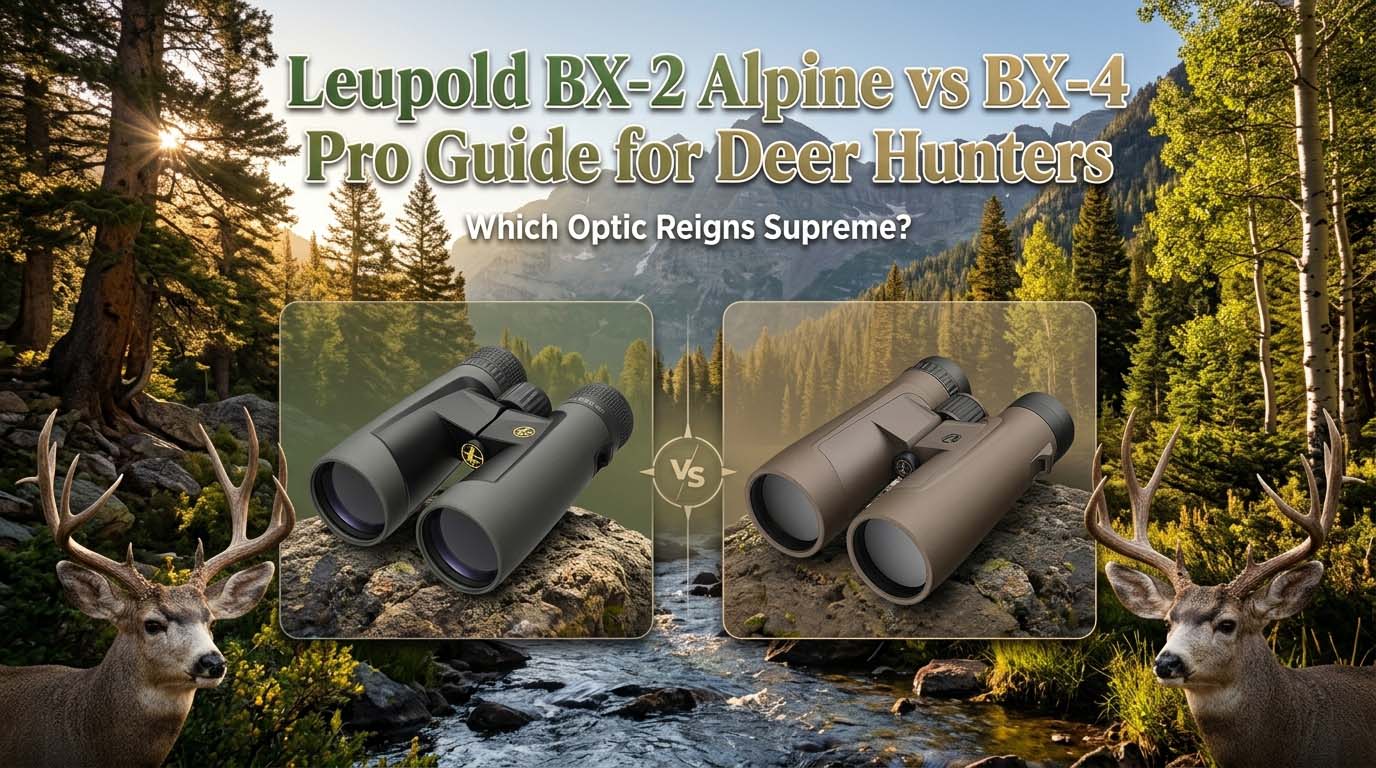
Comparing the Leupold BX-2 Alpine vs the BX-4 Pro Guide for deer hunting isn’t a simple specs-sheet exercise. Most articles treat these as direct competitors in the same category, but that misses the real story. The BX-2 Alpine people usually ask about is the 12x52mm configuration, not the standard 10×42. That one difference rearranges the entire conversation.
A 12×52 binocular is a specialized tool. It’s heavy. It magnifies every hand tremor. It pretty much demands a tripod if you want a steady image at full power.
The BX-4 Pro Guide in 10×42, on the other hand, is the configuration that experienced deer hunters reach for when they want one pair of binoculars that handles everything from first light to last light, from the truck to the backcountry.
Here’s the short version: the BX-4 Pro Guide is the better all-around deer hunting binocular. It wins in low light, weighs less, carries easier, and handles mixed terrain without compromise.
The BX-2 Alpine 12×52 is the specialist, it delivers serious reach for open-country hunters who glass from a tripod and want maximum magnification without spending flagship money. Both earn their keep, but they earn it in different places.
Winner for most deer hunters: BX-4 Pro Guide.
My Leupold Picks for Deer Hunting Ranked
Before I walk through each binocular in detail, here’s how they stack up for deer hunting specifically. This ranking weights low-light performance, versatility across terrain types, carry weight, and ease of use, not just magnification numbers or price tags.


Leupold BX-4 Pro Guide HD 10x42mm — The All-Day Standard
This is the pair I’d grab if I had to pick one binocular for a season of deer hunting across different terrain. The BX-4 Pro Guide sits at the edge of Leupold’s premium lineup without crossing into the four-figure territory of the BX-5 or Gold Ring series.
It’s a deliberate sweet spot: you get the optical coatings, the housing quality, and the low-light performance that serious hunters pay for, but you don’t pay for a nameplate that outshines your actual needs.
What makes the BX-4 stand out for deer hunting is the gap between how it looks on paper and how it feels in the field. The specs tell you it’s a 10×42 roof prism with phase-corrected prisms and what Leupold calls their Elite Optical System.
But the truth lives in the twilight minutes when a buck steps into a shadow line, and you need to see antler tines against dark timber.
The BX-4 resolves that shadow detail. The coatings manage glare better than anything in the BX-2 family, and the contrast stays punchy even when the sun is at a bad angle.
Low Light Performance
This is the BX-4’s strongest argument for the extra spend. Deer movement peaks at dawn and dusk, and those low-light windows punish lesser optics. The BX-4’s Guard-Ion lens coatings and upgraded prism glass let more of the available light reach your eye.
In practice, that means I could pick out antler tips maybe 10 to 12 minutes later in the evening compared to the BX-2 12×52 — and those minutes are often when a mature buck feels safe enough to move. For a deer hunter, that’s not a minor spec improvement. That’s the difference between seeing a deer and going home wondering.
Build and Carry
The open-bridge design makes single-hand focusing natural, which matters more than you’d think when you’re glassing with one hand and holding a shooting stick with the other. The magnesium chassis keeps the weight down without feeling flimsy.
Compared to the BX-2 12×52, the BX-4 is noticeably easier to pack for a full day of walking. It’s not a night-and-day weight difference on the scale, but it adds up over a ridge traverse or a long sit-and-glass session.
The armor texture is grippy without being tacky, and the eyecups lock into position with a positive stop that doesn’t slip over time.
Who This Binocular Is For
The BX-4 Pro Guide is for the deer hunter who hunts varied ground, fields one day, timber the next, mountains the week after. It’s for someone who wants one binocular that handles all of it without compromise.
It’s also for the hunter who recognizes that the last few minutes of legal light are the most likely time to see a buck, and who’s willing to spend more to see clearly in those minutes.
Who it’s not for: Someone hunting exclusively open prairie or high desert from a tripod, who needs every bit of magnification they can get and doesn’t mind hauling a heavier setup to get it. The BX-4 gives you 10x. If you want 12x, the BX-2 Alpine is the better play.
Leupold BX-2 Alpine HD 12x52mm — The Long-Range Specialist
The BX-2 Alpine in 12×52 is a different animal than the standard 10×42 version most people think of when they hear “BX-2.” It’s bigger, heavier, and optically optimized for one thing: putting more magnification on target at a price that doesn’t require a second mortgage.
If you hunt open country, mule deer basins, CRP fields, prairie whitetail setups, this binocular makes a lot of sense.
The 12×52 Value Proposition
At 12x magnification with a 52mm objective, the BX-2 Alpine gives you reach that punches above its price bracket. The calcium-fluoride HD glass is the same type of glass Leupold uses in their higher-tier optics.
It resolves well in good light, and the built-in 1/4-20 tripod adapter on the center hinge means you can mount it to a tripod without needing an aftermarket adapter. That’s a small convenience that makes a real difference when you’re setting up and tearing down glassing positions repeatedly throughout a day.
Where It Excels for Deer
This is a tripod binocular. I’ll say that plainly because too many reviews dance around it. Handheld at 12x, the image shakes noticeably, especially in any kind of wind or when your heart rate is up from walking. On a tripod, though, the BX-2 12×52 shines. You can count points at 400 yards.
You can pick apart a ridge line for bedded deer. The field of view is narrower than a 10×42 — that’s physics, but the trade-off is you see more detail at distance. For the open-country deer hunter who glasses from a tripod more than they walk, this binocular delivers real value.
The Trade-Offs You Need to Know
Let’s be honest about the downsides. The BX-2 12×52 is heavy. It’s not a binocular you want swinging from your neck for an eight-mile day.
The narrow field of view makes it harder to track moving deer, especially in brush or timber. And in low light, the BX-4 Pro Guide produces a noticeably cleaner, brighter image. The CaF₂ glass in the BX-2 is good, genuinely good, but the prism coatings and overall optical path in the BX-4 are a step up.
The difference shows in the edge sharpness and the way the BX-4 handles glare from snow or side-lighting.
There’s also the handheld factor. I tried using the BX-2 12×52 for a morning sit in a creek bottom where I needed to scan periodically without setting up a tripod. It was usable, barely, but I wouldn’t call it comfortable.
The shake at 12x makes it hard to pick out detail at a distance without a solid rest. If your style of deer hunting involves walking and glassing without a tripod, the BX-4 10×42 will serve you better every time.
Who This Binocular Is For
This is for the hunter who glasses from a tripod or a truck, who spends most of their time in open terrain, and who values magnification over low-light edge performance.
It’s a smart choice if your deer hunting happens in basins, alfalfa fields, or prairie country where shots and sightings happen at longer range.
Who it’s not for: The walk-and-glass hunter. The saddle hunter packing miles. Anyone who hunts thick timber or tight cover where quick target acquisition and a wide field of view matter more than magnification.
Leupold BX-3 Alpine HD 10x42mm — Budget Context Worth Knowing
The BX-3 Alpine 10×42 sits between the BX-2 and BX-4 in Leupold’s lineup, and it’s worth mentioning because it helps clarify what you’re getting (and not getting) when you step up to the BX-4.
The BX-3 uses Leupold’s Elite Optical System and a magnesium chassis, both upgrades over the BX-2’s polycarbonate body and standard prism coatings. For the price, it’s a solid mid-tier option.
But in the context of this comparison, the BX-3 highlights a key point: the BX-4 Pro Guide isn’t just a BX-3 with a different name. The BX-4 adds upgraded prism coatings, better glare management, and a refined optical path that makes a tangible difference in low light.
If you’re trying to decide between the BX-3 and BX-4, the low-light gap is real. I can see the improvement when glassing into shadowed edges at dawn. The BX-3 is good for the money. The BX-4 is good, period.
The BX-3 also doesn’t come in the 12×52 configuration; that’s exclusive to the BX-2 Alpine in this price tier. So if you need 12x, the BX-3 isn’t an option anyway. For a deer hunter on a strict budget who hunts in decent light and doesn’t push the low-light edges, the BX-3 is a capable choice.
But if you’re reading this comparison, you’re likely deciding between the BX-2 12×52 and the BX-4 — and both are better suited to serious deer hunting than the BX-3.
Leupold BX-2 Alpine vs BX-4 Pro Guide for Deer Comparison
This is where the rubber meets the road. The Leupold BX-2 Alpine vs BX-4 Pro Guide for deer hunting question comes down to three criteria that matter most: low-light performance, usable magnification, and how the price gap maps to real-world results. I’ve spent enough time behind both to give you a straight answer on each.
Low Light Performance
The BX-4 wins this category by a clear margin. The prism coatings and overall optical refinement produce a cleaner, more contrasty image in marginal light. I noticed it most in two specific situations: glassing into timber shadows from a field edge about 20 minutes after sunset, and picking out deer against dark hillsides in overcast conditions.
The BX-2 12×52 has more objective area to gather light; that’s physics working in its favor, but the BX-4’s superior light transmission and glare handling overcome that advantage in practice. The BX-2 image gets muddy faster as light fades. The BX-4 stays clear longer.
Magnification and Reach
Here the BX-2 12×52 takes the win, but with conditions. At 12x versus 10x, you see more detail at distance. That’s straightforward. The catch is that the BX-2’s 12x is only fully useful on a tripod.
Handheld, the shake negates most of the magnification advantage. If you’re set up on a tripod in open country, the BX-2 12×52 lets you identify bucks at ranges where the BX-4 10×42 requires more work. If you’re walking and glassing, the BX-4’s steadier 10x image actually gives you more usable detail because you’re not fighting wobble.
Value Per Dollar
The BX-2 Alpine 12×52 delivers impressive magnification for its price point. You’re getting CaF₂ HD glass and tripod-ready hardware at a price that undercuts the BX-4 significantly. For the open-country tripod hunter, that’s excellent value.
The BX-4 costs more, and the question is whether the improved low-light performance and lighter carry weight justify the gap. For most deer hunters who hunt varied terrain and prioritize low-light capability, yes, it does.
The BX-4 holds its value better over time, and the optical improvements are things you notice every time you hunt. But if your hunting style matches the BX-2’s strengths, the value equation tilts the other way.
Spec Comparison
| Spec | BX-2 Alpine HD 12×52 | BX-4 Pro Guide HD 10×42 | Advantage |
|---|---|---|---|
| Magnification | 12x | 10x | BX-2 reach |
| Objective Lens | 52mm | 42mm | BX-2 light gathering |
| Low Light Clarity | Good | Excellent | BX-4 performance |
| Handheld Stability | Poor without tripod | Good | BX-4 versatility |
| Field of View | Narrower | Wider | BX-4 tracking |
| Weight | Heavier | Lighter | BX-4 carry comfort |
| Chassis Material | Polycarbonate | Aluminum | BX-4 durability |
| Tripod Adapter | Built-in | Not built-in | BX-2 convenience |
| Glare Handling | Adequate | Superior | BX-4 low-light edge |
| Best Use Case | Open country, tripod | All terrain, all day | Depends on hunting style |
The Verdict | Which Leupold Should You Buy for Deer Hunting?
I’ve gone back and forth on this one more times than I’d like to admit, because both binoculars have a legitimate argument depending on how you hunt. But after enough time with each, the answer is consistent.
Buy the BX-4 Pro Guide HD 10x42mm if:
- You hunt varied terrain — fields, timber, ridges, or everything in between
- You hike miles and value every ounce you carry
- You hunt the low-light edges and need the best twilight performance you can afford
- You want one binocular that does deer hunting well everywhere
This is my pick for the majority of deer hunters. It’s not the cheapest option, but the performance gap in low light, those critical minutes at dawn and dusk, makes it worth the spend. The BX-4 earns its place by being the binocular you never wish was better when you’re in the field.
Buy the BX-2 Alpine HD 12x52mm if:
- You hunt open spaces — mule deer basins, cut fields, prairie, high desert
- You glass from a tripod or truck most of the time
- You want maximum magnification for the dollar and don’t mind hauling a heavier setup
- You’re willing to trade low-light edge performance for reach at long range
This is the specialist’s play. It’s not the right answer for everyone, but for the hunter who matches its strengths, it’s a smart buy that delivers more magnification than anything near its price.
The bottom line: The BX-4 Pro Guide is the better all-around deer hunting binocular. The BX-2 Alpine 12×52 is the smarter specialist choice for open-country hunters who need reach without paying flagship prices. Your terrain and your tolerance for weight will tell you which one you need.
Frequently Asked Questions
Is the BX-2 Alpine 12×52 usable without a tripod for deer hunting?
Barely, and it depends on how steady your hands are. At 12x magnification, every muscle tremor and heartbeat shows up in the view.
You can brace against a tree or sit with your elbows on your knees to get a usable image, but it’s not comfortable for extended glassing. If most of your hunting involves walking and spotting without a tripod, the BX-4 10×42 will give you a steadier, more useful image.
Does the BX-4 Pro Guide have a built-in tripod adapter like the BX-2 Alpine 12×52?
The BX-4 does not have a built-in 1/4-20 adapter in the center hinge as the BX-2 12×52 does. You can still mount it to a tripod using a standard binocular tripod adapter that clamps to the center bridge, but it’s not as convenient as the BX-2’s integrated solution. If tripod mounting is a priority, the BX-2 12×52 has a clear edge in this specific area.
Which binocular has better glass for deer hunting at dawn and dusk?
The BX-4 Pro Guide. Its Guard-Ion lens coatings and upgraded prism system produce noticeably better contrast and clarity in low light.
The BX-2 12×52 gathers more total light because of its larger objective lenses, but the BX-4 transmits and manages that light more efficiently. In practice, the BX-4 lets you see detail later in the evening and earlier in the morning than the BX-2.
Is the 12×52 too much magnification for whitetail hunting in timber?
Generally, yes. The narrow field of view and high magnification make it hard to acquire and track deer moving through brush or close cover. A 10×42 gives you a wider view and quicker target acquisition in timber. The 12×52 is better suited to open-country whitetail setups over food plots or fields, or for mule deer hunting in basins and ridge country.
How does the price difference between these two binoculars compare to the performance difference?
The BX-4 costs more, and the performance difference shows up most in low-light clarity and overall carry weight.
If you hunt mostly in good light and from a tripod, the BX-2 12×52 delivers strong value. If you hunt varied terrain and push the edges of legal shooting light regularly, the BX-4’s optical advantages justify the higher spend.
Can the BX-2 Alpine 12×52 serve as a spotting scope replacement for deer hunting?
Not fully, but it comes close for general glassing. The 12x magnification lets you see detail at a distance, counting points, evaluating body size, that you’d normally need a spotting scope for in some situations.
But a dedicated spotting scope at 20x to 60x still outperforms it for extreme-range detail and for sharing views with hunting partners. The BX-2 12×52 is a great gap-filler between a standard binocular and a spotting scope.