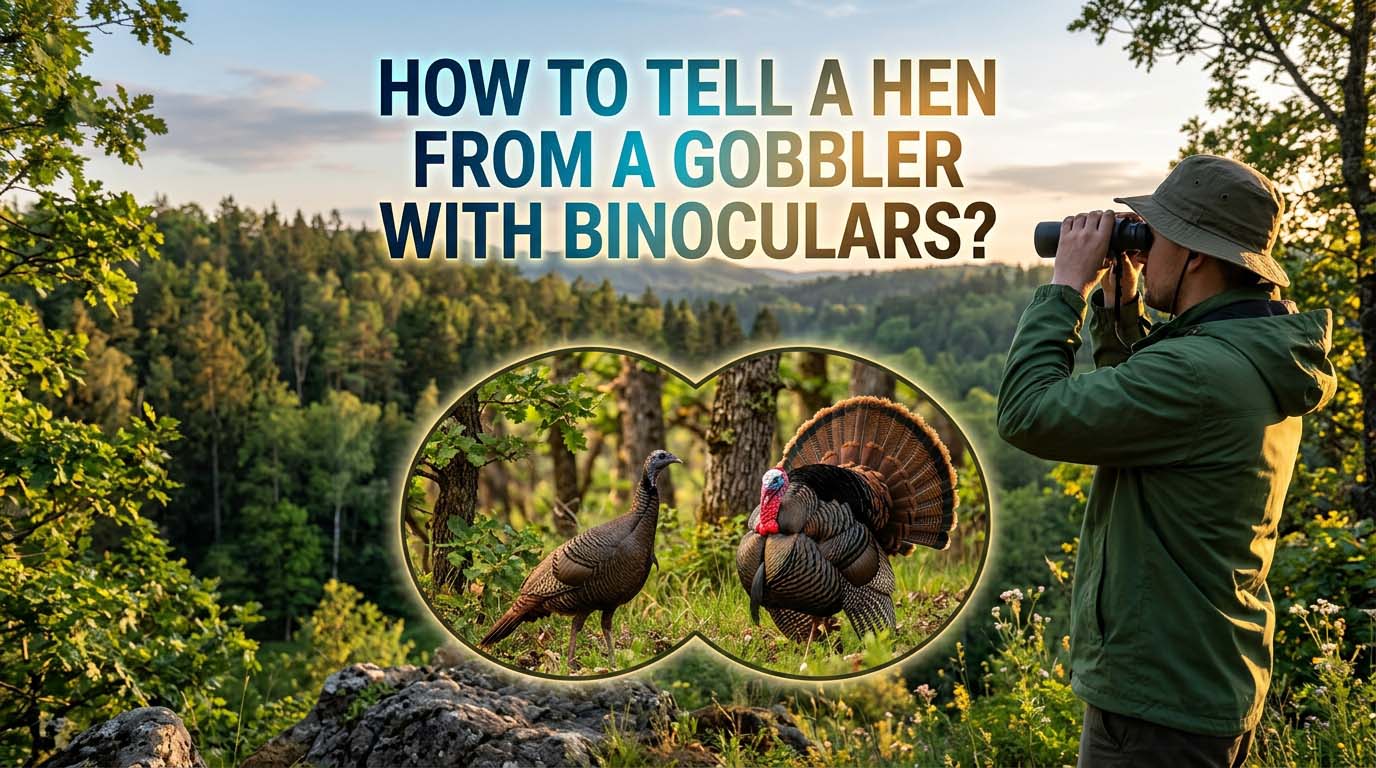
You are tucked against an oak tree, fog still lifting from the creek bottom. A turkey materializes at the edge of the field, 80 yards out, maybe 90: no strut, no gobble, just a brown shape moving through the shadows.
You lift your binoculars. One quick look tells you the bird is either a hen or a gobbler. But which one? The answer determines whether you stay put or start moving.
In the field, you don’t get a second chance to walk up and check the beard or spurs. You have to read the bird at a distance, through your binoculars, and make a call. Here is how to do it with confidence, based on real situations that wild turkeys present.
Why Binoculars Change the ID Game
Most turkey identification guides assume you have the bird in hand or on a full strut 20 yards away. Real life rarely works that way.
Through binoculars, you lose fine detail like spur length or beard thickness. But you gain something more useful: the ability to see posture, head color, and movement patterns without spooking the bird.
The trick is knowing which field marks are visible at 80 to 150 yards and which ones are unreliable at that range. Beard length, for instance, is useless when the bird faces away. Head color, however, works from almost any angle if you know what to look for.
The Three-Second ID Sequence
Here is a fast mental checklist you can run through in the time it takes to focus your binoculars. I use this sequence every time I glass a turkey that shows up unannounced.
Check the Head and Neck First
The most reliable binocular-visible difference between a hen and a gobbler is the head coloration and feather coverage. A mature gobbler has a completely bare head, no feathers above the neckline.
The skin shows a bold pattern of red, white, and blue. This pattern is often strongest during the breeding season, but even in fall, a tom’s head has a distinct blue-gray color with warty bumps called caruncles.
A hen’s head, by contrast, is mostly covered in small feathers all the way to the beak. Only her face and the area around her eyes appear bare. The overall color is a dull bluish-gray or brownish-gray, with none of the red-and-white flagging an old gobbler shows.
Through binoculars at 100 yards, a tom’s head looks like a fleshy knob sticking out of the body, smooth and bright. A hen’s head blends into her neck and body, with no strong color contrast.
Look for the Beard — But Don’t Trust It Alone
A gobbler’s beard is a clump of bristle-like feathers hanging from the center of the breast. It looks like a black or dark brown wire brush. At 80 yards through 8x binoculars, a thick beard is visible as a dark vertical line against the lighter breast feathers.
However, this is where new hunters make mistakes. According to state wildlife data, roughly 10 to 15 percent of adult hens grow a beard.
Some are thin and curled, while others look nearly like a jake’s beard. So seeing a beard does not automatically mean you are looking at a gobbler.
The key difference is the beard’s base and position. A tom’s beard grows straight down from the center of the chest and is thick, often 8 inches or longer. A hen’s beard, if present, is usually off-center, thin, and curls to one side.
Through binoculars, look at how the beard attaches. If it looks like a single, stiff brush growing from the exact middle of the breast, it is likely a gobbler. If the beard looks wispy or seems to sprout slightly to the left or right, it is likely a hen.
Tail Fan Shape When the Bird Turns
If the turkey fans its tail, you have an instant ID. A gobbler’s tail fan is broad and symmetrical, with long, pointed feathers that create a rounded dome shape. A hen’s tail fan is smaller, more bowl-shaped, with shorter and more rounded feathers.
The difference is visible even with a partial fan. When a gobbler struts, the tail feathers flare fully and the body tilts forward. A hen rarely fans her tail fully; when she does, it looks more like a half-circle than a full dome.
What to Look For When the Bird Faces Away
This is the most common problem I run into: a turkey shows up moving away from me, and I only see the back of the bird. Head color and beard are hidden. In that situation, shift your focus to two things.
First, posture. A gobbler walks with a more upright carriage, neck extended forward like a question mark. A hen carries her body lower to the ground, with the neck held more horizontally.
Second, the shape of the back feathers. A gobbler’s body appears bulkier and thicker from behind. When the bird moves, the wing tips often touch or cross over the tail. On a hen, the body is smaller and more streamlined, and the wing tips typically fall short of the tail.
Using Your Binoculars for Size Comparison
If you see two turkeys together, size difference becomes a powerful cue. A mature gobbler weighs about twice as much as a hen. Through binoculars, this shows as a thicker body, a deeper chest, and a noticeably longer neck.
When the birds are side by side, a hen looks almost compact beside a gobbler. Her legs appear shorter, and her stride is quicker. A gobbler moves with a deliberate, rolling gait.
How Subspecies Differences Affect What You See
The head color and body shape cues work best if you know which subspecies you are hunting. Here is a quick reference for the four main subspecies found in the United States.
- Eastern: Gobbler head is mostly red with a white cap and blue neck, especially during spring. Tail feather tips are dark brown to copper. Hens have dark legs and an overall brown body.
- Rio Grande: Gobbler head is red and blue with less white than Eastern. Tail feather tips are buff or tan. Hens have lighter-colored bodies than Eastern birds.
- Merriam’s: Gobbler head shows more white and blue than red. Tail feather tips and back feathers are white. Hens are often paler overall, sometimes with white edging on feathers.
- Osceola: Similar to Eastern but darker overall, with less white on the head. Wings have more white barring. Hens are very dark brown.
If you hunt Merriam’s turkeys like Mark Kayser describes in his Mossy Oak article, the white tail tips can be seen through binoculars at a surprising distance.
In his experience, watching a Merriam’s gobbler separate from hens is a common problem. Knowing the tail tip color helps confirm which bird is the tom even when other cues are hidden.
Spring vs. Fall Plumage
Season matters more than most guides admit. In spring (breeding season), gobblers wear their brightest colors. The head is fully exposed and vividly patterned. Hens at this time are nesting and are often more secretive.
In fall, gobblers shed their bright head colors. After molting, a tom’s head looks more uniform blue-gray, similar to a hen. The red and white pattern fades until late winter. This is when you cannot rely on head color alone.
In fall, focus on body size, beard presence, and tail fan shape. A young jake (juvenile male) in fall is especially tricky because he may have a short beard and small body, looking very close to a hen.
The safest cue is the tail fan: a jake’s tail feathers in fall are often uneven, some longer than others, while a hen’s tail is more uniform.
Advanced Binocular Techniques
Here are three methods I rely on when conditions are tough.
Focus on the snood. The snood is the fleshy protrusion above the beak. A gobbler’s snood is long enough to hang past the beak, especially when the bird is excited.
A hen’s snood is barely visible, just a small bump. This difference is visible through binoculars at 50 to 70 yards if you have steady hands and the light is good.
Use shadow to your advantage. When a turkey stands in shadows, the beard becomes invisible, and head color turns gray. In this situation, wait for the bird to step into a patch of sunlight. If you cannot wait, look at the leg color. Gobbler legs are thicker and usually have a pinkish or reddish tint. Hen legs are smaller and more gray.
Watch the walking pattern. A gobbler often stops and stands still for longer periods, especially when he thinks he heard a hen. A hen tends to feed continuously, pecking and moving. If the bird holds still for more than 30 seconds, it is more likely a gobbler that is listening.
What to Do After You Identify
Knowing the bird’s sex is only useful if you act on it. If you confirm a gobbler, stay still and let him work toward you. If you confirm a hen, decide whether you need to break contact.
As Mark Kayser explains in his article on Merriam’s turkeys, a hen that pulls a gobbler away from you is frustrating. But if you watch carefully through binoculars, you can see when the hen leaves the tom alone.
That is the moment to stop calling and wait. The gobbler may circle back, expecting to find the hen that was calling earlier.
If I see a gobbler with a flock of hens, I glass them until I see a separation. As soon as the tom is alone, I reposition and start calling again with a different sound.
Common Mistakes and How to Avoid Them
Mistaking a jake for a hen is the most common error among new turkey hunters. A jake in early fall often has a beard shorter than 4 inches, no spur to speak of, and a body size close to a hen.
The giveaway is the tail fan: a jake’s center tail feathers are longer than the outer ones, creating a notched appearance. A hen’s tail is evenly rounded.
Another trap is the bearded hen. If you see a beard but the head is feathered, and the body looks small, assume it is a hen until you can see the snood or leg color. I have called in a bearded hen twice, and both times I was glad I looked carefully before squeezing the trigger.
Frequently Asked Questions
Can a hen have a beard? What does it look like through binoculars?
Yes, roughly 10 to 15 percent of hens grow a beard. Through binoculars, a hen’s beard looks thin, wispy, and often curls to one side. It may appear shorter than a tom’s beard and does not hang straight down from the center of the chest.
How do I tell a jake from a hen?
A jake’s tail feathers in fall are uneven, with the center feathers longer than the outer ones, creating a V-notch. A hen’s tail is evenly rounded. Also, a jake’s body is slightly larger, and he may have a thin beard.
What should I look for if the bird is in shadow?
When head color and beard are invisible, look at leg thickness and color. Gobbler legs are thicker and often reddish. Hen legs are smaller and gray. Also watch posture: a gobbler stands more upright with neck extended.
Do turkey head colors change during the breeding season?
Yes. In spring, gobbler heads are bright red, white, and blue. After molting in late summer, the head becomes more uniform blue-gray. Hens maintain a duller head color year-round, but the absence of bare skin on the top of the head stays consistent.
Is it possible to sex a turkey standing in tall grass?
It is very hard. If only the head is visible above the grass, look for the snood. A gobbler’s snood hangs past the beak.
A hen’s snood is a small bump. If that is not visible, wait for the bird to move into an opening. Do not guess based on head color alone in grass because light conditions distort colors.