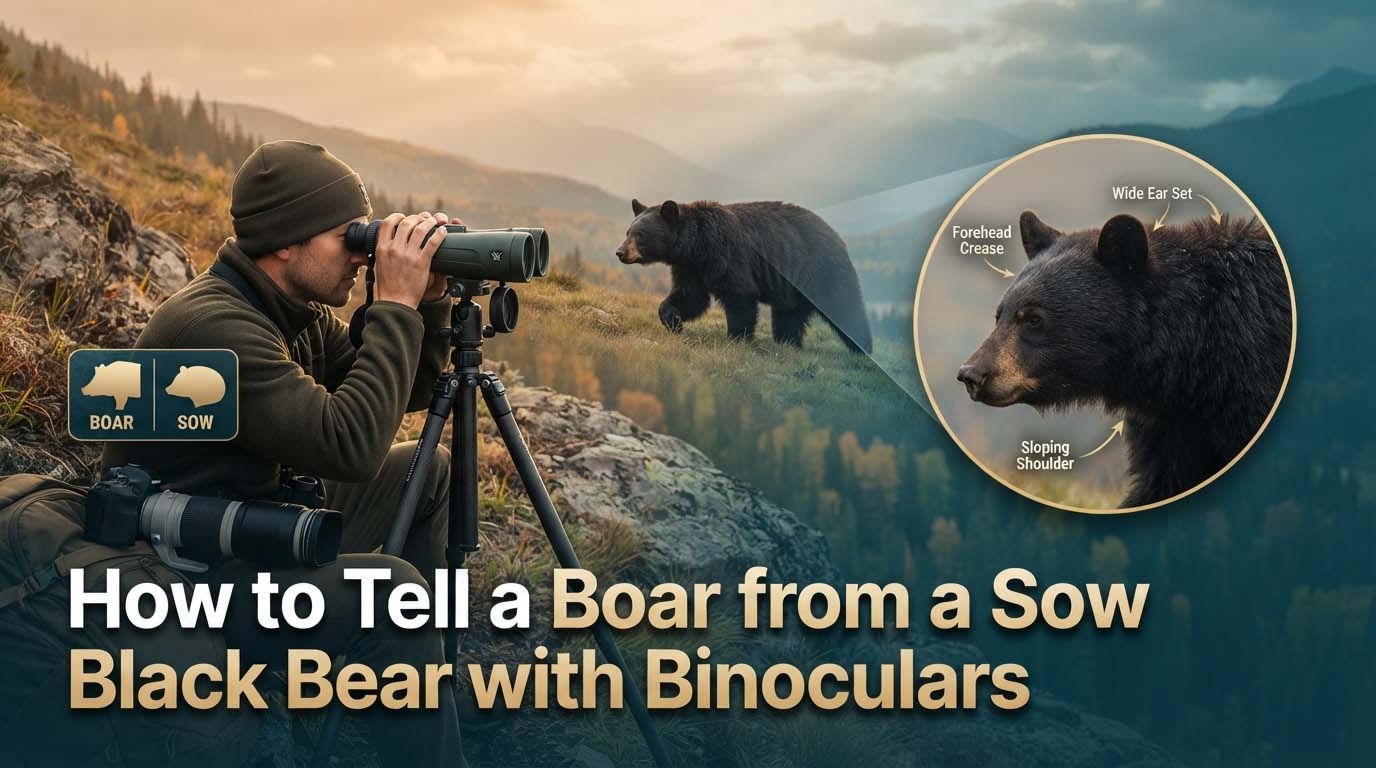
I have spent many spring and fall seasons behind a pair of binoculars trying to decide if the dark blob in the alder patch is a mature boar or a large sow. Size alone will fool you. A six-foot sow looks every bit as big as a six-foot boar when you have nothing to compare it to. The trick is to look at five separate indicators together. When all five point the same direction, you can be confident. When they conflict, you need more time or a closer approach.
The Foundational Principle: Composite Cues at Distance
No single feature reliably tells you the sex of a black bear through binoculars. You have to layer observations: head shape, shoulder mass, leg-to-body proportion, how the bear moves, and what it does while feeding. I have watched experienced guides call a bear a boar from two hundred yards and then find a sow with cubs when they got closer. That happens when you rely only on the ears or the belly sag. The composite approach works because each trait either reinforces the others or makes you hesitate. If you hesitate, you back out and look again.
Head Profile: The Most Reliable Binocular Cue
When I glass a bear, I start with the head. The snout and ear positions tell you more about sex than any other single feature at distance.
A boar’s snout is longer, wider, and looks more rectangular. His ears sit wide apart and appear pushed outward rather than standing up on top of the head. Because the jaw muscles are heavy, a big boar often develops a crease down the center of his forehead. You can see that crease in good light at 200 yards with 10x binoculars.
A sow’s head is shorter and more rounded. Her ears look taller and sit closer together, like two triangles perched on top of her skull. You will not see a forehead crease. The snout is noticeably shorter than the ear-tip distance when viewed from broadside.
How to measure with your binoculars: Focus on the space between the ears and compare it to the length of the snout. On a boar, the snout length roughly equals the ear-tip width. On a sow, the snout looks shorter. This ratio holds even when a sow has a full winter coat, because the skull does not change. If you see a bear with a blocky head but the ears appear tall and close together, it is likely a heavy-coated sow. Look for the bone structure beneath the fur at the muzzle.
Shoulder Hump and Body Proportions
Once you have the head read, drop your glass to the shoulders. This is where the differences jump out.
A boar has massive front shoulders. The hump rises above the backline when he walks, and the forearm from elbow to wrist looks thick—almost as wide as the foot itself. There is no pinch at the wrist. The whole front end looks like a block.
A sow has more sloping shoulders. The hump is subtle and does not lift above the backline. Her forearm tapers noticeably above the foot. You will see a narrow wrist just before the paw.
Field technique: When a bear stands broadside, compare the height of the shoulder hump to the depth of the belly. In boars, the hump height often exceeds the belly depth. In sows, the belly depth is greater than or equal. To make this comparison, use the bottom edge of your binocular field of view as a reference line. Center the bear’s shoulder at the bottom edge and note where the top of the hump lands relative to the horizon. Then do the same for the belly. This trick works because it removes the guesswork of absolute distance.
Leg Length and Body Sway
After shoulders, I look at how the bear carries itself. Leg length relative to body size is a strong sex indicator, but you have to train your eye because the fur can hide bone.
Boars have legs that look short for the body. Their torsos are thick and blocky, and the belly often sags low—sometimes nearly brushing the ground. When a boar walks, his front end sways from side to side in a lumbering, almost mechanical roll. The shoulder rocks out with each step.
Sows have longer-looking legs because their bodies are slimmer. The belly rides higher off the ground. Their gait is smoother and more direct. You do not see the exaggerated shoulder roll. A sow moves like a dog trotting; a boar moves like a bulldozer.
Reticle method: If your binoculars have mil-dots or hash marks, measure chest depth at the ribs against leg length from elbow to paw. In boars, chest depth is 1.5 to 2 times leg length. In sows, the ratio is closer to 1 to 1.2. This is not a perfect science, but after you check a dozen bears, you will start to see the pattern.
Behavioral Indicators Visible from a Distance
What a bear does can confirm what its body says. These behavioral cues are best used as supporting evidence, not primary proof.
Feeding posture: Boars feed with their heads low, neck stretched forward, moving slowly in a straight line. They rarely look up. Sows feed with their heads more upright, frequently lifting their noses to scan the surroundings. A sow meanders; she does not follow a straight line.
Group dynamics: A bear with cubs is always a sow. A bear following another bear at a steady distance is usually a boar pursuing a sow during the breeding season. Two bears of similar size walking together without cubs are likely a pair of sows or a mother with a grown cub. I have seen this many times in the spring—if you see two bears, watch which one is leading and which one is following. The boar will be the larger, more deliberate animal in the back.
Urination posture: Both sexes squat, but boars tend to squat with a wider stance. If you see a lone bear squat with legs spread wide, it is more likely a boar. Sows keep their hind legs closer together. This cue is subtle and requires a clear view and patience, but it can tip the balance when other indicators are mixed.
Rub and marking: Boars often stand on their hind legs to rub trees, creating a vertical black column against the trunk. Sows rub lower, at belly height. If you see a bear rubbing a tree and the back is high off the ground, it is a boar.
The Critical Pitfall: When Sows Look Like Boars
I have made the mistake of calling a big sow a boar twice in my hunting career. Both times I was looking at a solitary female without cubs. Here is how to avoid that error.
Large sow with no cubs: A sow can reach six feet and weigh over 300 pounds in some regions. At distance, her bulk can look exactly like a boar’s. But if you look at the head, you will see a rounded forehead, tall ears set close together, and no crease. Then look at the gait. If the bear moves without the side-to-side lumbering sway, you are looking at a sow. Check the shoulders—if the forearm pinches in above the foot, it is a sow.
Young boar with winter coat: A midsized boar (five to six feet) in heavy winter fur can appear square-headed and bulky. The ears may still look somewhat wide, but the snout will already show the longer, rectangular shape. Check the leg-to-body ratio: even a young boar will have legs that look stubby compared to his chest depth. A sow of the same size will have legs that look longer relative to her body.
Breeding pair confusion: When a boar follows a sow, they appear as two dark shapes at distance. The trailing bear (the boar) will be larger and move more deliberately. The lead bear (the sow) will have a more feminine head profile. Use the side angle to separate them—do not try to judge the pair head-on. Wait until they turn broadside.
Binocular Setup and Technique for Sex Identification
Having good binoculars is not enough. You need to use them correctly for this specific task.
Magnification: I recommend 10x as the minimum for reliable head and body detail beyond 200 yards. If you can carry a tripod, 12x or even 15x will reveal the forehead crease and the taper of the forearm. A tripod makes the biggest difference because it eliminates shake, and shake blurs the subtle cues.
Stabilization methods: Brace against a tree, use a car window mount, or lay your arms on a pack. Anything that steadies the image helps. I use a lightweight monopod with a clamp for my binoculars when I am spotting and stalking. It allows me to glass for long minutes without my arms tiring.
Lighting: Side lighting—early morning or late afternoon—emphasizes the shoulder hump and the leg profile. Full midday glare washes out the snout detail. Overcast is ideal because it softens shadows and lets you see the bone structure beneath the fur. I rarely try to sex a bear in flat, bright light.
Practice protocol: Before the season, watch known-sex bears at a zoo or on trail camera videos. Practice “sexing” each bear you see on screen before you check the answer. Then go into the field and sex every bear you glass, even if you are not hunting. The more you do it, the faster the composite cues become automatic.
Frequently Asked Questions
Can I use a bear’s track to confirm sex through binoculars?
Tracks visible in mud or snow at distance show size but not sex. Boar tracks are wider and more rounded; sow tracks are narrower and more oval. However, this requires a clear substrate and a distance under 100 yards. Use tracks only as a supporting clue, never as a primary method.
Do color phase differences help identify sex?
No. Blond, cinnamon, chocolate, and black phases occur in both sexes equally. Color is irrelevant for sexing a black bear.
How does the time of year affect visual sex identification?
In spring, the hide is sleek, making the shoulder hump and forearm width easier to judge. In summer and fall, heavy coat obscures body lines. In late season, look for rubbing marks or missing hair patches that reveal the body shape underneath. Behavior is most reliable in spring during the breeding season when pairs travel together, and in fall during hyperphagia when bears feed alone.
At what distance is sexing impossible through binoculars?
Beyond 400 yards, individual head detail—ears, snout shape—becomes unreliable. Beyond 600 yards, only body proportions and behavior remain. Use a spotting scope or a high-magnification rangefinder for long-range work.
What is the “three bear rule” and how does it apply?
The three bear rule is an ethical guideline: if you have to look at a bear three times to confirm it is a shooter, it is likely not. For sexing, the same principle applies—if after three deliberate looks through binoculars you cannot confidently assign sex, accept the uncertainty and either get closer or pass. I have walked away from more bears than I have shot, and I have never regretted it.