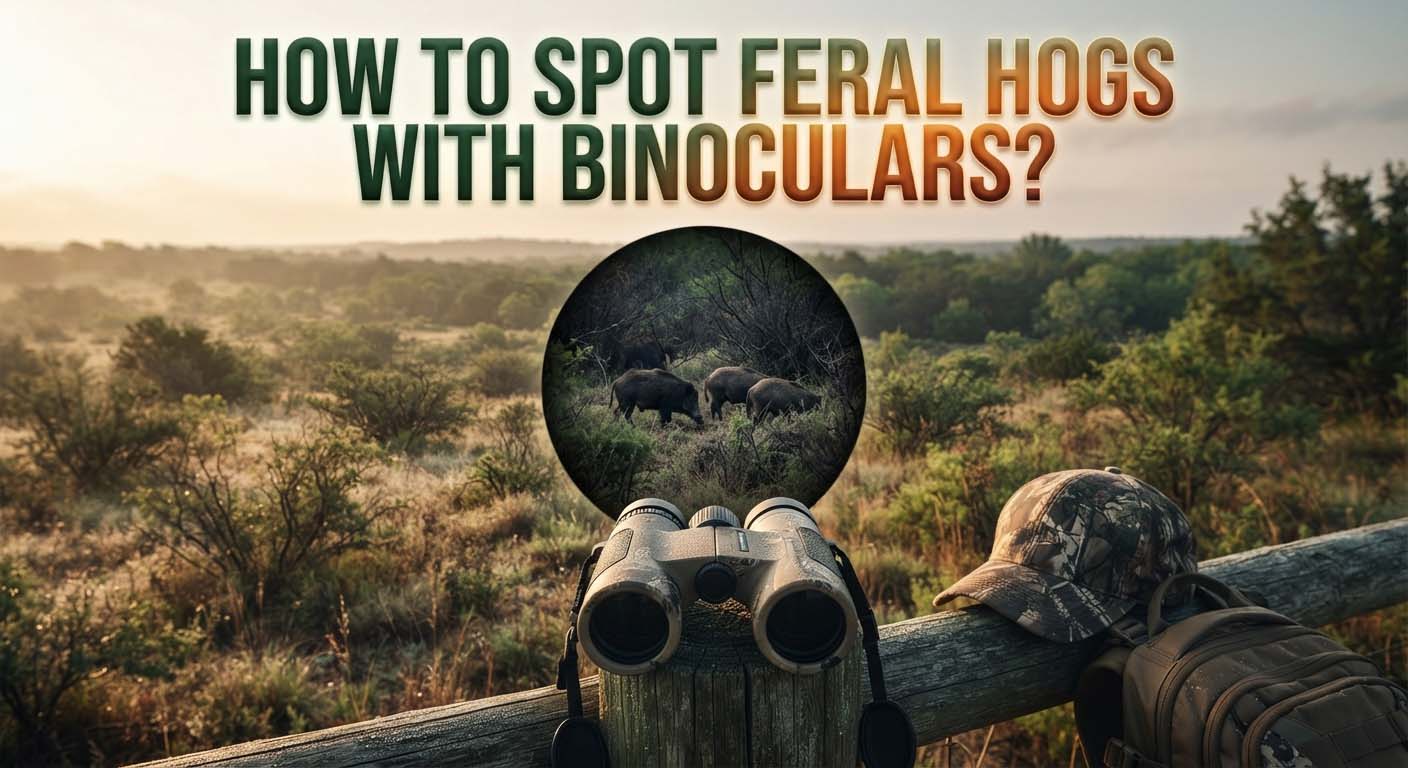
If you glass for hours without seeing hogs, the problem is rarely your binoculars. The problem is your system. You can own the most expensive glass on the market and miss a big boar bedded ten feet inside the brush line. Spotting feral hogs is a skill built on understanding the animal and using a deliberate scanning method. Here is what actually works.
The Best Times to Spot Hogs
Hogs are most active at dawn and dusk. But they do not disappear once the sun gets high. Cool weather, overcast skies, and especially rain will keep them moving all day.
Do hogs move in the rain? Yes. A steady light rain is one of the best times to find them during the middle of the day. The cool air lets them feed without overheating, and the soft ground makes rooting easy. A heavy downpour will push them into thick cover. A drizzle or steady shower keeps them in the open.
During the heat of the day, hogs bed down in thick cover. You are not looking for the whole animal at this point. You are looking for a patch of black or brown deep in the shadows. Train yourself to scan the shady edges of bedding cover when the sun is high.
Choosing the Right Magnification
Stick with 8x or 10x for most hog hunting. An 8×42 gives you a wide field of view, which is crucial in brush and timber. A 10×42 is the standard all-around choice. It gives you enough reach for open fields without losing too much field of view.
If you hunt open country or sit over a food plot, a 12x set on a tripod is deadly effective. But do not use a 12x for walking and scanning. The narrow field of view will make you miss hogs that are close.
You do not need thermal binoculars to spot hogs, but they change the game in complete darkness or dense cover. Standard glass works best in daylight, especially at dawn and dusk. Thermal binoculars detect heat, which lets you see a hog bedded in a thicket that standard binoculars cannot penetrate. The catch is that thermal only tells you something warm is there. You still need visual confirmation to tell a hog from a coyote or a cow. If you mostly hunt in daylight in semi-open country, good quality standard binoculars are all you need.
How to Scan for Hogs
Picking up your binoculars and sweeping left to right is the fastest way to miss hogs. A systematic scan takes longer but finds more animals.
- Pick a starting point. Choose a landmark like a pond, a fence line, or a big tree.
- Divide the ground into zones. Near zone is zero to 100 yards. The middle zone is 100 to 300 yards. The far zone is 300 yards and beyond.
- Scan each zone with a horizontal grid. Start at the left edge of your zone. Move your binoculars slowly to the right. Pause for ten seconds on any spot that looks like good cover. Drop down half a field of view and scan back to the left.
- Focus on edges. The transition between cover and open ground is where hogs appear first. Scan the edge of a brush line before you scan the field.
- Look for pieces, not whole hogs. You rarely see a hog standing in plain view. You see an ear flick, a curved backline, a patch of black in the shadows.
Hogs freeze when they think they have been seen. A deer will flush and run. A hog holds still and tries to blend in. This is why the pause is so important. If you sweep past a hog that is frozen, you will miss it. Slowing down and pausing on likely cover gives the hog time to move an ear or flick its tail.
What to Look For
Feral hogs are built low to the ground. Their back is a straight, horizontal line. Look for that line in the grass or shadows.
Hog color varies from solid black to brown to spotted. Fresh mud can change their color completely. In a wallow, they come out looking red or rust colored. Do not just look for black. Look for anything that does not match the background.
The tail is a dead giveaway. A hog’s tail is straight and often sticks straight up when the animal is alert. If you see a tufted tail flicking in the brush, that is a hog.
Watch for movement in the grass. Hogs rooting through brush will shake the vegetation in a jerky, uneven rhythm. Deer move smoothly. Hogs move like bulldozers.
Reading Sign Through the Glass
Before you see a hog, you should see what the hog left behind. Your binoculars are for reading signs at a distance.
Rooting. Fresh rooting looks like churned-up soil. From a distance, it shows up as dark patches against the green or brown ground. Scan the edges of fields and open woods for this.
Wallows. Hogs love mud holes. They use them to cool off and get rid of parasites. Scan the muddy edges of ponds, creeks, and seeps. Look for a hole filled with churned mud.
Tracks. Hog tracks are rounder and wider than deer tracks. If you see a game trail leading into thick cover, use your binoculars to check the ground for the distinctive round print.
Rubs. Hogs rub against trees, fence posts, and utility poles. Look for smooth, muddy patches on the bark about waist high on the tree. Old rubs dry out and fade. A fresh rub with wet mud means hogs are still using the area.
The Glass and Stalk Method
Do not just sit in one spot and glass. Move slowly and use your binoculars to scan ahead before you take each step. This is called glass and stalk.
Walk ten or fifteen yards. Stop. Scan the area ahead. Look into the cover before you expect to see anything. Hogs that are bedded will let you walk right past them if you are not paying attention.
Wind direction is everything. Hogs have a poor reputation for eyesight, but their sense of smell is incredible. Keep the wind in your face. If you have to circle around to get the wind right, do it. A hog that smells you is gone before you ever see it.
When you spot a bedded hog, do not rush. Plan your approach using the cover. Your binoculars let you find the route that keeps you hidden.
Frequently Asked Questions
Can you spot feral hogs during the middle of the day?
Yes. In cool weather, winter, or after a rain, hogs will feed throughout the day. During hot weather they bed in thick cover, but you can still find them if you scan the shady edges and deep brush.
What magnification is best for spotting hogs in brush?
An 8x or 10x binocular is the best choice for brush. The wide field of view helps you catch movement and spot partial shapes in the cover.
How do I tell a feral hog from a domestic pig through binoculars?
Feral hogs are leaner and hairier than domestic pigs. They have a straight back, a long snout, and a thick coat of bristles. Domestic pigs look rounder and softer. Feral hogs also move differently. They walk like a wild animal, not like livestock.
Should I use a tripod or steady rest when glassing for hogs?
For scanning large open fields, a tripod helps you hold still for long periods and reduces shake at 10x and above. For walking and hunting in brush, skip the tripod and use a steady rest like a tree trunk or fence post.
How far away can you see a feral hog with 10x binoculars?
On a clear day in an open field, you can detect a hog at 500 yards or more with a 10x binocular. At that distance, you will see a dark shape. Identification is easier inside 300 yards.
Final Word
Spotting feral hogs comes down to patience, a deliberate grid-scanning system, and knowing what subtle signs to look for in the shadows. Stick with 8x or 10x glass, focus on cover edges, and always play the wind. Once you slow down and let your binoculars break up the brush, those hidden boars will start standing out fast.