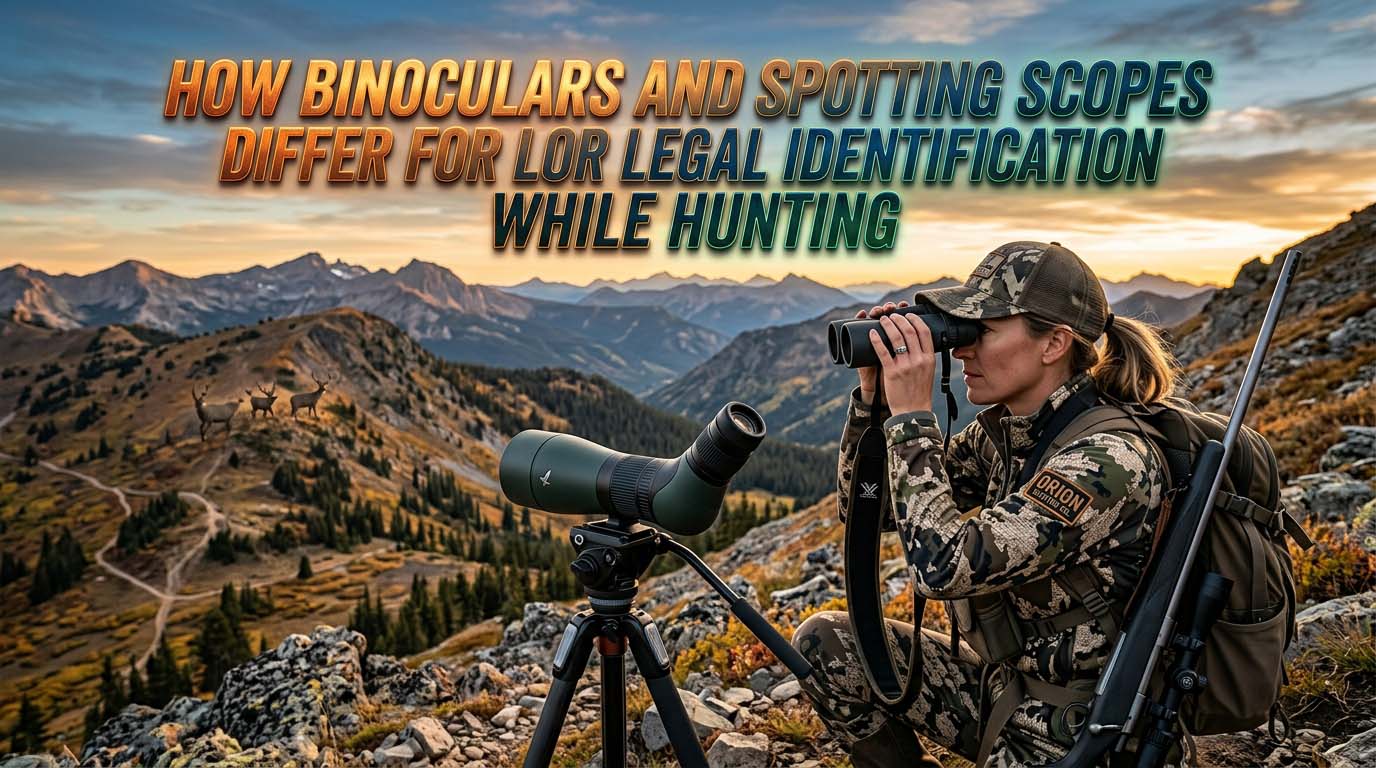
If you hunt with a tag that has antler point restrictions, curl requirements, or brow tine minimums, the simple difference between binoculars and a spotting scope can keep you legal. Use binoculars to find game and confirm broad details like antlered or antlerless. Use a spotting scope when you need to count points, measure a curl, or verify a legal spread.
Misidentification because of inadequate optics can lead to a citation, even if your intentions were good. This article walks through exactly when you need each tool and how to use them to make a legal shot.
What Regulations Force You to Use a Spotting Scope Over Binoculars?
Many western and northern states have regulations that demand you identify specific physical features before shooting. These are not optional recommendations. If your binoculars cannot resolve the detail required by law, you are gambling with a fine or losing your hunting privileges.
- Bighorn sheep curl: Most states require a ¾ curl or better. At 300 yards, a 10x binocular shows a ram’s horn as a curved line. You cannot tell the difference between 7/8 and ¾ curl. A spotting scope at 30x makes the horn tip position against the jawline obvious.
- Moose brow tines: In Alaska and parts of Canada, a bull moose needs at least three or four brow tines on one side. These tines project forward from the base of the antler. At 200 yards, even top-end 15x binoculars struggle to count them, especially if the bull is in brush or deep shadow.
- Elk antler points: Some units require a minimum number of points on one side. You cannot count a sixth point if you cannot see the tip clearly. A spotting scope lets you scan each tine individually.
- Whitetail spread restrictions: In Texas, a buck must have an inside spread of 13 inches or more. Judging that with binoculars is nearly impossible unless the deer is less than 100 yards away and perfectly broadside.
- Turkey beard length: Some states require a visible beard of at least six inches. Binoculars can work here if the turkey is in the open and you can see the beard hanging below the breast. But if the turkey is in tall grass, a spotter helps confirm.
The core reason is distance and detail. Binoculars give you a wide field of view but limited magnification.
Spotting scopes often go from 20x to 60x, which turns a fuzzy shape into a countable set of points. Even a cheap spotting scope at 20x will outperform a premium binocular at 10x for fine detail work.
When Are Binoculars Legally Sufficient?
Not every hunt requires a spotting scope. Many tags only ask you to identify the species and whether the animal is antlered or antlerless. In those cases, binoculars alone are fine.
- General season doe tags: If you have an antlerless-only tag, you just need to confirm there are no antlers. Binoculars at a reasonable distance can show you a smooth head. Look for ear position and body shape: a small buck often has a thicker neck and a flatter forehead than a doe.
- Species that are obviously different: Pronghorn vs. mule deer. Elk vs. cow. If the only legal question is what animal you are looking at, binoculars are enough.
- Close-range hunts: In thick timber or agricultural fields where shots are under 200 yards, binoculars give you all the detail you need. You can see antler size and points without extra magnification.
- Open terrain with long glassing sessions: Sometimes you can wait until a buck turns his head or stands broadside. With patience, a 10x binocular on a tripod can reveal enough detail. But this is risky if the animal moves and you only get one look.
Here is the honest take: if you are hunting a species with any antler point or horn curl requirement, you should carry a spotting scope.
The weight is worth the peace of mind. I have watched hunters shoot a legal buck only to find out later it was one point short. A spotting scope would have prevented that.
How to Use Each Tool to Make a Legal Determination?
Knowing which tool to use is only half the battle. You also need a method for confirming the legal details.
Binocular Technique for Legal ID
Use a steady rest. Sit down, brace your elbows on your knees, or use a tripod. Focus on the animal’s head. Look for signs that tell you sex and age without seeing the antlers clearly.
Ear length compared to antler base can indicate a spike. Body shape and neck thickness help differentiate a small buck from a doe. If you are after antler points, wait until the animal looks straight at you.
When the antlers are framed against the sky, you can sometimes count points with 10x. But do not trust this beyond 200 yards.
Spotting Scope Technique for Legal ID
Set up your tripod low and stable. Get behind the scope and adjust focus to the animal’s head. If you are counting points on an elk or moose, start at the base and work up each tine one at a time. Use the reticle if your scope has one for approximate measurement. For sheep curl, focus on the horn tip relative to the eye or nose.
Many hunters use the “check” method: a ¾ curl ram will have the tip reaching at least to the front of the eye. A 7/8 curl goes past the eye. A full curl reaches the jaw. You cannot see that with binoculars.
Critical Consideration – The Legal Burden of Proof
In most states, the hunter must positively identify the animal before shooting. If a warden asks you what you saw, and you say “I thought it was a legal buck,” that may not hold up. Wardens know what optics can and cannot do.
If you used only 10x binoculars on a buck at 400 yards, they may argue you took a risk. A spotting scope provides documented proof that you did your due diligence.
My rule of thumb: if you cannot confidently count points or measure curl with binoculars after three minutes of steady observation, set up the spotter.
The “Legal Minimum Magnification” Myth
Some hunters think buying 15x binoculars or a 20x spotting scope automatically makes identification easy. That is not true. Magnification alone does not guarantee a clear image. Resolution, aperture, and stability matter just as much.
A 20x spotting scope with a small objective lens (50mm) may look dim and fuzzy at 200 yards, especially in low light or heat haze. A 10×50 binocular on a tripod can actually give a sharper image because the larger objective gathers more light.
The real gain comes from combining high magnification with a stable platform and good glass. A cheap 60x scope at full zoom is often useless due to mirage. Run it at 30x to 40x for the best balance of detail and clarity.
Also, higher magnification increases shake. Handheld binoculars above 12x are hard to hold steady. If you try to count points at 15x without a tripod, the image bounces, and you lose detail. A spotting scope must be on a tripod to be effective.
Spotting Scope vs. Binoculars for Legal Species-Specific Checks
Here is a quick reference based on common regulations. Always check your local laws because specifics vary by state and unit.
- Whitetail buck with point restrictions: Spotting scope necessary beyond 150 yards.
- Mule deer (ear-to-antler ratio): Binoculars may work if the animal is broadside and you can see the ear size compared to antler width. But point counts still need a spotter.
- Bighorn sheep (curl): Spotting scope mandatory at any distance over 200 yards.
- Moose (brow tines or spread): Spotting scope required. Binoculars will not reliably show three tines at normal hunting distances.
- Turkey (beard length): Binoculars sufficient if you can see the beard hanging below the breast. If the turkey is in grass, a spotter helps.
- Waterfowl (species identification in flight): Neither works well. Use flight pattern and plumage at close range. Spotting scopes are too slow to track flying birds.
If you hunt multiple species, a 20-60x spotting scope covers all these needs. For backpack hunters, a lightweight 15-45x model is a good compromise.
Frequently Asked Questions
Can a rangefinder with angle compensation help with legal identification?
No. A rangefinder only tells you distance. It cannot show antler points, curl, or spread width. It is still useful for determining if an animal is within your comfortable shooting range, but it does not replace a spotting scope for legal ID.
Is a 20x fixed eyepiece enough for moose brow tine check?
Yes, if you have a high-quality scope and a stable tripod. Fixed eyepieces often have better resolution than zoom eyepieces at the same magnification because they have fewer lens elements. Avoid zooming to maximum power if it degrades clarity.
Do game cameras count as “binoculars” for legal identification?
No. The law requires you to positively identify the animal before shooting, not after. A game camera picture from last night is not proof of what you saw in the field. You still need real-time optics.
What if I use binoculars and a phone camera zoom? Does that count?
Legally risky. Phone zoom is not designed for hunting and may not provide a clear image. If you get cited, a warden will likely argue that a phone camera is not a dedicated optic for positive ID. Do not rely on it.
Can a spotter be too powerful for legal work?
Yes. At extreme magnification, heat shimmer (mirage) can blur details. A 60x image on a hot afternoon may look like a watercolor painting. Drop down to 30x or 40x to get a steadier, sharper view. The goal is clear detail, not maximum power.
The binoculars vs spotting scope legal difference hunting comes down to whether you need to see fine details like antler points, brow tines, or horn curl. For general identification and close-range hunting, binoculars do the job. For any regulation that requires counting or measuring, a spotting scope is not optional. Carry it, learn to use it, and you will never have to guess whether that buck is legal. Guessing gets expensive. The right tool keeps your tag valid and your hunt legal.