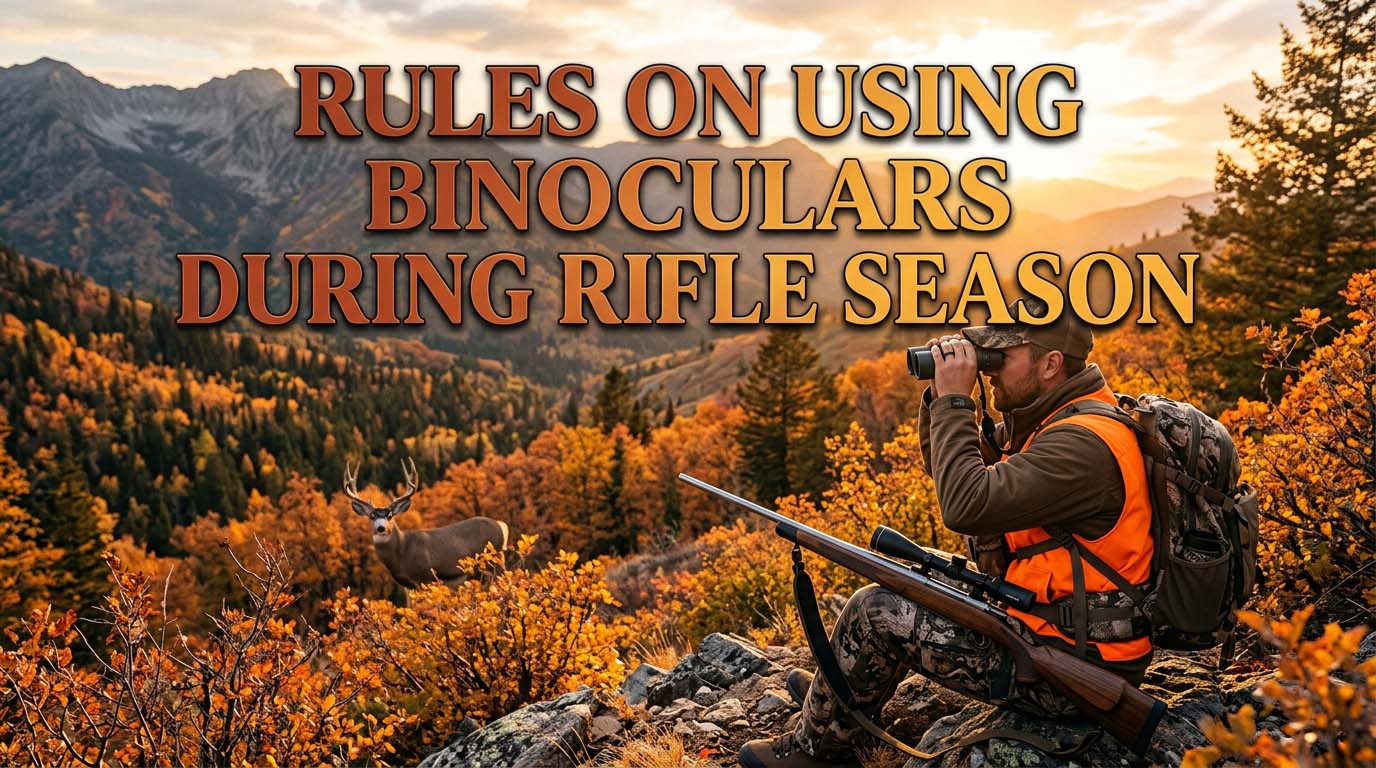
Binoculars are almost always legal to carry during rifle season, but there are critical exceptions, especially regarding scouting from vehicles, magnification limits in some states, and the use of electronic features.
Most hunters who get in trouble do so not because they own binoculars, but because of how they use them.
This guide covers the actual rules you need to know, the common violations that get hunters cited, and how to stay legal while getting the most out of your glass.
The Legal Foundation
On federal public land, binoculars are generally allowed during rifle season. The U.S. Forest Service and Bureau of Land Management do not ban binoculars. The same goes for most state wildlife management areas.
The rules that do exist come from state wildlife agencies, and they usually focus on behavior, not equipment.
The key distinction is this: carrying binoculars is legal. Using them from a vehicle, using them to scout for someone else, or using them with certain electronic features might not be. Hunters who understand this difference rarely have problems. Hunters who assume all binocular use is fine are the ones who get cited.
The most common legal issue is not about the binoculars themselves. It is about where and when you use them.
If you stand on a public road and glass a field for deer, you might be breaking the law in states that prohibit hunting from a road. Some states treat glassing as part of the hunt, even if your rifle is in the case.
Vehicle Glassing and Road Hunting Rules
This is where most violations happen. Many Western states have specific rules against using binoculars from a motor vehicle on a public road. Colorado Parks and Wildlife Rule 2.11 is a good example.
It prohibits taking or attempting to take wildlife from a public road, but the enforcement often includes glassing from the road as part of the attempt.
The rule usually works like this: if you are stopped on a public road and using binoculars to locate game, you are actively hunting.
If you then step out and take a shot, you have hunted from the road. Even if you do not shoot, you can still be cited for hunting from a road if the officer believes you were attempting to locate game.
Montana has a similar rule. It is legal to glass from a road if the engine is off and you are not blocking traffic. But if you are driving slowly while glassing, that is road hunting, and it is illegal. The difference is intent and movement. Stopped and glassing is usually fine. Driving and glassing is not.
Some states go further. In Utah, you cannot use a vehicle to spot game and then direct a hunter on foot. This is called “touting” or “spotting,” and it is a separate violation.
The rule is meant to prevent one hunter from using a vehicle as a mobile scouting platform while another hunter does the shooting.
The safest rule of thumb is this: step away from your vehicle before you start glassing. Get at least 100 yards from any public road. Park your truck, grab your binoculars, and walk. That one step alone keeps you legal in almost every state.
Magnification Limits and Banned Features
Very few states have magnification limits for binoculars. Texas is the notable exception. On certain public hunting lands in Texas, binoculars cannot exceed 10x magnification.
The rule is listed in the Texas Parks and Wildlife Code under hunting equipment restrictions for specific wildlife management areas. If you hunt in Texas, check the rules for the specific unit you are using.
Other states with magnification limits are rare. Some states restrict magnification during archery seasons that overlap with rifle season. For example, if you carry a bow during rifle season, some states limit binocular magnification to 10x.
This is not common, but it exists in places like parts of Arizona and New Mexico; check your state regs.
The bigger issue is electronic features. Many states have rules against using any electronic device to aid in taking game.
This includes binoculars with built-in digital rangefinders that display data in the field of view. If your binoculars require batteries to show you a distance reading, some states consider that an illegal electronic scouting aid.
California is strict on this. Their Fish and Game Code prohibits using any electronic device to locate or track game. A binocular with a digital compass display could count. A binocular that connects to a smartphone app and streams video could definitely count.
The rule of thumb is simple: if your binoculars do nothing more than magnify light, they are legal everywhere. If they display data, record video, or transmit signals, check your state regulations before you take them into the field.
Quick Decision Tree for Electronic Binoculars
Ask yourself these three questions. If you answer yes to any of them, you need to check your state regulations before hunting.
Does your binocular require batteries to function at all? If yes, some states consider it an electronic device.
Does your binocular display distance, angle, or compass data inside the lens? If yes, it may be treated as a rangefinder, which has its own set of rules.
Does your binocular have a camera that records or transmits images? If yes, it is likely illegal under electronic scouting device rules.
Scouting vs. Hunting: The Gray Area
The biggest gray area with binoculars during rifle season is the difference between scouting and hunting. Most states allow you to scout for game before the season opens. But once rifle season starts, using binoculars to locate game is part of the hunt, not scouting.
The rule works like this: if you are in the field during rifle season with a valid license, and you use binoculars to find an animal, you are hunting. That is legal. But if you use binoculars to find game and then direct another hunter to it, that can be illegal in many states.
This is where “touting” rules come in. Some states explicitly prohibit using binoculars to spot game and then communicate its location to another hunter. This applies even if both hunters have valid licenses.
The act of spotting and directing is considered hunting, and if the spotting hunter does not have a tag for that species, it is a violation.
The ethical rule is straightforward: use your binoculars to find your own game. If you spot an animal and want to tell your hunting partner, that is usually fine.
If you spot animals for an entire hour and relay every location to another hunter who then shoots, that is touting, and it is illegal in several states.
Preseason Scouting vs. In-Season Use
Preseason scouting on foot with binoculars is almost always legal. You can walk public land, glass ridges, and note where animals are bedding.
But there is a catch. Some states prohibit “intentional disturbance” of game before the season. If you glass a bedded buck and then walk toward it, forcing it to move, you might be violating harassment laws.
During rifle season, your binocular use is part of the hunt. You can glass from a legal position. You can glass from a tree stand. You can glass from a ridge.
What you cannot do is glass from a vehicle on a public road or glass from an aircraft. That is illegal everywhere.
State by State Spotlight
Every state has different rules. Instead of listing all 50, here are three states with distinct regulations that show the range of possible restrictions.
Colorado has strict rules against glassing from a public road. You cannot use binoculars to locate game from a vehicle on a road.
There is no magnification limit for binoculars. You can carry 15x binoculars on your chest all day. The only restriction is how you use them from a vehicle. Colorado also prohibits using binoculars to spot game for another hunter.
Texas has magnification limits on some public hunting lands. For certain wildlife management areas, binoculars cannot exceed 10x. Texas also treats binoculars as hunting equipment, which means they must be stored properly while traveling to and from the hunting area.
You cannot have binoculars within reach if you are driving on a public road with a loaded rifle in the cab.
Montana is broadly permissive. There is no magnification limit for binoculars. You can glass from a road if the engine is off and you are not blocking traffic.
Montana’s touting rule is clear: you cannot use binoculars to locate game and then direct another hunter to it. If you spot an animal and tell your partner where it is, that is legal. If you spend an hour glassing and giving coordinates, that is touting.
Myth Versus Fact
The hunting world is full of bad information about binocular rules. Here are the common myths and the facts.
Myth: You cannot use 15x binoculars anywhere during rifle season.
Fact: Only a few states have magnification limits, and those limits usually apply only to specific public lands. In most states, 15x binoculars are perfectly legal.
Myth: Binoculars are illegal if they have a digital camera.
Fact: Having a camera is not illegal unless the camera records or transmits data in real time. A binocular that takes still photos is usually fine. A binocular that streams video to your phone is not.
Myth: You cannot glass from a truck if the engine is off.
Fact: Many states allow glassing from a stopped vehicle if the engine is off and you are not blocking a road. The rule is about active hunting from a vehicle, not about sitting still and looking.
Myth: Binoculars are banned during archery-only seasons.
Fact: Binoculars are almost always allowed during archery seasons. The only restriction is in states that limit electronic aids for bowhunters. Simple binoculars without electronics are fine.
Myth: Using binoculars to check antler points from the truck is “spotlighting.”
Fact: Spotlighting laws prohibit using artificial light to locate game at night. Using binoculars during daylight hours is not spotlighting, even if you are in your truck.
Seven Ethical Rules Every Hunter Should Follow
Legal rules keep you out of court. Ethical rules keep you welcome on public land. These seven guidelines are not laws in most states, but following them will keep you from getting yelled at by other hunters or reported to a game warden.
One: Never glass into another hunter’s camp. If you see tents or vehicles, point your binoculars elsewhere. Glassing a camp is rude and can be considered harassment in some areas.
Two: Confirm your target before you raise your rifle. Use your binoculars to check antler size, count points, and verify species. Then use your scope for the shot. Binoculars give you a wider field of view and better low-light performance than a riflescope.
Three: Do not use binoculars to harass game. If you glass an animal and then walk toward it, forcing it to move repeatedly, you are harassing wildlife. That is illegal in every state.
Four: Put your binoculars away when you are walking through an area with other hunters. Slung binoculars can reflect sunlight and give away your position or spook game. Keep them under your jacket or in a chest harness case.
Five: Do not use binoculars to scout private land from a public road. This is not illegal in all states, but it is disrespectful. Private landowners hate glassing from the road. If you want to hunt private land, ask permission first.
Six: If you spot a wounded animal, use your binoculars to track it. Do not chase it blindly. Wait for the animal to stop, watch it through your binoculars, and then make a careful approach. This is ethical hunting, and it also keeps you safe.
Seven: Teach new hunters how to use binoculars properly. Many beginners either never use them or use them too much. Show them when to glass and when to move. Good binocular habits make better hunters.
Frequently Asked Questions
Can I use binoculars with a built-in compass during rifle season?
Usually yes. A compass is a passive instrument. It does not transmit or record data. As long as the compass display does not have any electronic components, it is legal in most states. Check your state regulations if the compass is part of a digital display.
Do rules apply differently on national forest land versus state land?
State wildlife regulations apply on national forest land unless federal law overrides them. This means state rules about vehicle glassing, electronic devices, and touting still apply. Check the state regulations for the area where you hunt, even if the land is federal.
Is using binoculars to check antler points from the truck considered spotlighting?
No. Spotlighting is using artificial light at night to locate game. Using binoculars during daylight hours from a truck is not spotlighting. But it may still be illegal if your state prohibits glassing from a vehicle on a public road.
What if my binoculars have a digital rangefinder display?
This is a gray area. Some states treat any binocular with a digital display as an electronic scouting aid. Other states allow them as long as the display does not transmit data. Check your state regulations. If you are unsure, use binoculars without any electronics.
Can I use binoculars during an archery-only season that overlaps with rifle season?
Yes, in almost every state. Binoculars are not considered weapons or electronic scouting aids in most archery regulations. The only exception is if your state has a specific rule about magnification limits for archery hunters. Check your archery regs for that detail.
Is it legal to use binoculars to locate game for another hunter?
This depends on the state. Some states prohibit “touting” or “spotting” for another hunter. Other states allow it as long as both hunters have valid licenses. The ethical rule is to spot for yourself. If you spot for someone else, you risk a touting violation in states with strict rules.