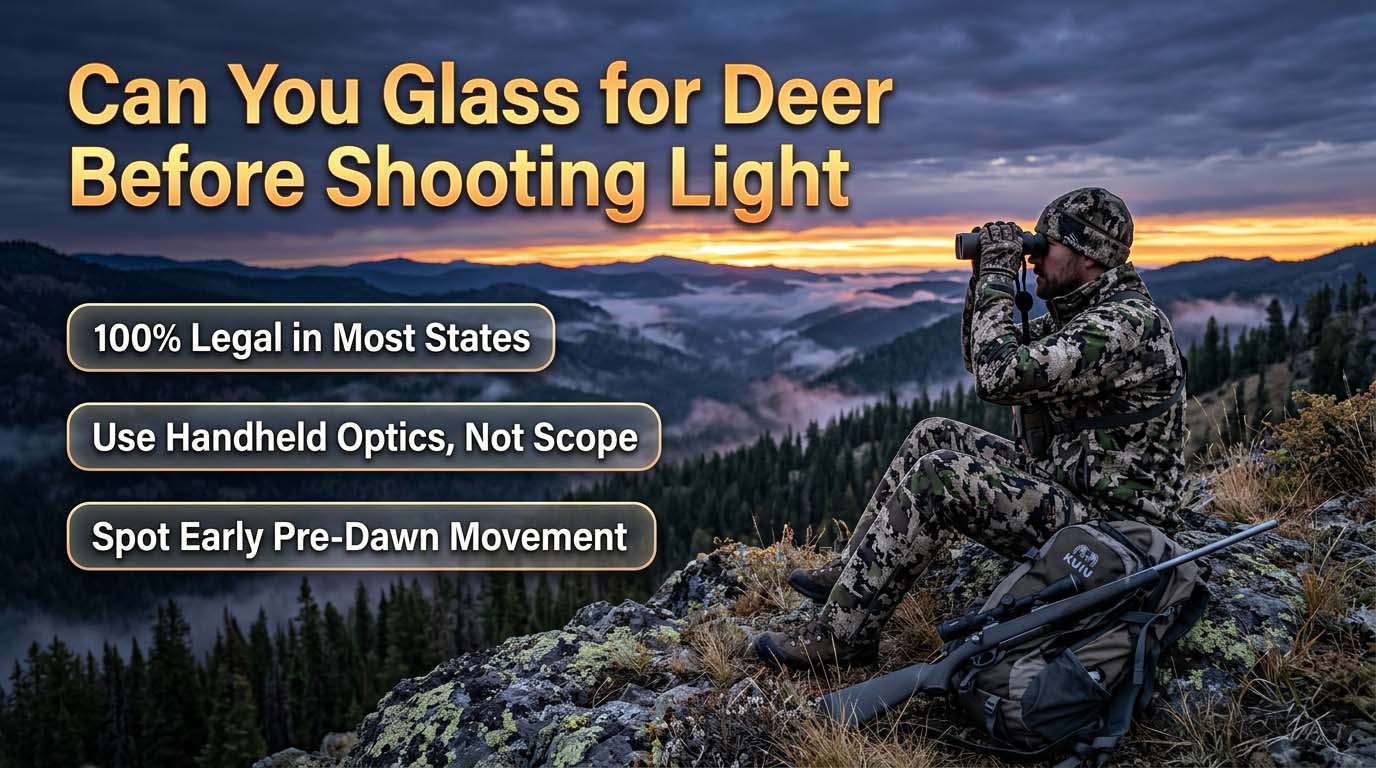
The short answer is yes, in most states, glassing before legal shooting light is allowed. But the real questions are: Is it smart? What counts as “hunting” versus “watching”? And how do you do it without ruining your hunt or breaking a law? I’ve been in the field before dawn more times than I can count, and I’ve learned that the difference between a successful morning and a blown setup often comes down to how you handle those dark minutes.
This article walks you through the legal side, the tactical trade-offs, and the practical techniques- everything you need to decide for yourself whether pre-light glassing belongs in your playbook.
The Legal Ground Rules | What Shooting Light Actually Means
Most state wildlife agencies define “shooting light” as a specific time – typically 30 minutes before sunrise for the start, and 30 minutes after sunset for the end. This window is when you can legally discharge a firearm or shoot a bow at deer.
Glassing before that window is almost always considered a form of scouting or observation, not hunting. But here’s where it gets fuzzy: if you use your binoculars to locate a deer and then move into position to shoot it before shooting light, you might cross the line into “active hunting.”
The Observation vs. Hunting Spectrum
Game wardens and courts look at intent and action. Three tiers exist:
Passive observation: You sit in one spot and look around with optics. You take no action based on what you see. This is almost always legal.
Active scouting: You move to a different location after glassing, but still before legal light, to get into a better position. This can be legal if you do not attempt to shoot until shooting time.
Some states define “hunting” as any attempt to take or pursue wildlife. Moving to intercept a deer you just spotted could count as pursuit.
Hunting preparation: You glass, then set up a blind, range a spot, or chamber a round. In some states, having a loaded gun in the field before shooting time is illegal even if you aren’t shooting. Check your local rules.
The safest approach: glass from your stand or blind, and don’t move until legal light. If you must reposition, do it well before shooting time, not after you’ve seen a deer.
Should You Glass Before Shooting Light? The Real Trade-Off
Legal permission doesn’t mean tactical wisdom. I’ve learned that glassing too early can backfire.
The Hidden Cost: Educating Deer
Deer are extremely sensitive to human presence in low light. Your silhouette, your breath fog, the click of your binoculars- they all stand out more when the world is quiet and dark.
If you glass from a ridge and a deer catches movement, it won’t know you’re a hunter, but it will associate that spot with danger. That deer might avoid the area for days.
When Pre-Light Glassing Pays Off
Sometimes it’s worth it. Here’s where the cost-benefit tilts in your favor:
Wide-open terrain – Out west or in big ag fields, glassing from a high point before shooting light can reveal where deer are traveling. You can mentally mark their paths without moving.
Multiple deer sightings – If you see a buck you want but can’t shoot yet, you know exactly where to look when legal light hits. That intel is gold.
Stand hunting with no exit option – If you’re already in your stand, a quick pre-light scan can help you settle in and find your shooting lanes without fumbling in the dark later.
When It Hurts You
Thick cover – In timber or brush, glassing before shooting light is nearly useless. You can’t see more than 50 yards. The noise and movement only spook deer.
Public land pressure – In high-pressure areas, deer are jumpy. Any unnatural movement before dawn sends them to cover. Better to sit still and let them come to you.
Hunting with a partner – If you’re coordinating with someone, whispering and radio chatter before light can telegraph your presence. Stay silent.
How to Glass Effectively in Pre-Dawn Light?
If you decide to do it, you need to adjust your technique and gear. Normal daytime glassing habits don’t work in the dark.
Gear That Helps
High-transmission glass: Look for binoculars with a large objective lens (42mm or bigger) and fully multi-coated lenses. They gather more light. A 10×42 model works well for open country; 8×32 is better for close woods.
Tripod stability – At dawn, your hands shake more from cold and tension. A lightweight tripod or a solo-pod lets you hold steady without making noise.
Retina-safe infrared – Some states allow thermal or IR during scouting hours. But many ban them during hunting seasons. Check your regulations before using electronics.
Red-lens headlamp – A red light preserves your night vision and is less visible to deer. Use it only to adjust gear, not to glass.
Technique Adjustments
Scan in sections – Divide your field of view into quadrants. Sweep each slowly. Your eyes need time to adjust, so don’t rush.
Look for movement, not details – In low light, you won’t see antler points or body shape clearly. Focus on motion – a tail flick, an ear twitch, a leg stepping.
Use the horizon – The skyline is brighter than the ground. Silhouettes of deer against a lighter sky are easier to spot. Scan ridges and field edges first.
Stay low and still – If you’re glassing from the ground, lie prone. Your outline breaks up less than sitting. Avoid standing – you’re a dark blob against the sky.
Reading Deer Behavior Without Full Light
You can learn a lot without seeing clearly. Listen for hoof steps, blowing, or the sound of a deer urinating. Watch for dark shapes that move in a deliberate pattern; feeding deer wander slowly, while deer heading to bedding move with purpose.
If you see a shape that stops and stares in your direction for more than a few seconds, it likely knows you’re there. Freeze and wait until it relaxes.
State-Specific Regulations: How to Find Your Local Rules
No article can list every state’s laws because they change. Instead, here’s a reliable process for researching your own state.
Key Questions to Answer
Does your state define “hunting” as any attempt to take wildlife? If yes, glassing with the intent to shoot later could be considered part of the hunt.
Are there separate rules for archery vs. firearms? Some states allow bow hunters to be in the field earlier than rifle hunters.
Can you use optics that amplify light? Thermal and night vision are often banned during hunting hours, but scouting before shooting light might still be allowed.
What is the penalty for hunting outside legal hours? Fines, loss of license, and even criminal charges in some states.
Where to Check?
Go to your state wildlife agency’s website. Search for “legal shooting hours” or “hunting hours definition.” Read the PDF of the full hunting regulations booklet. If you’re not sure, call the local game warden. They’d rather answer your question before you make a mistake than after.
Frequently Asked Questions
Can I use my rifle scope to glass before shooting light, or does that count as aiming at deer?
Using a scope to look at deer before legal light is generally allowed, because you aren’t shooting. But if you mount your rifle and the scope is aimed at a deer, a warden could argue you were “preparing to shoot.” Better to use binoculars instead.
Do different game species have different rules about pre-light observation?
Yes. Some states have species-specific seasons. For example, deer season might allow glassing earlier than turkey season. Always check the season you’re hunting.
What’s the penalty if I’m caught glassing before legal shooting time in a restrictive state?
Penalties vary. In many states, it’s a misdemeanor with fines up to $500 and possible license suspension. Repeat offenses can lead to loss of hunting privileges for years. It’s not worth the risk.
Can I glass from my vehicle before shooting light using my truck as a blind?
Most states allow you to glass from a vehicle on public land as long as you’re not on a road or trail that prohibits stopping. But if you get out and walk, you’re no longer in a vehicle blind. Know your state’s road hunting laws.
Does pre-light glassing require me to wear orange if I’m outside a vehicle?
If you are outside a vehicle and you are hunting (or in the field with a firearm or bow), yes – blaze orange is required during any firearms season, even before shooting light. Check your state’s specific requirements.
How do public land regulations differ from private land regarding pre-light activity?
Private land rules are often more permissive because you have landowner permission. But the state’s hunting hours still apply – you cannot shoot before or after legal light on any land. Glassing is usually fine if you’re not disturbing game.
Is there a difference between binoculars and spotting scopes in terms of legal classification?
No. From a legal standpoint, both are optics used for observation. Neither is a weapon. But some state laws define “pursuit” as using any device to locate game. Rarely enforced for glassing alone, but worth knowing.
Putting It All Together: Your Pre-Dawn Decision Framework
Here’s a simple checklist I use before every morning hunt:
- Know your state’s rules – Have the regulation booklet on your phone.
- Assess the terrain – Open country = go for it. Thick woods = stay still.
- Check your gear – Tripod, high-transmission binos, red light.
- Stay quiet and low – Move only if you have to, and only before shooting light.
- Act on intel only after legal light – Don’t stalk a deer you saw before sunrise.
Glassing before shooting light is a tool, not a rule. Use it wisely, and it will put you on more deer than it costs you. Use it carelessly, and you’ll educate every buck in the area. Learn the laws, respect the deer, and hunt smart. That’s the real answer.