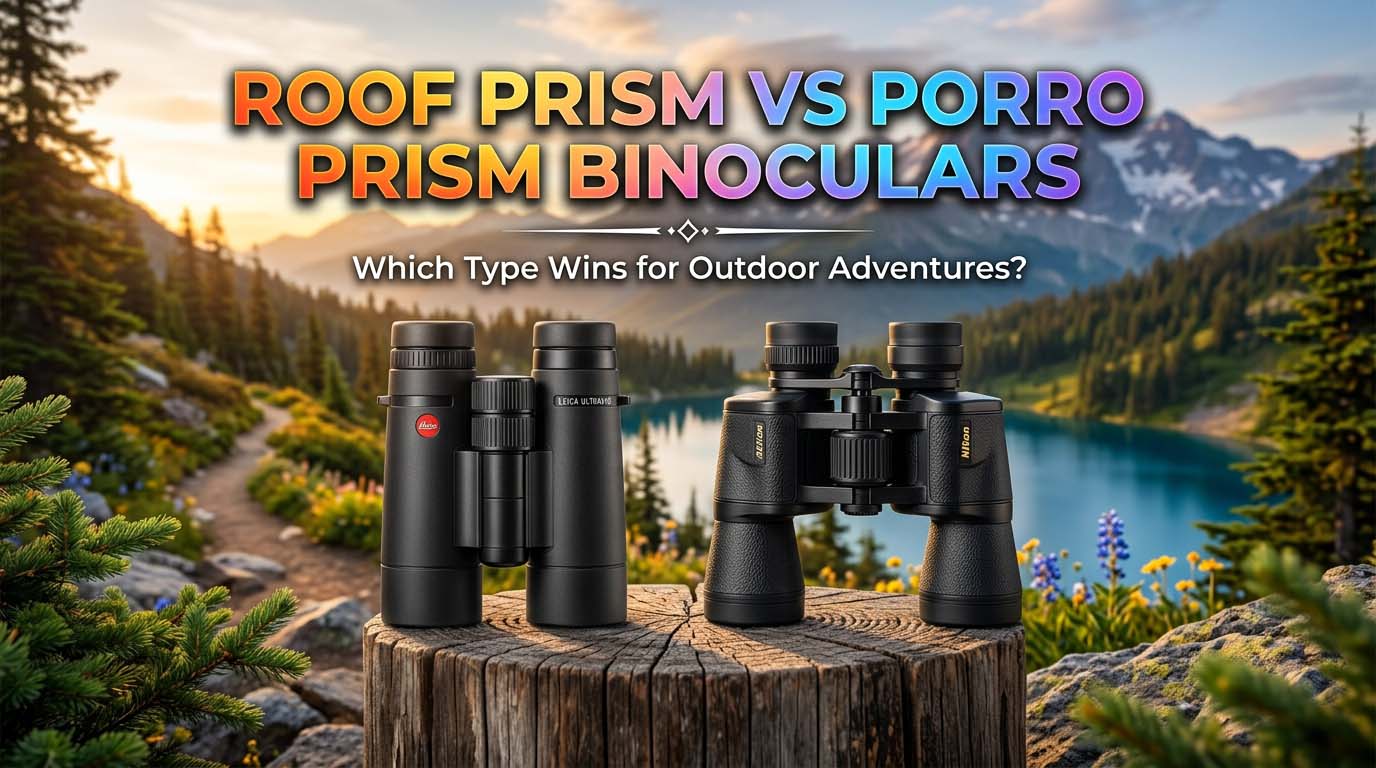
If you’ve shopped for binoculars, you’ve run into two main types: roof prism and porro prism. Neither is automatically better. Your choice depends on what you value most.
Here’s a quick decision framework:
- Choose roof prism binoculars if you want a compact, lightweight build, good weather sealing, and a modern look. Expect to pay more for quality.
- Choose porro prism binoculars if you want maximum optical value for your money, better depth perception at medium distances, and easier repairability. You’ll get great performance for less.
That’s the nutshell. Now let’s go beyond the basic geometry and look at how each system actually behaves in your hands and in the field.
The Prism System Difference That Shapes Everything
The core difference is how light travels through the prisms. In a porro prism binocular, the light takes a zigzag path – the objectives are offset from the eyepieces. That’s why porros have that classic, wide-body look with the barrels farther apart.
In a roof prism binocular, the light path is straight through the body. The prisms are folded into a compact inline design. That’s why roofs are sleeker and more modern.
But the real difference isn’t just shape – it’s the optical consequences. Porro prisms rely almost entirely on total internal reflection (TIR). TIR bounces light inside the glass without losing any intensity. No reflective coatings needed. Roof prisms, on the other hand, have at least one surface where light must hit at an angle that doesn’t allow TIR. That surface requires a reflective coating – either silver or dielectric – to redirect the light. This is why making a good roof prism is more complex and expensive.
Image Quality Showdown: Brightness, Contrast, and Resolution
Brightness in daylight and low light
Porro prisms naturally achieve 90 to 95 percent light transmission because TIR happens on nearly every surface. A decent porro from Nikon or Celestron will look bright in twilight without any fancy coatings.
Roof prisms need dielectric coatings on the reflective surface and phase correction coatings on the roof surface to get near that level. Without phase coating, a cheap roof can lose 20 to 30 percent of light – and the contrast suffers badly. A well-made roof (with both coatings) can match or even beat a porro, but it costs more.
Contrast and color accuracy
Phase shift is a problem unique to roof prisms. As light reflects off the roof edge, the wave splits and shifts. That shift reduces contrast and sharpness. Phase correction coating realigns the waves. Without it, the image looks hazy, especially in fine details like bird feathers or distant tree branches.
Porro prisms don’t have phase shift. Their contrast is naturally high. Color neutrality is also easier to achieve – budget porros often have more accurate color than comparable roofs.
Resolution at the edge
Roof prism binoculars often use complex lens designs (field flatteners, extra-low dispersion glass) to correct edge softness. High-end roofs produce tack-sharp images across the entire field. Porros typically have simpler optics; edge sharpness can fall off but often less dramatically than you’d expect. The difference is that a porro’s aberrations are easier to correct with fewer lens elements.
Real-world takeaway: A $150 porro will almost always outperform a $150 roof in low light and contrast. But a $500 roof with good coatings and ED glass can beat a $500 porro in overall sharpness and brightness.
Handling, Weather Resistance, and Long-Term Reliability
Focus mechanism feel
Porro binoculars use an external focus wheel placed near the objective end. It’s large and easy to turn with gloves, but because it’s exposed, dirt and moisture can get into the mechanism. Roofs use an internal worm gear that’s sealed inside the body. The focus action is often smoother and more precise, but it can feel stiff on cheaper models. I’ve used both in rain and snow – the sealed roof focus stays consistent; the porro wheel can get gritty after a day in mud.
Ergonomics and fit
Porros have a wider hinge because the objectives are offset. If you have a narrow interpupillary distance (IPD) or small hands, some porros can be awkward to hold. Roofs have a narrow, central hinge that fits most hand sizes easily. On the other hand, porros often have a larger IPD range, which benefits people with deep-set eyes or wide-set pupils. The barrel spacing also gives a natural, solid grip – many long-time users prefer that feel.
Waterproofing and durability
Roof prism binoculars are easier to nitrogen purge and seal. Almost all modern roofs in the mid-to-high end are fully waterproof and fog-proof. Porros are harder to seal because the offset optics create multiple gasket points. Many premium porros (like Fujinon or Swarovski Habicht) are fully waterproof, but budget porros often only claim water resistance. If you glass in heavy rain or plan to drop bins while crossing streams, a sealed roof is safer.
Repairability
Porro prisms are mounted on adjustable brackets. A technician can realign (collimate) them if they get knocked out of whack. Roof prisms are glued or epoxied into place during manufacture. Once misaligned, they often cannot be repaired economically. For field users who may take falls, a porro is more serviceable. For casual users who baby their gear, it’s less relevant.
At What Price Does Roof Prism Become the Better Buy?
This is the question that frustrates many shoppers. Here’s a simple breakpoint:
- Below $200: Buy a porro. A porro from Nikon (Action EX), Celestron (Nature DX), or Pentax (SP series) will give you better optics than any roof at this price. Cheap roofs lack phase coatings and dielectric coatings, so they look dim and soft.
- $200 to $400: You’re in the crossover zone. Some porros still dominate for raw image quality. But with careful shopping, a decent roof (like Vortex Diamondback HD or Nikon Monarch 5) becomes competitive – especially if you prioritize compactness and waterproofing.
- Above $400: Roof prisms from Vortex (Viper HD), Nikon (Monarch HG), Zeiss (Conquest HD), or Swarovski (CL Companion) deliver outstanding brightness, sharpness, and features (ED glass, field flatteners). They often surpass porros in overall performance. At this level, the design complexity is fully leveraged.
If you can only spend $150 and want the brightest view, get a porro. If you can stretch to $500 and want a one-buy-does-all binocular, a good roof is worth it.
Three-Dimensional Viewing: Is a Porro Really More Immersive?
You’ll often read that porro binoculars provide a “three-dimensional” image. That’s real, but it depends on distance.
The effect comes from the wider separation of the objective lenses. Your eyes receive two slightly different perspectives, which the brain interprets as depth. At close to medium distances – say 10 to 50 meters – porros give a genuine “pop” that can make birds and leaves look more lifelike. This is a clear advantage for birders and hikers who observe wildlife at those ranges.
At longer distances – such as astronomy, landscape scanning, or observing a mountain ridge at 500 meters – the stereo effect fades. The angle difference between the two objectives becomes too small. In those uses, both porro and roof deliver essentially the same flat image.
If you spend most of your time glassing closer objects, a porro’s depth perception is a real bonus. If you mainly watch distant birds over a lake or scan horizons, it’s barely noticeable.
Frequently Asked Questions
Can I use roof prism binoculars for astronomy?
Yes, but roofs with fast focal ratios (like many modern designs) can show more off-axis astigmatism than porros. For wide-field views of star clusters or the Milky Way, many astronomers still prefer porros because of better edge sharpness and lower cost per millimeter of aperture. High-end roofs with field flatteners (like Swarovski NL Pure) are excellent, but expensive.
What is a phase coating, and do all roof binoculars have it?
Phase coating is a thin layer applied to the roof surface that corrects phase shift. Without it, contrast and resolution suffer noticeably. Not all roof binoculars have it – many budget models omit it entirely. Check the specifications: if a roof binocular does not mention “phase coating” or “P-coating,” assume it lacks it and avoid it.
Are porro prism binoculars obsolete?
Not at all. Premium porros like the Nikon SE, Fujinon FMTR-SX, and Swarovski Habicht are still produced and highly regarded by enthusiasts. They offer fantastic optical performance at a lower price than equivalent roofs. They are not obsolete – they are a tried-and-true design that many users prefer.
Does the focus wheel placement affect balance?
Yes. Roofs have the focus wheel placed between the barrels, right under your thumb. That keeps the center of gravity near your hands. Porros have the focus wheel near the objective end, which shifts the balance forward. For long glassing sessions, the roof’s balance often feels more neutral. Porro users adapt quickly, but it’s a real ergonomic difference to try before buying.