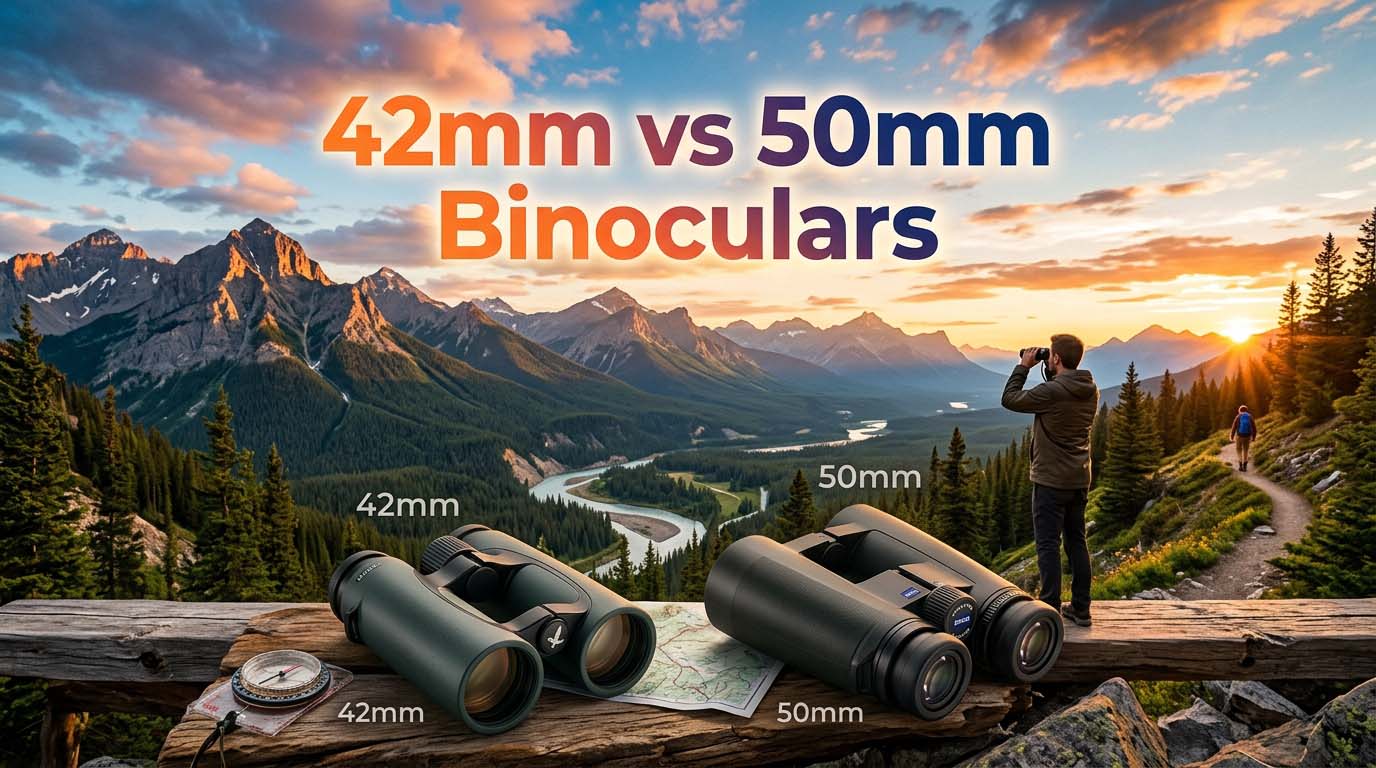
I have spent years testing binoculars across everything from dawn birding to backyard astronomy. The 42mm vs 50mm question comes up constantly. Here is the short answer: for general daytime use, hiking, birding, sports, 42mm offers the best balance of brightness and portability.
For dedicated low-light use at dawn, dusk, or under the stars, 50mm gives you a real edge in light gathering.
But the trade-off in size, weight, and balance is real. The right choice depends on your typical conditions, your magnification choice, and the size of your own pupils. This article will walk you through every factor so you never second-guess your decision.
The Physics of Aperture
The objective lens diameter, 42mm or 50mm, determines how much light enters the binocular. The light-gathering area scales with the square of the radius. A 50mm lens has about 1.42 times the area of a 42mm lens.
That translates to roughly 42% more light. In theory, a 50mm binocular makes the image brighter, especially when light is scarce.
But raw numbers don’t tell the whole story. The actual brightness you perceive depends on the exit pupil and your own eyes. A larger aperture also means a bigger, heavier chunk of glass and metal. You need to consider the whole system, not just the front lens.
Exit Pupil and Your Eyes
Exit pupil is the diameter of the beam of light that leaves the eyepiece and enters your eye. You calculate it by dividing the objective diameter by the magnification. For example:
- 10×42 gives an exit pupil of 4.2mm
- 10×50 gives an exit pupil of 5.0mm
- 8×42 gives an exit pupil of 5.25mm
- 8×50 gives an exit pupil of 6.25mm
A larger exit pupil means a brighter image, but only if your pupil can dilate enough to accept all that light. In bright daylight, your pupils shrink to around 2–3mm.
A 10×50 binocular with a 5mm exit pupil is wasted during the day; your eye simply stops down the extra light, making the image no brighter than a 10×42.
At night, your pupils open wide, to about 7mm in a young adult. A 10×50 (5mm exit pupil) is then a good match. A 7mm exit pupil (like an 8×56) would be wasted on anyone whose pupils don’t dilate that far. This brings us to the age factor.
The Age Factor – Why Your Pupil Size Matters More Than Aperture
Most people don’t realize that pupil dilation shrinks with age. A 20‑year‑old can dilate to 7mm or more in total darkness. By age 50, maximum dilation drops to about 5mm. By age 60, it is often 4.5mm or less.
What does that mean for your choice? If you are over 50, a 10×50 (5mm exit pupil) is a nearly perfect match for your eyes. A 10×42 gives you 4.2mm, still adequate, but you are leaving a little light on the table.
A 7mm exit pupil binocular is overkill for you; you will never use the extra light. Conversely, if you are 25 and want to do serious stargazing, a 50mm binocular delivers all the light your young pupils can handle.
So before you compare lens sizes, think about the size of your own eye. That often makes the decision easier than any chart.
Beyond Brightness: Twilight Factor and Resolution
Brightness gets all the attention, but there is another spec that matters for low‑light detail: the twilight factor. The formula is the square root of (magnification x objective diameter). For example:
- 8×42: √(8 × 42) = √336 ≈ 18.3
- 8×50: √(8 × 50) = √400 = 20.0
- 10×42: √(10 × 42) = √420 ≈ 20.5
- 10×50: √(10 × 50) = √500 ≈ 22.4
A higher twilight factor means better resolution in low light. At dusk, a 10×50 lets you resolve finer details, like the striping on a deer’s coat or the shape of a distant bird, compared to a 10×42.
The difference is subtle but measurable. If you often glass at dawn or dusk (hunters, wildlife photographers, serious birders), the 50mm advantage goes beyond just brightness.
But remember: magnification also affects twilight factor. An 8×50 (20.0) has a slightly lower twilight factor than a 10×42 (20.5).
So a 42mm with higher magnification can sometimes match a 50mm at lower magnification for detail in dim light. That is why you must always compare apples to apples, same magnification.
The Weight and Size Reality
I have carried both 42mm and 50mm binoculars on long hikes. The difference is not just on the scale. A typical 42mm binocular weighs between 600 and 750 grams (21–26 oz).
A comparable 50mm model often weighs 800–950 grams (28–34 oz). That extra 200 grams may not sound like much, but hanging around your neck for six hours, it becomes very real.
Prism size also grows with objective diameter. Larger objectives force manufacturers to use bigger prism housings, which shifts the balance forward. A 50mm binocular tends to be front‑heavy, making it harder to hold steady for extended periods.
Many 42mm models feel well‑balanced in the hand, especially if they use magnesium or polycarbonate frames instead of aluminum.
Dimensions also differ noticeably. A 50mm binocular is typically 20–30mm longer and 15–20mm wider than its 42mm sibling. That affects how it fits in a daypack or chest harness. For all‑day carry, 42mm is the practical limit for most people.
Use‑Case Scenarios
Daytime Hiking and Birding
For bright‑light use, 42mm is the sweet spot. It gathers plenty of light for crisp, contrasty images from dawn to dusk. You rarely miss the extra 8mm of aperture because your pupils are contracted anyway.
And the lighter weight makes it easier to keep the binoculars up at your eyes all day. I have switched from 50mm to 42mm for general birding and never regretted it.
Astronomy and Low‑Light Hunting
If your main use is under the stars or in deep twilight before legal shooting time, 50mm gives a visible edge. Star clusters, nebulae, and faint objects are noticeably brighter. The larger exit pupil at lower magnifications (e.g., 8×50) is especially helpful for scanning the Milky Way.
Hunters glassing open fields at last light also appreciate the extra resolution from the higher twilight factor. Just be prepared to mount them on a tripod for long sessions; hand‑held shake becomes an issue with heavier optics.
All‑Rounder Compromise
Many people want one binocular for everything. I recommend a 42mm model with a lower magnification, like 8×42. The 5.25mm exit pupil works well for low‑light use, almost as good as a 10×50’s 5mm exit pupil, and the weight stays manageable.
You lose a little reach compared to a 10x, but the stability and comfort make up for it. If you must have high magnification for distant viewing, a 10×42 is a reasonable all‑rounder, though it struggles more in twilight than an 8×50.
Compact Travel
For backpacking, international trips, or any situation where every gram counts, 42mm is the largest you should consider. Many 42mm models are still compact enough to slip into a jacket pocket or waist pouch. A 50mm binocular, even a modern one, demands a dedicated spot in your pack and will be noticed on your chest after a few miles.
Avoiding the Common Mistake: Always Compare at the Same Magnification
I see people say, “I tried 8×42 and 10×50 and the 50mm was much brighter.” That is a skewed comparison. The 10×50 has a larger aperture and higher magnification — it should be brighter and more detailed. The real question is: which lens size is better at the same magnification?
True pairs:
- 8×42 vs 8×50
- 10×42 vs 10×50
When you compare those, you isolate the effect of aperture alone. A 10×42 and a 10×50 differ only in light grasp. A 10×50 will be heavier and slightly brighter, but the field of view and magnification are identical. That clean comparison avoids the confusion that plagues most online advice.
Also, do not compare 8×42 with 10×50 — the magnification difference muddies everything. Always keep magnification constant when deciding between 42mm and 50mm.
Frequently Asked Questions
What is the twilight factor of 8×42 vs 10×50?
8×42 has a twilight factor of about 18.3. 10×50 has a twilight factor of about 22.4. The 10×50 resolves finer details in dim light due to both higher magnification and larger aperture.
Can I use 42mm binoculars for stargazing?
Yes. For casual stargazing — looking at the Moon, bright star clusters, and major constellations — a 42mm binocular works fine. For fainter objects like nebulae and galaxies, a 50mm or larger helps, but a 42mm on a tripod with low magnification (8x) still gives satisfying views.
Is 50mm too heavy for a day hike?
It depends on your tolerance. Most 50mm binoculars weigh 800–950 grams. Many hikers find that acceptable for short trips, but for all‑day use, the extra weight and bulk become a burden. A harness helps, but 42mm is generally preferred for long hikes.
Does a larger objective lens automatically give a wider field of view?
No. Field of view is determined by the eyepiece design and magnification, not the objective size. You can find 8×42 binoculars with a wide field and 10×50 models with a narrow field. Aperture and field of view are mostly independent.
Are 42mm binoculars considered full‑size or mid‑size?
42mm is the standard “full‑size” binocular. Anything above 50mm is often called “large aperture.” Some compact full‑size models exist at 40–42mm, and 32mm is considered “mid‑size.”
How does the price differ between comparable 42mm and 50mm models?
For the same brand and series, a 50mm model typically costs 15–30% more than the 42mm version. The extra cost comes from more glass, larger prisms, and heavier construction. However, budget 50mm options can be cheaper than premium 42mm models — build quality and glass coatings matter more than size alone.
What does an exit pupil below 3mm mean for my viewing comfort?
An exit pupil below 3mm (e.g., 10×32 gives 3.2mm, 12×42 gives 3.5mm) becomes uncomfortable in low light. The image appears dim, and you must align the binocular precisely with your eye or you see black cutoffs. For daytime use, it is acceptable, but for long sessions, you want at least 4mm.
Do I need a tripod for 50mm binoculars more often than 42mm?
Yes. The extra weight and magnification (if you use 10x or 12x) make hand‑held shake more noticeable. A tripod or monopod improves stability, especially for astronomy or prolonged scanning. Many 50mm binoculars come with a tripod adapter built in.
Choosing between 42mm and 50mm is not about which is “better” — it is about what fits your eyes, your gear, and your typical light conditions. Measure your own exit pupil needs, compare at the same magnification, and never forget the physics of weight. Do that, and you will buy the right binocular the first time.