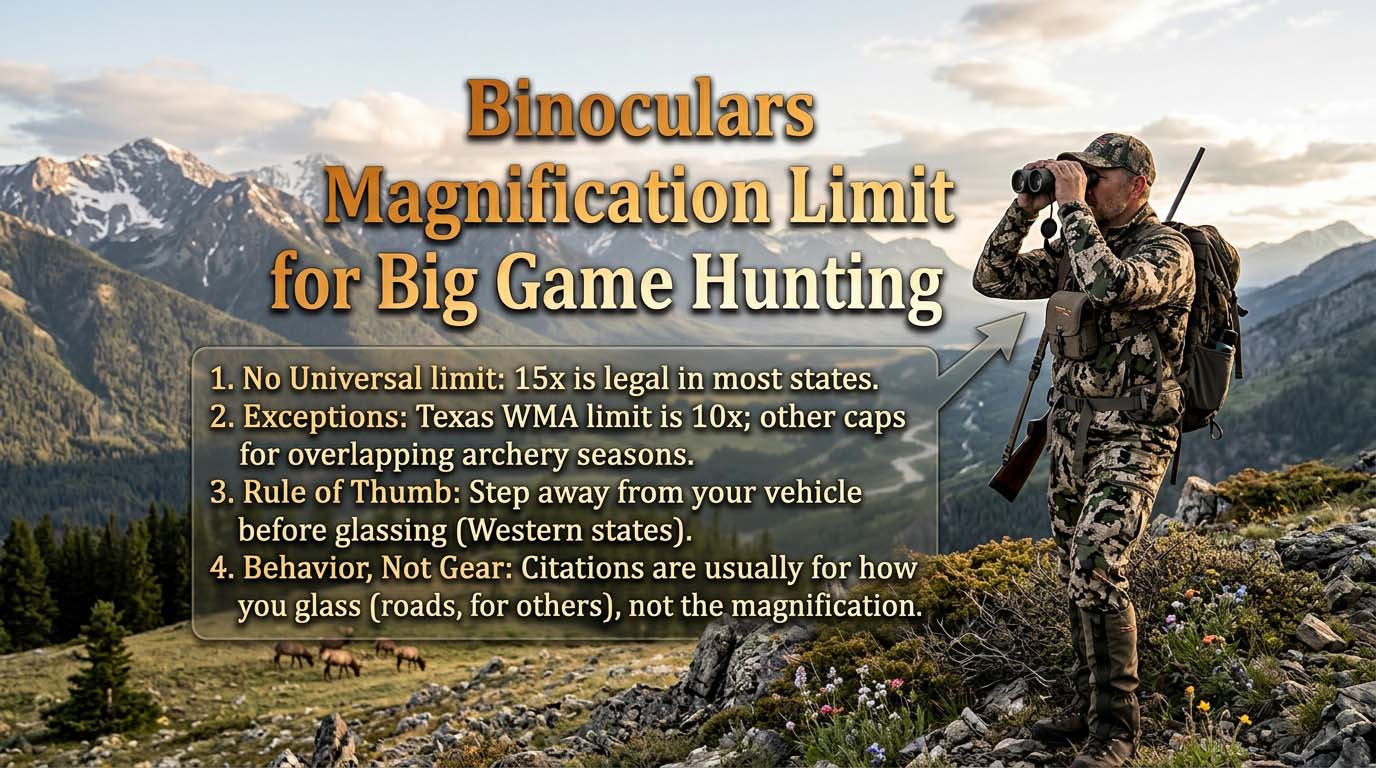
If you are serious about big game hunting, you have probably wondered how high you can push magnification before it stops helping and starts hurting. The answer is not just a number pulled from someone else’s gear bag. It comes from your own body and the physics of light.
Most hunters who spend real time behind glass eventually land on 12x as the ceiling for handheld binoculars. Here is why that limit exists and how to know if it applies to you.
How Human Physiology Sets the Practical Magnification Boundary
Binoculars do not just magnify the elk or the mule deer you are watching. They magnify every tiny shake your hands and arms make. Even when you think you are perfectly still, your body tremors at rest.
For the average hunter, that natural tremor is about 0.15 degrees of arc per second. At 10x magnification, that becomes 1.5 degrees of perceived movement inside the view. At 12x it is 1.8 degrees. At 15x it jumps to 2.25 degrees.
You might not notice this difference while sitting in your living room. But out on a mountainside with a light breeze, your heart pounding after spotting a bull, that tremor doubles or triples. The image becomes a blur of motion that makes counting antler points or judging body size impossible.
That is why 12x is the functional handheld ceiling for big game hunting. Above that, you need some kind of support.
This is not a gear recommendation from a magazine. It is the reality of your own nervous system. If you have particularly steady hands or you glass mostly from a sitting position with elbows braced, you might push to 12x comfortably. But 15x handheld in the field will frustrate you nine times out of ten.
Exit Pupil, Light Transmission, and the Dawn-Dusk Limit
Big game animals move most at dawn and dusk. Those are the hours when you need every photon your binoculars can gather. Exit pupil is the circle of light that exits the eyepiece and enters your eye.
You calculate it by dividing the objective lens diameter by the magnification. A 10×42 gives a 4.2mm exit pupil. A 12×42 gives 3.5mm. A 15×42 gives only 2.8mm.
As we age, our pupils do not dilate as wide. A young hunter might have a 7mm pupil in the dark. A middle-aged hunter might max out at 5mm. When your binoculars’ exit pupil drops below your own pupil size, the image dims noticeably. For most big game hunters, an exit pupil of 4mm or larger is ideal for low light.
That means a 12×50 (4.2mm exit pupil) is the highest viable handheld combination. A 15×56 (3.7mm exit pupil) works but only if you are willing to accept a dimmer view during critical shooting hours.
The limit here is not just a number. It is a trade-off between reach and usable light. If you hunt from a treestand or a blind where shots often happen within 100 yards, 8x or 10x with a big exit pupil will let you see an extra 15 minutes of legal shooting light.
If you hunt open country and need to identify a buck at 500 yards in the last ten minutes of daylight, you might need the magnification but will lose light. That is why many high-end hunters carry two binoculars: a lower power for scouting and a higher power for confirmation.
Field of View and the 300-Yard Search Problem
Picture yourself scanning a sagebrush flat for the tip of an antler. At 300 yards, a small piece of bone can look like a twig. You need magnification to see it, but you also need enough field of view to cover ground quickly.
An 8x binocular gives you roughly 400 feet of width at 1000 yards. A 12x drops that to about 280 feet. A 15x takes you down to 220 feet.
That narrowing might not sound dramatic, but in the field it changes everything. With 8x you can sweep a hillside in three or four passes. With 15x you need eight or ten passes, and you are more likely to miss movement at the edges.
Worse, once you spot an animal and it takes a step, you lose it in the narrow tube. You then have to pull your binoculars down, find your reference point again, and start over. That wasted time can cost you the shot.
For big game hunting, especially when animals are not standing still, a field of view below 300 feet at 1000 yards is a serious handicap. That is why 12x is the comfortable top end for most mobile hunting.
If you are glassing from a fixed position for long periods, you can use a tripod to hold the view steady while you search slowly, but for walking and glassing, wider is almost always better.
Why Variable Magnification Changes the Limit Calculation
Variable zoom binoculars, like an 8-12x or 10-15x, let you have your cake and eat it too, but only up to a point. When you need a wide field of view to find animals, you dial down to low power.
When you need to confirm details, you zoom in. This shifts the practical limit higher. You can carry a 10-15x and use it at 15x only when already locked onto a target. That works because you are not trying to search at high power.
But variable binoculars have trade-offs. Their maximum field of view is narrower than a fixed power of the same magnification. They also have more glass inside, which reduces light transmission slightly.
They are heavier and bulkier. For a hunter who carries binoculars all day, those ounces add up. Many experienced western hunters find that a quality fixed 10x or 12x serves them better than a zoom that tries to do everything.
If you do choose variable, keep the magnification range tight. An 8-12x gives you useful low and high ends. A 10-20x is a bad idea for handheld use because at 20x you are back in the tremor problem and the exit pupil drops too low.
When 15x, 18x, or 20x Becomes Viable
The magnification limit dissolves the moment you put your binoculars on a tripod. Many serious western hunters carry a compact 15x eye piece (or a dedicated 15x binocular) with a lightweight tripod. They set up at a glassing point and spend 30 minutes to an hour scanning a basin.
With the support, tremor disappears, the binocular exit pupil becomes less critical because you can steady your head and eye position, and the narrow field of view is manageable because you are not walking and scanning.
This is a different category of tool. If you plan to glass from a single location for an hour or more, 15x or even 18x gives a real advantage.
You can see antler points at distances where a 10x user might only see a vague shape. But you have to carry the tripod, which adds weight and setup time. For mobile hunting over varied terrain, stick to 12x as the handheld ceiling.
The inflection point is simple: if you glass for more than 30 minutes without moving, bring a tripod and go higher. If you move every few minutes, keep it to 12x or less.
Your Personal Stability Threshold: A Self-Assessment Guide
You do not need to guess where your personal limit falls. Do this test at home. Sit at a table and brace your elbows on the surface. Hold a 10x binocular to your eyes and look at a small detail, like a light switch across the room.
Watch how much the image bounces. That is your natural tremor at 10x. Now do the same without bracing your elbows. Notice the increase. Now try 12x if you have access. The point where the image feels “busy” and you cannot hold it still enough to read fine print is your personal handheld limit.
Count on adrenaline and fatigue making this worse in the field. Your home test will show you the best-case scenario. Subtract two power levels for real-world hunting. If you can hold 12x steady at the kitchen table, expect to need 10x after hiking uphill for two hours with a pack.
This self-assessment is more reliable than any chart or list of recommendations. It puts the decision in your hands based on your own body.
Frequently Asked Questions
Is 8x magnification ever a limit for big game?
Yes, but in the opposite direction. 8x becomes a limit when you need to identify antler points or judge trophy quality at long range, say 400 yards or more in open country.
For tight timber or short shots under 100 yards, 8x is excellent. For wide open basins where you might need 500-yard identification, 8x falls short.
Does objective lens size change the magnification limit?
No, the magnification limit is set by your stability and the optical trade-offs. But a bigger objective gives you more room to push higher. A 12×50 has a 4.2mm exit pupil, workable in low light.
A 12×32 gives only 2.7mm, which is terrible at dawn and dusk. So objective size does not change the upper end, but it determines whether that magnification is useful in real hunting conditions.
Can I use 15x binoculars if I have very steady hands?
Potentially, but you should test it under field conditions. Fatigue, adrenaline, wind, and cold all degrade your stability. Even the steadiest hunter will find 15x handheld a struggle when glassing for long periods. Most who try it end up using a tripod or switching to 12x.
What about image stabilization binoculars?
Image stabilization binoculars effectively raise the magnification limit to 18x or even 20x handheld. They use gyros or electronics to cancel tremor. The trade-offs are weight, battery life, and cost.
For big game hunting where reliability is key and you may be far from a charger, they remain a niche tool. Many hunters prefer a simpler, lighter setup that cannot fail.
Does magnification matter differently for bowhunting versus rifle hunting?
Yes, significantly. Bowhunters usually engage under 60 yards and need a wide field of view to track movement and pick a spot. Lower magnification, like 6x to 8x, is ideal. Rifle hunters making 300- to 500-yard shots need higher magnification for precision identification. The limit still applies, but the optimal range shifts.
Choosing Your Limit | Matching Magnification to Your Hunting Style
There is no universal best power, but three profiles cover most situations.
Timber or whitetail hunter. Shots under 100 yards, dense cover. 8x or 10x is your ceiling. Field of view matters more than reach. You need to pick up antler movement quickly in brush and follow a deer through gaps.
Mountain or mule deer hunter. You glass open country, shots from 200 to 400 yards. 10x or 12x handheld is the sweet spot. If you also carry a tripod for long glassing sessions, a 15x eyepiece makes sense.
Elk or plains hunter. You spot long distances over varied terrain. 12x is the handheld ceiling, and a 15x on a tripod for dedicated glassing is a powerful combination. Your pack weight will be higher, but the ability to see antler points at a mile can save you hours of walking.
In every case, remember that the binoculars you actually use matter more than the ones that look impressive on paper. A 10×42 that you carry comfortably and can hold steady will serve you better than a 15×56 that stays in the truck because it is too heavy to hike with.
The limit is not a rule written in a manual. It is a function of your own body, your hunting style, and the light you hunt in. Respect that, and you will pick the right power every time.