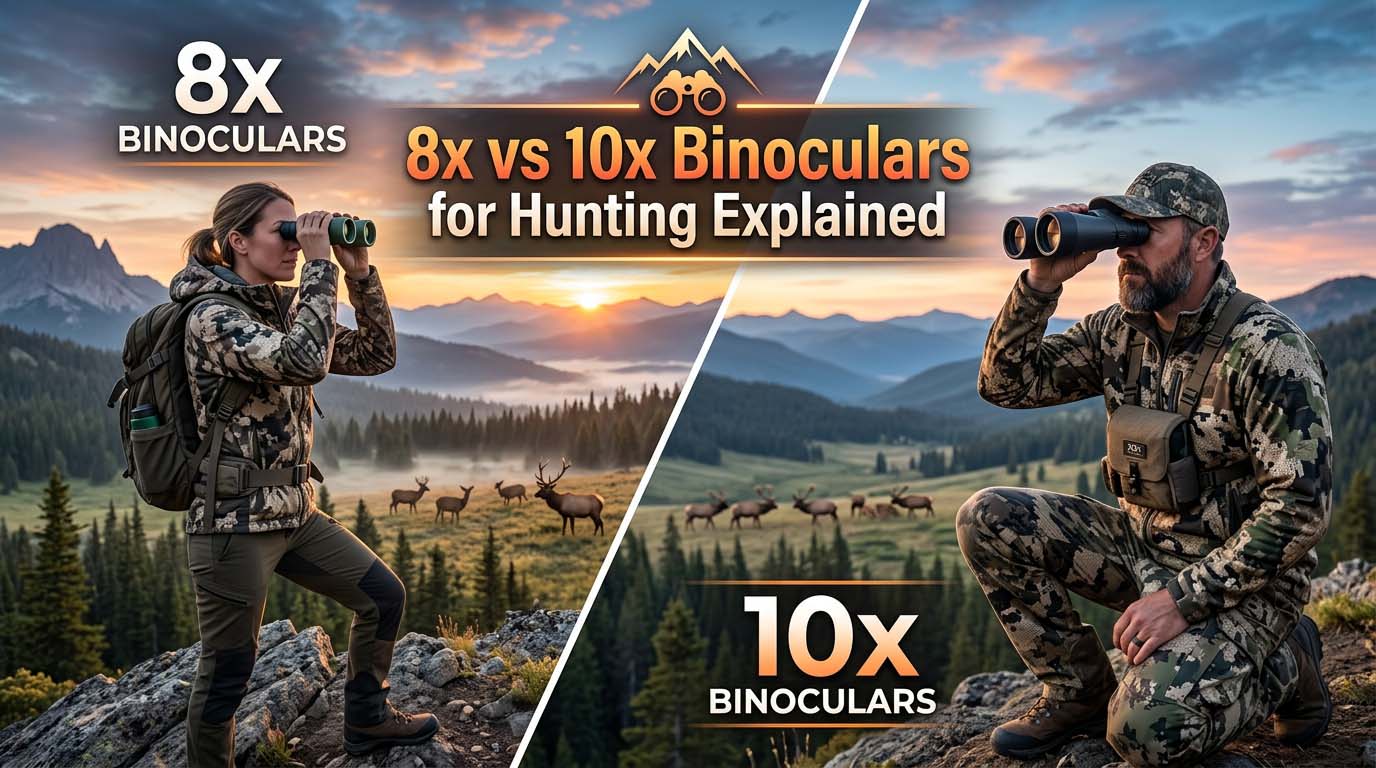
You are here because you have heard both sides. One hunter swears by 8x. Another says 10x is the only way. Both of them are right, but only for their own situation. That is the truth that most articles skip.
The 8x vs 10x decision is not about which magnification is better in some lab test. It is about what fits your eyes, your hunting ground, and how you actually glass.
For most hunters, 8x is the safer all-around pick. For a meaningful number of hunters, 10x is clearly the better tool. Your job is to figure out which group you fall into.
This guide walks you through every factor that matters. By the end, you will know your answer with confidence.
What You Gain and Give Up With Each Magnification
Magnification does one simple thing. It makes the image bigger. An 8x binocular makes a deer at 100 yards look like it is 12.5 yards away. A 10x binocular makes that same deer look like it is 10 yards away. That extra reach sounds like a pure win, but it comes with trade-offs.
The bigger the magnification, the more you also magnify your own movement. Your heartbeat, your breathing, the slight tremor in your hands- all of it gets amplified.
A 10x binocular can show you more detail, but only if you can hold it steady enough to actually see that detail. If you shake, the bigger image becomes a blurry mess, and the 8x actually lets you see more because the image stays calmer.
Real Field of view is the other big trade-off. An 8x binocular shows you a wider area than a 10x of the same quality. That wider view matters when you are scanning for movement in thick brush or trying to follow a running animal.
With 10x, you see a narrower slice of the world, which means you have to move the binocular more to cover the same ground.
These are the core physics of magnification. There is no way around them. But the real question is how these trade-offs land in your specific hunting situation.
How Your Hunting Terrain Points to the Right Pick
Hunting is not one activity. It is many different activities that happen to share the goal of taking an animal. The terrain you hunt in changes everything about what a binocular needs to do.
Western Spot-and-Stalk
Out west, you are often glassing across canyons and open basins. Your targets are miles away before they become close. You spend hours behind your binoculars, scanning slowly and methodically.
Most serious western hunters use a tripod or a bipod to support their binoculars. That changes the equation entirely.
When your binocular is on a stable support, the shake argument for 8x disappears. You can run 10x without any penalty because the tripod holds everything still. The extra magnification gives you a real advantage at long range. You can pick apart a hillside and spot the ear flick of a bedded mule deer that you would miss with 8x.
If you hunt this way and you use a tripod, 10x is the strong choice.
Eastern Still-Hunting
The woods east of the Mississippi are a different world. You are in thick cover, often inside 50 yards when you see the animal. Quick movement and snap shots are common. You rarely have time to set up a support. Everything is handheld and fast.
In this environment, the wider field of view of 8x is a real asset. You pick up movement at the edge of your vision. You find the deer in the brush faster. The steadier image of 8x also helps because you are breathing hard from walking and you have no support.
If you hunt eastern hardwoods from the ground, 8x is your binocular.
Treestand Hunting
Sitting in a treestand is its own category. You have time. You are stationary. You can rest your elbows on your knees or brace against the tree. That makes holding a 10x much easier than when you are on the move.
The question becomes what range you expect to shoot. In many treestand setups, shots are under 40 yards.
For that, 8x is plenty. You do not need the extra magnification, and the wider view helps you track a deer moving through shooting lanes. If you hunt open fields from a treestand and take longer shots, 10x starts to make sense.
Your Age Changes the Low-Light Equation
This is the factor that almost nobody talks about. It matters more than most of the spec sheet details.
The Age-Pupil Connection
Your pupils open wider in dim light to let in more light. A young hunter in their twenties can have pupils that dilate to 7mm.
A hunter in their mid-fifties might only reach 4mm to 5mm even in total darkness. That is a normal part of aging. Nothing is wrong with your eyes. They just cannot open as wide anymore.
The exit pupil is the shaft of light that leaves the binocular and enters your eye. You calculate it by dividing the objective size by the magnification. A 10×42 binocular has a 4.2mm exit pupil. An 8×42 has a 5.25mm exit pupil.
Here is where the age factor hits. If your pupil only opens to 4.5mm, then a 10×42 with its 4.2mm exit pupil delivers nearly all the light your eye can accept.
The extra exit pupil from an 8×42 goes to waste because your eye cannot use it. The low-light advantage of 8x shrinks dramatically for older hunters.
What This Means for Your Choice
If you are under 40, the 8x has a real low-light edge that you can feel. The bigger exit pupil matches your bigger pupil. You see brighter images at dawn and dusk.
If you are over 50, the low-light difference between 8x and 10x in a 42mm binocular is much smaller. Your eye is the bottleneck, not the glass. A 10×42 may well give you all the light you can use, and you get the benefit of higher magnification.
This is not a knock on older eyes. It is just physiology. It means the conventional advice to always pick 8x for low light needs to be adjusted based on who is looking through the binocular.
How Tripods and Other Gear Shift the Balance
The biggest single factor that determines whether 10x shakes too much is whether you support the binocular. If you use a tripod, the shake problem is gone. Period. And more hunters are using tripods than ever before.
A lightweight carbon fiber tripod with a binocular adapter turns any binocular into a stable platform.
You can sit behind it for an hour and not feel the strain. At that point, 10x gives you more reach with zero stability penalty. Many Western hunters use 10x or even 12x on tripods for exactly this reason.
Chest harnesses that cinch the binocular tight against your body also help. They absorb some of the natural sway and give you a more stable platform for handheld use.
They do not eliminate shake as a tripod does, but they make 10x more manageable for some hunters.
If you are willing to carry a tripod, or you already use one for spotting, 10x becomes a much more attractive option. If you refuse to carry extra weight and you will always glass handheld, 8x is the safer bet.
A Simple Decision Framework
You do not need to memorize all the factors. You just need to answer a few questions about yourself. Be honest.
1. Do you use a tripod or bipod for glassing?
Yes — Go with 10x. The stability problem is solved.
No — Move to question 2.
2. Are you over 50?
Yes — The low-light advantage of 8x is smaller for you. 10x becomes a real option, especially if you use any support at all.
No — Move to question 3.
3. Do you hunt mainly in thick eastern woods or similar heavy cover?
Yes — 8x gives you the wider view you need. Pick 8x.
No — Move to question 4.
4. Do you hunt open country where most shots are over 200 yards?
Yes — 10x gives you a meaningful advantage for spotting and evaluating game at distance.
No — You are in the middle. 8x is the safe all-around choice.
5. Do you wear glasses?
Yes — Check the eye relief spec. Many 10x binoculars have shorter eye relief. You need at least 16mm of eye relief to see the full field. If you find a 10x with 17mm or more, it can work. If not, 8x typically offers more eye relief.
That is the whole framework. Your answer comes from your specific combination of age, terrain, gear, and eyesight.
What to Look for When You Buy
Once you know 8x or 10x, the next step is picking the right objective size and confirming the specs that matter.
Objective size. For most hunters, 42mm is the sweet spot. It balances light gathering and weight. A 10×42 or 8×42 works for almost every scenario. If you hike long distances, a 10×32 or 8×32 saves weight but gives up low-light performance.
If you hunt from a treestand and weight does not matter, a 10×50 or 8×50 gives the brightest image at dawn and dusk.
Eye relief. If you wear glasses, this is the spec to check. Look for 16mm minimum; 17mm or more is better. Many 10x binoculars have shorter eye relief than their 8x counterparts. Do not assume. Check the number.
Build quality. A binocular is a tool you rely on in bad weather. Look for nitrogen purging to prevent fogging, and O-ring seals for waterproofing. Cheap binoculars fail at the worst time.
Weight. A 10x binocular often weighs the same as an 8x of the same line. The difference is usually negligible. But heavier binoculars are harder to hold steady, which matters more for 10x. If you go 10x and plan to glass handheld, keep weight in mind.
Frequently Asked Questions
Is 10x harder to keep steady for someone with naturally shaky hands?
Yes. Some people have more natural hand tremor than others. If you know your hands are not steady, 8x is the safer choice.
You can test this yourself by comparing the two magnifications in a store. Hold each to your eyes and see which one gives you a cleaner image. Your own body tells you the answer.
Do compact binoculars in 8x and 10x behave differently than full-size?
Compact binoculars with 32mm objectives have smaller exit pupils. An 8×32 gives you a 4mm exit pupil. A 10×32 gives you only 3.2mm.
That is tight, especially in low light. Compacts are fine for daytime use, but they struggle at dawn and dusk. If you hunt the edges of the day, stick with 42mm objectives.
What magnification do experienced guides and outfitters actually use?
It varies by region. Western guides who glass from tripods often use 10x or even 12x. Eastern guides who move through thick cover tend toward 8x. Many guides own both and pick based on the hunt. That tells you something. This is not a question with one right answer.
Can I use a 10x binocular comfortably on a boat or vehicle?
The movement of a boat or vehicle adds an external source of shake that you cannot control. In that situation, 8x is much easier to use. The extra magnification of 10x makes motion sickness more likely and makes it harder to hold a steady image. Stick with 8x for water or vehicle-based hunting.
How much more do 10x binoculars typically cost than comparable 8x models?
At the same quality level, the price difference is usually small. Sometimes the 8x and 10x versions of the same binocular line cost the same.
Other times the 10x is slightly more due to tighter manufacturing tolerances in the optics. The difference is rarely the deciding factor. Buy the one that fits your needs, not the one that saves twenty dollars.
If I already own an 8×42, when should I upgrade to 10x?
You do not need to upgrade unless you find yourself in situations where the 8x leaves you wanting. If you consistently wish you could see more detail at long range, or if you have started using a tripod and want to take advantage of the stability, a 10x is a worthwhile addition.
But there is no urgency. An 8×42 is a perfectly capable binocular for almost all hunting. If it works for you, keep using it.