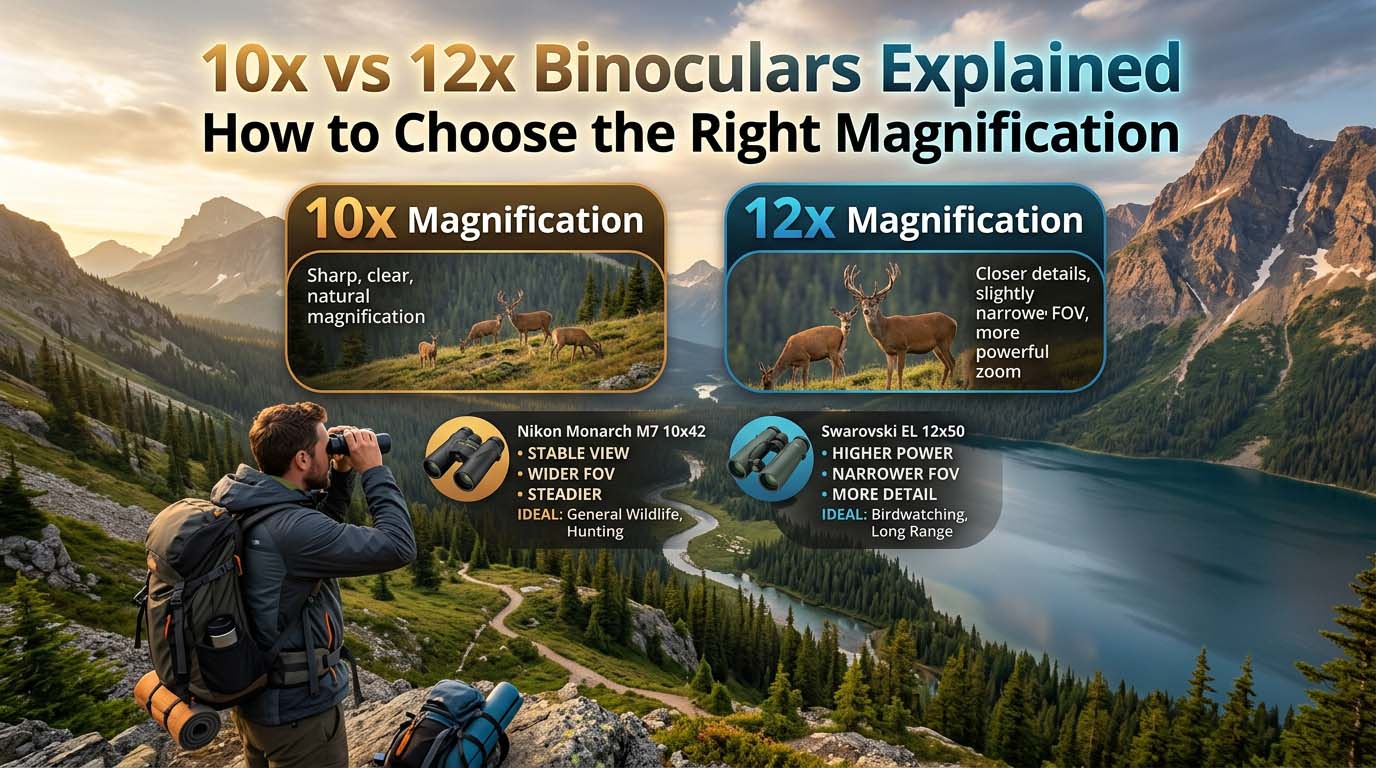
If you are reading this, you already know that 10x and 12x are the two most common magnifications for serious binoculars. What you probably do not know is which one is right for you.
The answer is not a simple “get the higher one.” The 10x vs 12x decision comes down to matching magnification to your primary use scenario, your physical stability, and the environments where you will glass most often.
I have spent years behind both magnifications in different settings. The wrong choice will frustrate you in the field in ways that no amount of optical quality can fix. Here is how to get it right.
The 10x vs 12x Decision Starts With Your Scenario
The first step is to be honest about what you actually do with your binoculars. The best choice for a western hunter glassing miles of open country is different from what works for someone hiking dense timber or watching birds in a forest.
Think about your typical use. Are you mostly looking at objects that are 200 yards or farther? Do you glass for long periods without moving? Do you hold your binoculars freehand or do you use a tripod? Your answers to these questions point toward one magnification or the other.
Here is a simple self-assessment checklist. Check the boxes that apply to your dominant use:
- I regularly need to identify animals or objects at distances beyond 300 yards.
- I glass from a stationary position, often using a tripod or vehicle rest.
- I hunt or observe in open terrain like prairies, plains, or alpine meadows.
- I rarely hike more than a mile with my binoculars around my neck.
If you checked most of these, you are a good candidate for 12x. If not, 10x is likely the better fit.
The long-range western hunter benefits from 12x because the extra magnification reveals detail at distances where 10x leaves you guessing.
The eastern woods hunter or all-around enthusiast finds that 10x’s wider field of view helps them spot movement in cover and glass for longer periods without fatigue.
The Physics That Drives the Trade-Offs
Now let us get into the “explained” part. Why do these trade-offs exist? It comes down to a few hard rules that apply to every binocular.
Exit Pupil and Low-Light Performance
The exit pupil is the shaft of light that leaves the eyepiece and enters your eye. You calculate it by dividing the objective lens diameter by the magnification. A 10×50 binocular gives you a 5mm exit pupil. A 12×50 gives you about 4.1mm.
Your pupils dilate to roughly 5- 7 mm in low light. A 5mm exit pupil fills your dilated pupil well. A 4mm exit pupil delivers less light to your eye.
This matters most at dawn and dusk, when you need every photon you can get. If you do much glassing in marginal light, the 10x gives you a real advantage.
Hand Shake Amplification
Every binocular magnifies your body’s natural tremor. A 12x does not just magnify the image 20 percent more than a 10x. It magnifies your hand shake by the same factor.
The perceived instability is worse because the same angular movement occupies more of the actual field of view. This is why many people find 12x binoculars difficult to hold steady without support.
Atmospheric Limitations
At 12x, you start seeing things in the air that you would rather not see. Heat shimmer from the ground, haze, and mirage become visible at long distances.
This means that even though you have extra magnification, the useful detail you can extract may not increase much. You see a larger, shakier image that is also degraded by atmospheric distortion.
The Real-World Consequences of Each Choice
Let us translate that physics into what you will actually experience in the field.
Dawn and Dusk Performance
A 10x binocular with a 42mm or 50mm objective delivers a brighter, more usable image in low light. The 5mm exit pupil means your eye gets all the light the binocular can gather.
With a 12x, the smaller exit pupil means you are seeing a dimmer image. On a morning when light is fading fast, the 10x will let you see clearly for several more minutes than the 12x.
Scanning Behavior
Field of view is the area you see at a given distance. A 10x typically has a wider field of view than a 12x. This matters when you are scanning brush lines, timber edges, or fields. With a 10x, you can sweep an area quickly and pick up movement with your peripheral vision.
With a 12x, you have to be more deliberate and methodical, which takes longer and can fatigue your eyes faster.
Extended Glassing Sessions
Holding a 12x steady requires more tension in your arms, shoulders, and neck. After 30 minutes of continuous glassing, that tension translates into fatigue. You may find yourself putting the binoculars down more often. A 10x lets you glass for longer periods with less strain.
Distance Verification
At distances beyond 200 yards, the 12x provides a genuine identification advantage. If you need to determine whether that shape on the ridge is a legal buck, the 12x will likely let you see antler points when the 10x leaves you guessing. This is the main reason western hunters and long-range shooters choose 12x.
The Field Test Protocol
Before you spend money, you can test which magnification works for you. Here is a systematic way to evaluate both options side by side.
- Hand-held stability test. Take a 10x and a 12x outside. Look at a small, detailed object like a license plate or sign at 100 yards. Hold each binocular freehand and see which one you can hold steady enough to read the text. If you cannot read the text with the 12x, it will not help you identify animals at a distance.
- Field of view comparison. Find a scene with multiple objects at different distances. Practice acquiring each object quickly with both magnifications. Notice how the narrower field of view on the 12x requires more deliberate aiming.
- Low-light assessment. Test at dawn or dusk. Look at a dark, shaded area with both binoculars. If the 12x looks noticeably dimmer, it will cost you visibility in the last minutes of shooting light.
- Extended session test. Use each binocular continuously for 30 minutes. Note when you start feeling eye strain or hand fatigue. The one that lets you glass longer without discomfort is your choice for all-day use.
- Target size relevance. Compare the binoculars on targets that match what you actually observe. Looking at a deer at 200 yards is different from looking at a bird at 50 yards. Test with realistic targets.
The Ergonomic and Practical Differences
Magnification also affects how the binocular handles and how it feels over time.
Weight and Balance
Higher magnification often requires more glass elements, which adds weight. A 12×50 can feel noticeably heavier than a 10×42 even if the objective size differs. The extra weight shifts the balance point forward, making it harder to hold steady for extended periods.
Eye Relief and Eyeglasses
If you wear glasses, eye relief is critical. Eye relief is the distance from the eyepiece lens to your eye where you can see the full field of view. Higher magnifications often have shorter eye relief. Look for at least 16mm of eye relief if you wear glasses. The 10x often provides more comfortable eye relief than the 12x.
Tripod Dependence
A 12x binocular becomes much more useful on a tripod. If you are willing to carry a tripod and use it, the 12x’s stability issues disappear. But if you need a binocular you can grab and scan, the tripod requirement is a liability.
The Compromise Paths Worth Considering
If you are still torn between the two, some alternatives bridge the gap.
Variable Magnification Binoculars
Zoom binoculars like 8-12x or 10-15x let you adjust magnification on the fly. They give you the wide field of view at lower power for scanning and the extra reach at higher power for detail verification.
The trade-off is that zooms typically have smaller fields of view at each power and slightly less optical quality than fixed-power models.
Image-Stabilized Binoculars
Image stabilization at 12x eliminates the hand-shake problem. Stabilized 12x binoculars are remarkably steady and let you see detail that would be impossible to resolve with an unstabilized 12x. They are heavier and more expensive, but for many users they make 12x practical for the first time.
10x With Superior Glass
A premium 10x binocular with high-end coatings and large objectives often outperforms a budget 12x, especially in low light. The better contrast and resolution from excellent glass can make a 10x image more useful than a dim, shaky 12x image. Do not assume higher magnification always wins.
The Rangefinding Binocular
A rangefinding binocular gives you distance data directly in the image. This reduces the need for maximum magnification because you do not have to estimate distance by image size. You can confirm “that is a legal buck” with a 10x better than a 12x if you also know it is at 320 yards.
Frequently Asked Questions
Can I use a 12x binocular without a tripod if I brace against a tree or vehicle?
Yes, you can. Bracing against a solid object like a tree trunk, fence post, or vehicle window adds stability and makes 12x binoculars usable freehand for short sessions. For long glassing sessions, a tripod is still better, but many hunters use 12x successfully with just a brace.
How does objective lens size interact with the 10x vs 12x decision?
Objective lens size determines light gathering. A 10×42 gives a 4.2mm exit pupil. A 12×50 gives a 4.1mm exit pupil. The larger objective on the 12x compensates somewhat for the higher magnification. If you choose 12x, go with at least 50mm objectives. If you choose 10x, 42mm is adequate for most conditions.
What is the minimum eye relief I need if I wear glasses while using high-power binoculars?
16mm is the absolute minimum for glasses wearers. 18mm or more is better. The TORIC 10x has 19.3mm of eye relief, which is excellent. The 12.5x has 16.6mm, which still works for most glasses wearers but is less forgiving.
Are 12x binoculars suitable for birding, or is 10x the maximum recommended?
For most birding, 10x is the practical maximum. Birding involves quick acquisition, tracking moving subjects, and often scanning dense foliage. The wider field of view and better stability of 10x make it the standard choice. Some birders use 12x for open-water or mountain birding, but it is a niche application.
How much difference will I actually notice between 10x and 12x when looking at a deer at 300 yards?
At 300 yards, the difference is significant. The 12x makes the deer appear about 20 percent larger in the field of view. That extra size can mean the difference between counting antler points and just seeing a brown shape. If you regularly judge animals at 300 yards or more, the 12x pays off. At 100 yards, the difference is barely noticeable, and the 10x is often more comfortable to use.