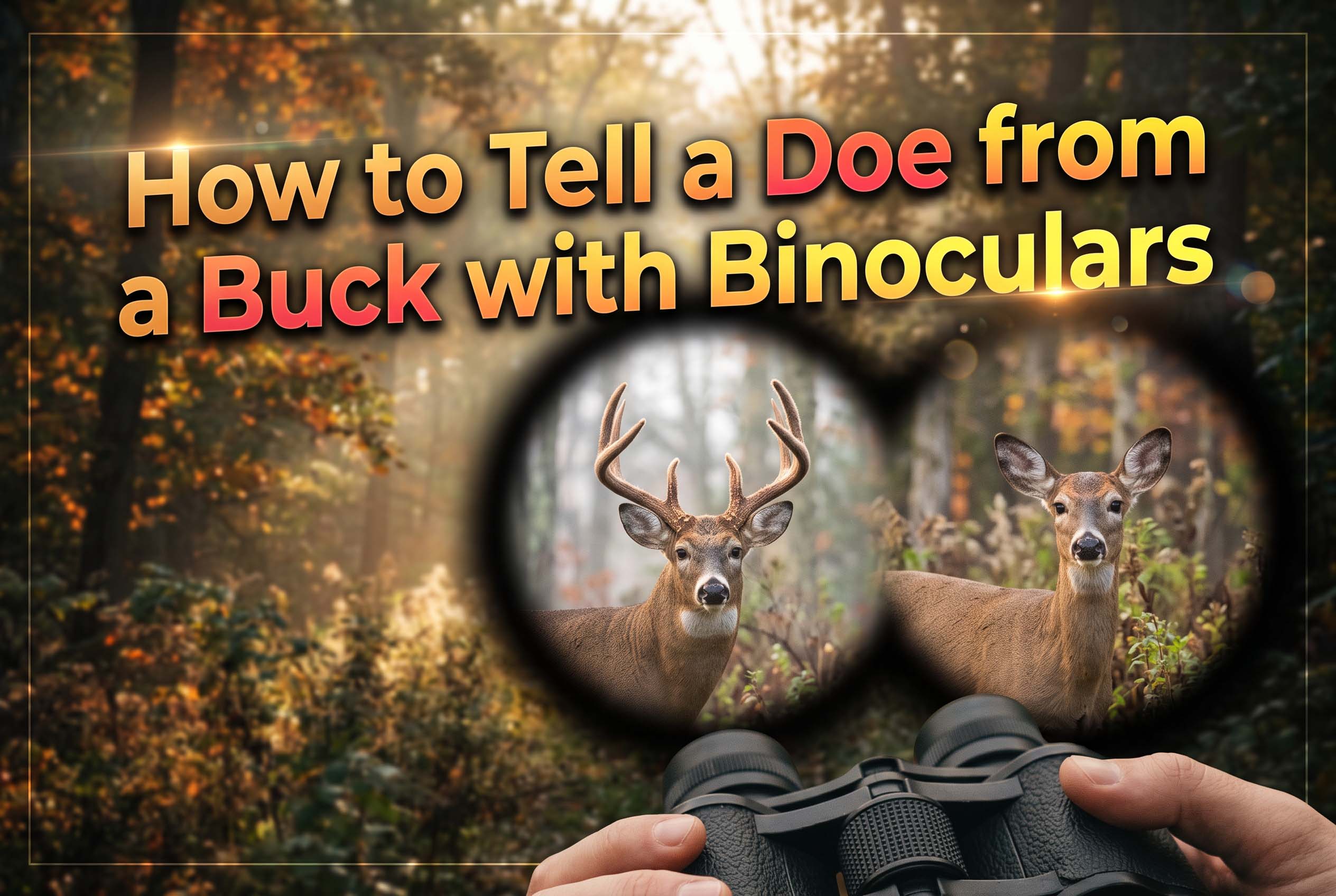
I have been in the stand more times than I can count, staring through binoculars at a deer that just does not want to show me what it is. The light is fading, the animal is half-hidden in brush, and I need to decide in seconds. If antlers are obvious, the call is easy. But when you cannot see antlers, the real skill begins.
Here is the single sentence that sums up everything: when a deer steps out, you have three seconds to decide – look for antlers first, then check the skull and neck shape, then watch for behavior. These three layers will almost always give you the right answer.
Phase 1: The Antler Check
Your binoculars are the first tool. Raise them and scan the top of the deer’s head. You are looking for any projection above the ears. This sounds obvious, but many hunters skip this step when they see a deer that looks small.
What to look for specifically:
- Antler tines – even a small spike will show as a distinct line above the forehead.
- Antler bases – a buck’s antlers start from a bony bump on the skull. In velvet, those bumps can look like two rounded knobs. A doe’s head has no such bump above the eye line.
- Forward projection – a buck’s antlers often curve forward. A doe’s ears stick out sideways. If you see a straight up-and-down line above the head, it is likely an antler.
I have mistaken a doe’s ear for a small antler when the ear was pinned back. The trick is to watch the ear move. If that “antler” flips and twitches, it is an ear. Real antlers do not twitch.
Phase 2: When Antlers Are Missing
This is where most mistakes happen. No antlers does not automatically mean doe. You could be looking at a button buck (a young buck with antler buds still hidden in velvet) or a mature buck that has shed his antlers after the rut.
The three categories of antlerless deer:
- Doe – adult female with no antler growth at all. Head is slender, neck blends smoothly into shoulders.
- Button buck – male fawn or yearling. Has two small bumps on the skull covered in velvet. Those bumps catch light differently than a doe’s smooth head. From 100 yards, you might see a tiny shiny spot on top of the head.
- Shed buck – an older buck that lost antlers. These deer have a thick neck and a blocky head even without antlers. The pedicels (the bony bases) remain as small rough bumps. They are usually wider apart than a button buck’s bumps.
In my experience, the button buck trap is the most common. I once watched what I thought was a doe for ten minutes until it turned and I saw the tiny velvet nubs catching the sun. That deer was a buck.
How to Spot a Button Buck
Look for the triangular shape of the ears. A button buck’s ears are often set wider apart than a doe’s because the skull is still growing. And the forehead appears slightly flatter. Through binoculars, focus on the top of the head between the ears. If you see any irregularity – a bump, a shine, a change in hair direction – suspect a buck.
Phase 3: Head and Neck Morphology
When antlers are invisible, your next read is the head shape and neck thickness. This works best when the deer gives you a side or quartering view.
Doe head: Tapered, almost pointed snout. The eye socket appears large relative to the head. The distance from eye to nose is longer and more slender. The bridge of the nose is straight.
Buck head: Blocky and wide. The snout is more squared. The eye sits in a smaller socket that looks more recessed. The distance from eye to nose is shorter because the skull is broader. A buck’s nose often looks darker or more swollen during the rut.
Focus on the neck: This is a reliable clue. A doe has a smooth transition from head to shoulder. A buck, especially a mature one, has a thick, muscular neck that blends heavily into the shoulders. The neck appears wider than the head. Through binoculars, check the width of the neck compared to the deer’s body. If the neck looks as thick as the chest, it is almost certainly a buck.
I keep a mental rule: If the neck looks like a football, it is a doe. If it looks like a log, it is a buck.
Phase 4: Behavioral Dead Giveaways
Behavior is the proof you cannot argue with. Even if the deer is far away and the light is bad, certain actions are 100% buck.
Unmistakable buck behaviors:
- Scrape pawing – a buck will paw the ground with a front hoof, clearing leaves and dirt, then urinate into the scrape. If you see a deer repeatedly pawing a spot on the ground, it is a buck.
- Rub making – a buck will rub its antlers and forehead on a sapling or bush. The motion is vigorous, side to side. Antlerless deer do not do this.
- Urine spraying on hind legs – a buck’s tarsal glands (on the inside of the hind legs) often appear as dark, wet stains. During the rut, those stains become very dark and obvious. A doe’s tarsal area is light and dry.
- Licking or chewing a branch overhead – bucks will stand on hind legs to reach overhanging branches, leaving saliva and scent. A doe might nibble leaves, but she does not do the full stretch-and-sniff routine.
Remember the story of Will Dear: he thought he was looking at a big doe until the deer started pawing a scrape and stood on its hind legs to rub a limb. That behavior saved him from misidentifying a monster buck.
Myths That Get You in Trouble
Do not fall for these common mistakes:
- “Big body means buck.” A mature doe can weigh as much as a yearling buck. Size alone is not a reliable indicator.
- “If it is alone, it is a buck.” Does travel alone all the time, especially before the rut.
- “Does never have antlers.” Rare hormonal imbalances can cause a doe to grow small antlers. It is uncommon but possible.
- “A deer with a dark nose is always a buck.” Both sexes can have dark noses; it is a seasonal color change, not a gender marker.
Phase 5: Gait and Movement Subtleties
Once you have looked at antlers, head, neck, and behavior, pay attention to how the deer moves. Bucks and does walk differently.
Buck gait: More deliberate, almost stiff. Bucks tend to carry their head lower, with the nose pointing slightly down. Their stride is longer, and the front legs seem heavier. When a buck walks, the back often appears flat or slightly humped.
Doe gait: More fluid and bouncy. A doe often holds her head higher and moves with a springy step. The tail is a giveaway: a doe frequently flicks her tail from side to side or holds it up when alert. A buck usually holds his tail straight down or straight out, rarely flicking.
Through binoculars, focus on the rear profile. If you see a white tail that keeps flipping up and down, it is almost certainly a doe. A buck’s tail will stay still most of the time.
Phase 6: Putting It All Together – A Decision Flowchart for the Field
Here is the mental checklist I run through every time a deer appears at distance. Practice this until it becomes automatic.
- Raise binoculars and scan the top of the head. Any antlers? Yes → buck. No → go to step 2.
- Check for antler bumps (pedicels) and head shape. Are there small bumps on the skull? Yes → possible button buck or shed buck. No → likely doe.
- Look at the neck thickness relative to head. Is the neck as wide as the chest? Yes → buck. No → go to step 4.
- Watch the behavior for 10 seconds. Does it paw the ground, rub a tree, or spray urine? Yes → 100% buck. No → continue.
- Observe the gait and tail carriage. Is the tail flicking? Yes → likely doe. Is the tail still and down? Still possible buck.
- If still unsure, wait for a better angle. Do not shoot until you are certain.
I cannot count how many times this sequence has saved me from a bad call. It takes only a few seconds, and it works in low light, through brush, and with any binocular magnification.
Binocular Tricks for Low Light
Hunting light is often dim. Here are three things I do with my binoculars to get a better read:
- Adjust the diopter. Most binoculars have a ring on the right eyepiece. Close your left eye and focus the right barrel on a distant branch. Then open both eyes. This small adjustment reduces eye strain and sharpens detail in low light.
- Look for antler shine. Antler bone reflects light differently than hair. If you see a subtle glossy line above the ear, that is antler.
- Use the center focus wheel slowly. Scan across the deer’s head and body slowly, letting your eyes pick up shape differences. Rushing the focus can make you miss the neck thickness.
Frequently Asked Questions
How can you tell a button buck from a doe using only body shape?
Button bucks often have a shorter, stubbier body than a mature doe. Their legs look slightly too long for their body, giving a lanky appearance. The forehead is flatter, and the ears appear large and wide-set.
What does a buck’s eye socket look like through binoculars compared to a doe’s?
A buck’s eye socket appears smaller, more triangular, and sits deeper in the skull. A doe’s eye socket looks rounder and larger relative to the head. This difference becomes visible at 100 yards with 8x binoculars.
Can a doe ever exhibit scraping behavior?
Very rarely. Does do not paw scrapes or rub trees. If you see a deer pawing the ground repeatedly, it is a buck. A doe might nibble leaves, but she will not do the deliberate scrape-making motions.
What is the best magnification power for identifying deer gender at 200 yards?
A 10×42 binocular is ideal. It gives enough magnification to see antler tines and head shape without being too heavy to hold steady. For low light, a larger objective lens (42mm or 50mm) helps gather light.
Does the color of the coat help distinguish a buck from a doe in October?
Not reliably. Both sexes have similar summer and winter coats. However, a buck’s neck may appear darker or thicker during the rut due to swelling and staining from urine.
How do you use binoculars to see a buck’s tarsal gland (dark stain on hind legs)?
Focus on the inside of the deer’s hind legs, just above the hock. Look for a dark, wet patch of hair. In white-tailed deer, this stain is much darker on bucks, especially during the rut. Does have a clean, light-colored tarsal area.
Why does a buck’s nose sometimes appear darker than a doe’s?
Hormonal changes during the rut can cause a buck’s nose to darken and even swell slightly. But this is not a 100% indicator because some does also have dark noses. Use it as one clue among many.
Can you reliably tell gender by the way a deer raises its tail when startled?
Yes, this is a useful clue. A doe almost always raises her tail straight up and waves it side to side when alarmed. A buck often holds his tail down or straight out, with minimal movement. If you see that white flag waving, it is almost certainly a doe.