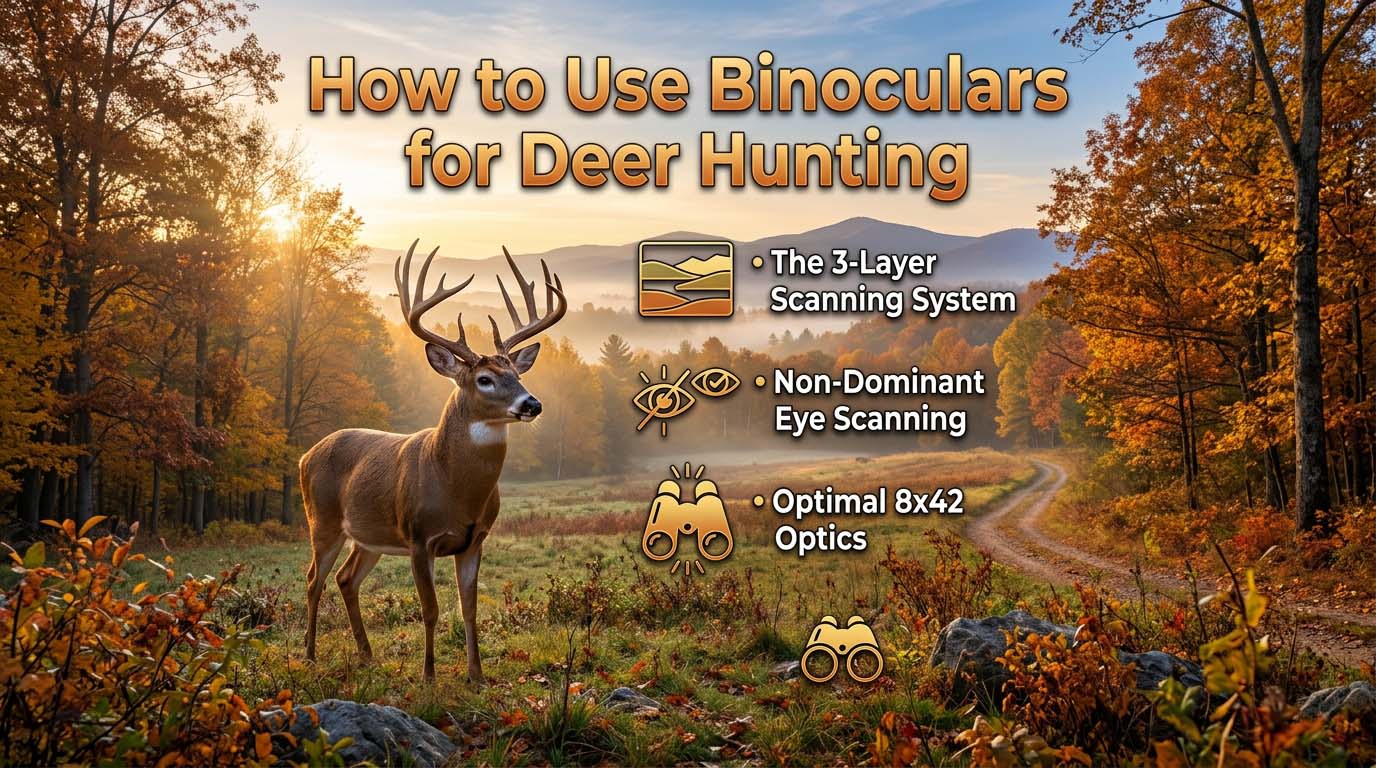
You already own a pair of binoculars. You carry them into the woods. But if you’re like most whitetail hunters, you use them wrong. You lift them to your eyes only when you think you see something, confirm it’s a deer or a stump, and then drop them back down. That’s not hunting with binos. That’s wasting their potential.
The best whitetail hunters I know treat their binoculars as an active tool, not a passive confirmation device. They use them to find deer before the deer finds them. Let me show you the exact system.
The one technique that changed my hunting is the non-dominant eye scan. When you bring binos to your face, most people close their other eye or let it see nothing but the back of the objective lens. That’s a mistake. Instead, keep your non-dominant eye open and focused on the area outside your binoculars.
Your peripheral vision stays alive. You can spot movement in the corner of your eye while you study a specific patch of brush.
This is how you avoid being surprised by the deer that walked in from the side while you were glassing straight ahead. Practice it. It feels weird at first, but it becomes second nature in two sits.
Your Binos Are a Weapon, Not an Accessory
The biggest mistake whitetail hunters make is using binos only to confirm something they already saw. If a branch wiggles and you glass it to see if it’s a deer, you’re already behind. The correct use is to search for deer before you ever see motion. Turn your binoculars into a discovery tool.
Here’s the core idea: if you spot a buck at 60 yards instead of 30 yards, you have twice the time to plan your shot, check your lane, and get ready. And if you can see a doe feeding 100 yards away, you can predict where she will walk and set up tomorrow. Binoculars let you see the future of the hunt.
I’ve learned that the most effective way to do this is to scan the woods in a deliberate pattern. Don’t just sweep left and right. Break the area into zones. Use the three-layer system below.
The Three-Layer Scanning System for Hardwoods
Layer 1: Immediate Perimeter (0 to 40 yards)
This is the danger zone. Deer can appear silently inside bow range. For this layer, keep your binoculars at low magnification (6x or 7x). Do not stop on any single spot. Instead, let your head and the glass move together in a smooth sweep. Look through gaps in cover, not at the cover itself.
Focus on horizontal lines; that’s a deer’s back. Also look for the difference between light and dark near the ground, what I call the “leg shadow.” A deer’s legs create a dark stripe against the forest floor. If you stop scanning, you will miss the buck that is already there.
Layer 2: Observation Zone (40 to 100 yards)
This is where you stop and study. Switch to a tighter focus or higher magnification. Break the area into small sections like a clock face; imagine each hour is a 5-degree wedge. Scan every wedge completely before moving to the next.
Look at edges: where the field meets the woods, where the thick stuff meets the open. Look for bedding transition zones where deer cross from cover to feed. Watch doe groups here. If you see a doe staring intently into a patch of brush, don’t glass the doe; glass what she is staring at. She has already done the work for you.
Layer 3: Distant Intel (100+ yards)
You’re not going to shoot a deer at this distance with a bow or even most rifles in the woods. But you can gather information. Look for movement that reveals a buck’s travel route. Glass from a distance to read signs without entering the core area.
Spot a rub line on a ridge? Mark it on your mental map. See a buck cross a saddle at 300 yards? You know where to set up next time. This layer is all about pattern recognition, not immediate action.
The Ground and Stand Deployment Protocol
Tree Stands: The Lean and Scan
Shaky hands ruin glassing. When you’re 20 feet up, lock your elbows into your ribcage. If you have a ratchet strap or bow hanger, use it to press your torso against for stability.
Move your entire upper body, not just your arms, to pan across the area. This reduces shake by half. I also use my knee as a rest if I’m sitting.
Ground Blinds: Over-the-Top vs. Slit Scan
In a blind, push the binoculars through the window slit, not up to it. That way the lens stays behind the mesh and doesn’t flash. For a quick scan, put the binos over the top of the blind edge. Then keep your elbows on your knees for stability.
Mobile Hunting and Still-Hunting
When you are walking, do not keep your binos around your neck. Hold them in your hand, the non-dominant hand, so you can snap to your eyes in under one second. I see hunters fumble with neck straps and miss the in-and-out deer. Keep them in your hand with the strap wrapped around your wrist.
The Hands-Full Problem
What do you do when you’re carrying a bow or rifle? Use the chest swivel. Keep your bow in your left hand. Use your right hand to glass. To scan different directions, pivot your whole chest, not your arms. This keeps the glass steady and your weapon ready.
How to Glass the Unglassable (Thick Cover & Low Light)
Thick Cover
Most hunters try to look through thick brush. That never works. Instead, look at the edges and above head height. A moving antler tip at 25 yards is 10 times easier to spot with binos than with naked eyes.
The trick is the Wait and Wiggle method: pick a dark spot (a shadow, a tangle of vines) and hold the binos completely still for 10 seconds.
Your eyes will start to detect micro-movement, an ear flick, a tail swish, the slight bob of a deer’s head. If you scan too fast, you miss it.
Low Light
Those last 20 minutes of legal light are when the biggest bucks move. Your naked eyes let in only so much light. An 8×42 binocular gives a 5.25mm exit pupil, which matches your fully dilated pupil. That means you literally see better through them. Here’s the trick: pre-focus before dark.
Set your focus ring about three-quarters of the way to infinity before the sun goes down. Then never touch it again. Use your head position to shift focus: lean forward to focus closer, lean back to focus farther. This is called using parallax. If you try to refocus in the dark, you’ll only blur your vision.
The Critical Moment: When to Look, and When to Look Away
Here is the paradox that most hunters never learn: if a buck is walking toward you at 60 yards, lower your binos and look with your naked eyes. Why? The binoculars narrow your real field of view and make the deer look farther away than it is.
You will misjudge distance. Use binos to identify and locate. Once the deer is within 60 yards and coming your way, drop them and use your peripheral vision.
Another mistake: swinging your binos across a deer that has already seen you. The movement pattern or glare can spook him. Instead, glass to the deer, not at the deer. If he is looking your way, look away.
And always remember the predictor’s trick: when a doe stares into a drain and stomps, do not glass the doe. Glass what she is staring at. She has already found the danger — or the buck.
Frequently Asked Questions
What is the ideal magnification for whitetail hunting?
8x is the all-around best. It gives you a wide field of view (critical for close encounters) and excellent low-light performance. 10x is okay for open fields but sacrifices peripheral awareness in thick cover. I use 8×42 for everything.
How do I stop my binos from fogging when I bring them inside?
Keep them inside your jacket next to your body heat until you are in the stand. If they fog, do not wipe them, you will scratch the coating. Instead, put them under your armpit for two minutes to equalize the temperature. Then wipe them gently with a lens cloth if needed.
Should I use a rangefinder or binos first?
Binos first, always. Identify the target and read its body language. Use the rangefinder only after you have committed to the shot and the deer is calm. Rushing to range a deer that is already spooked will push it out.
What is the ‘binocular trick’ people talk about?
Cover the objective lens (the big front lens) with your hand for one second when switching from bright to dark areas. This lets your eye’s iris adjust without a sudden flash of light, preserving your low-light vision. It sounds simple, but it works.
How do I clean binoculars in the field without ruining them?
Never use your shirt; it has lint and grit. Use a rocket blower to remove dust first. Then use a lens pen. For stubborn dirt, breathe on the lens to create moisture, then wipe with a microfiber cloth in a circular motion from the center out. Never press hard.
That is the system. Carry your binos in your hand, practice the non-dominant eye scan, and use the three layers. You will see more deer, and you will kill more deer. That is what using binoculars for deer hunting really means.