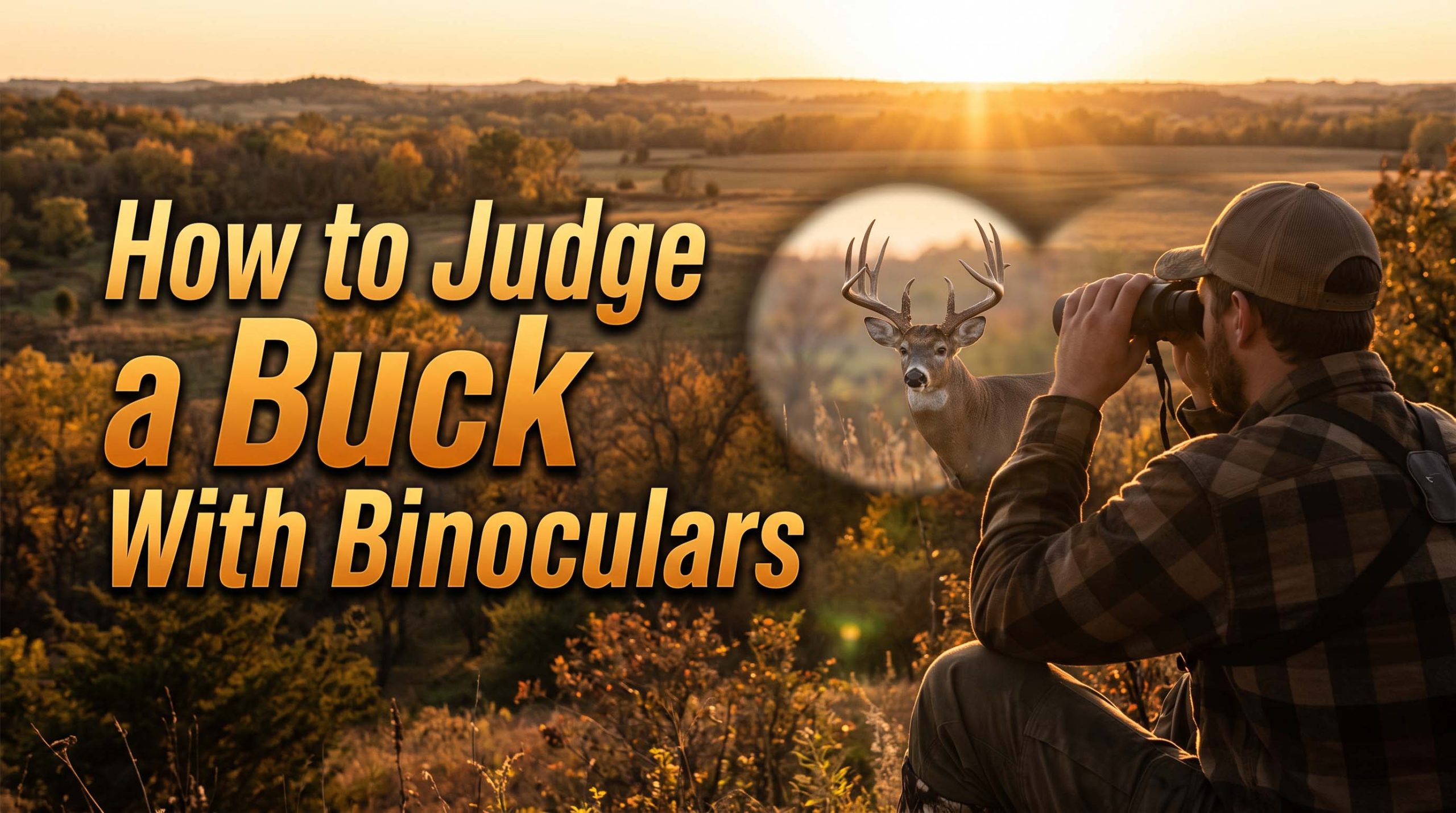
I remember my first real look at a big buck through my 10×42s. My heart hammered, my hands shook, and I had no clue if he was a 140-inch deer or a 170-inch deer. I guessed wrong that day, and the mistake cost me a shot at a mature animal I never saw again.
Over the years, I learned that judging a buck with binoculars isn’t about scoring inches in your head; it’s about reading the animal with a repeatable system. When you learn what to see, the guesswork disappears.
This guide covers the three pillars of field judging, the right magnification for each job, and how to use the buck’s own body as a measuring stick. By the end, you will know exactly what to look for when glass is pressed to your eyes.
The Three Pillars of Field Judging
Forget score sheets and tape measures. Out here, we work with three simple concepts: spread, mass, and symmetry (antler anatomy), plus age class (body clues). Binoculars handle spread and symmetry well at most ranges.
Age class takes practice, but it’s the most reliable way to avoid shooting a young buck with big potential. Start with the antlers, then check the body. If the body says mature, the antlers matter more.
The Magnification Calculator for Judging Tasks
Different parts of a buck require different levels of detail. Here is the rule I follow:
- 10x binoculars – Good for estimating spread and body mass out to 400 yards. You can see the ear-to-ear relationship clearly.
- 12x or 15x binoculars (on a tripod) – Needed for counting tines and judging tine length at distances beyond 200 yards. Handheld 15x shakes too much for fine work.
- Spotting scope (20-60x) – Best for final verification of base mass, back tines, and any abnormal points. Use it when you need to confirm a shooter before a long stalk.
If you only have a 10×42, don’t worry – most judging happens inside 300 yards, where 10x is plenty for spread and body cues. Save the high-mag work for fine details on a steady tripod.
Using the Buck’s Head as a Ruler
This is the single most useful trick I know. A whitetail buck’s ear from tip to tip (inside spread) is roughly 16 inches. A mule deer ear span is about 20 inches. Once you lock that in your mind, everything else falls into place.
Spread
Compare the gap between the antler tips to the ear width. If the antlers extend well past the ears on both sides, you are looking at a wide buck, likely 18 to 20 inches inside spread. If the antlers barely reach the ears, the spread is average, around 14 to 16 inches.
Tine Length
Use the distance from the deer’s nose to its eye, roughly 8 inches on a mature buck. Compare the G2 (second tine) length to that nose-to-eye distance. If the G2 looks as long as that space, you have a solid 8-inch tine. If it looks longer, you might have a 10-inch tine.
Mass
Look at the base of the main beam compared to the buck’s hoof. A hoof is about 3 inches wide at the front. If the base looks as thick as the hoof, you have good mass. If it looks thinner, the deer is lighter in antler weight.
The Buck Judging Sequence
When your heart is pounding, run this mental checklist. It keeps you from making a hasty mistake.
- The Trap Check – Before you get excited, scan for broken tines or a weak side hiding behind the strong one. A buck with one weak side looks bigger head-on than he really is.
- The Spread Posture – Does the buck hold his head high or low? Heads-up makes the spread look wider; heads-down feeding makes it look narrower. Adjust your estimate accordingly.
- The Symmetry Scan – Compare left side tines to right side tines one by one. Don’t stare at the middle of the rack – your eye fills in missing details. Hunt for differences.
- The Maturity Filter – Ignore the antlers for a full 10 seconds. Look at the nose: a long, Roman nose means an older buck. Look at the belly: a deep sagging gut line says 4.5 years or older. Look at the neck during the rut: a thick, swollen neck with a pronounced transition from head to body screams mature.
The Tine Counting Trap at Distance
I learned this the hard way on a mule deer hunt. Through 10× binos at 300 yards, a buck looked like a nice 5×5. When I finally got closer, he was a 4×4 with a split brow tine on one side that blended with the background. The human brain wants to see symmetry, so it connects dots that aren’t there.
To avoid this: count only the tine tips you can see clearly against the sky or a contrasting slope. If a tine tip is not fully disconnected from the background, it does not count. Use a tripod-mounted spotter or high-mag binos to verify suspicious points.
Age Class Over Score
A 130-inch mature buck is a far better trophy than a 150-inch 2.5-year-old. Mature bucks carry more mass, have thicker beams, and display the character that inches alone don’t measure. Here is how to judge age class through binoculars:
- Nose profile – Young bucks (1.5–2.5 years) have a short, blunt nose. Mature bucks (4.5+) have a long, straight or Roman nose.
- Belly depth – A 1.5-year-old has a tight, high belly line. A 5-year-old shows a deep sag that drops well below the brisket.
- Coat condition – Young deer often have bright, clean coats. Old bucks tend to look dull, stained, and worn – especially in late season.
When you spot a buck, run the maturity filter first. If the body says young, let him walk even if the rack looks big. He will only get better.
Frequently Asked Questions
Can a 10×42 binocular give you a reliable score estimate for a buck?
Yes, for general size – spread, body mass, and overall frame – a 10×42 works fine out to 400 yards. But for precise tine length and mass details, you need higher magnification or a spotter, especially beyond 200 yards.
Is there a difference in judging a whitetail versus a mule deer through binoculars?
Yes. Mule deer have wider ear spans (about 20 inches compared to 16 for whitetails). Mule deer are judged more on frame width and symmetry than main beam mass. Whitetail scoring relies more heavily on tine length and beam circumference.
What is the first thing to look for when you start judging a buck?
Do not look at the antlers first. Look at the legs and body. If the buck looks long in the body and tall in the legs, he is likely mature. Antlers are the reward, not the first clue.
Does antler color help in judging a buck?
Indirectly, yes. Dark, heavily stained antlers suggest a buck that beds in thick cover or rubs on trees with high tannin content. Bleached-white antlers are common in open country or late-season deer. Color builds the story, not the score.