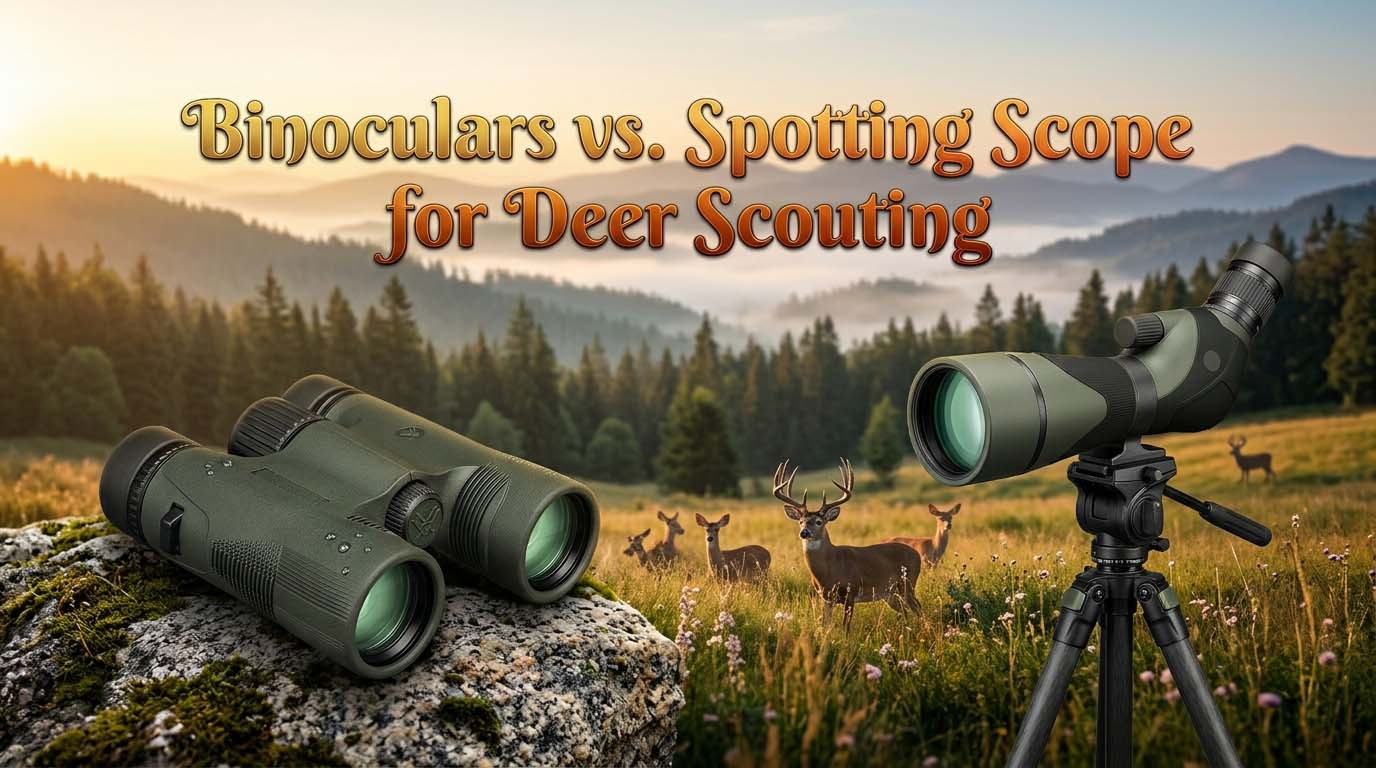
You’ve got room in the budget for one serious piece of glass. Maybe two, if you skip the expensive new releases. But the question of binoculars vs. a spotting scope for deer scouting doesn’t have a single right answer, and anyone who tells you otherwise is selling something.
Here’s the short answer: if you walk miles to scout, buy the binoculars. If you sit in one spot for hours, buy the spotting scope.
For most hunters who cover ground on foot, the Vortex Diamondback HD 8×28 is the single smartest purchase you can make. For the sitters, the spotter wins by a mile. And if you do a bit of both, there’s a clever way to split the difference.
Here’s the decision framework I’ve landed on after too many seasons of hauling gear I didn’t need:
- You walk to scout: Buy the binoculars first. This covers most deer hunters.
- You sit to scout: Buy the spotting scope. Field edges and food plots are its home turf.
- You do both: Read the hybrid strategy at the end of this article. It’ll save you money and pack weight.
I’ve made the mistake of hauling a full spotting scope setup up a mountain, only to leave it on the truck tailgate the next weekend.
I’ve also shown up to open-country glassing with only an 8x bino and missed half the antler points on a buck that was standing exactly where I’d been looking. Both mistakes taught me the same lesson: the right tool depends entirely on how you scout.
This guide is built around scouting scenarios, not spec sheets. I’m using the Vortex Diamondback HD 8×28 as the binocular benchmark because it’s the tool I trust most in deer country.
It’s not the flashiest or the priciest; it’s just the one that actually rides on my chest every single trip.
My Top Pick for Hunters Who Scout on Foot

That’s my pick in one line. But a pick without reasoning is just a logo on a page, so let’s get into the trade-offs that actually matter when you’re standing in a cold parking lot at 5 a.m.
The Physics Behind Choosing Binoculars vs. Spotting Scope for Deer Scouting
Every optics decision comes back to one law of physics: field of view and magnification are locked in a fight, and you can’t win both at the same time. Understanding that fight is the whole ballgame.
An 8x binocular gives you a wide, forgiving window on the world. At a thousand yards, the Diamondback 8×28 shows you a broad sweep of ridge, timber edge, and creek bottom.
Your eyes skip across that landscape, hunting for the one thing that doesn’t belong, the flick of an ear, the tan line of a back, the odd shadow that shifts. A wide field of view is about finding deer.
I remember a specific morning when this played out perfectly. A buck stepped out of a draw at 200 yards, and with the 8x bino I caught him instantly, almost without trying.
But when I tried to count points, the tines blurred together. I couldn’t tell if he was a shooter, so I had to let him walk. A spotter would have answered that question in five seconds.
A spotting scope flips the trade-off completely. At 20x or 30x, it turns the same hillside into a narrow slice. But inside that slice, you can count tines, judge mass, and make the call between a 140-inch deer and a 160-inch deer. High magnification is about judging deer.
The trap is thinking one tool can do both jobs well. Crank a bino to 10x, and the field of view shrinks dramatically. Drop a spotter to its lowest setting, and it still can’t keep up with the speed of a bino.
You’re choosing a priority: find them, or judge them. That’s not to say one tool is useless at the other’s job, but the further you push either one past its design, the more you sacrifice.
The Boots-on-the-Ground Scout Needs Binoculars
Let me be honest about how most deer scouting actually happens. You park the truck, lace up the boots, and cover ground. Public land, walk-in areas, the back corner of a lease nobody else bothers with.
If that’s your routine, the binocular wins before you even leave the truck. A spotting scope on that kind of trip just ends up being weight.
Why the Vortex Diamondback HD 8×28 Is the Perfect Mobile Tool
Quick specs:
- Magnification: 8x
- Objective lens: 28mm
- Coatings: Fully multi-coated, dielectric prism coating
- Protection: Armortek coating, rubber armor, argon-purged
- Extras: Tripod-adaptable, lifetime VIP warranty
I’m judging this glass on four things: portability, clarity, durability, and how it feels in hand during a full day of use. The first thing you notice with the Diamondback 8×28 is how little you notice it.
The 28mm objective keeps the whole package compact, and it hangs against your chest without bouncing, snagging, or reminding you it exists.
I’ve worn it on eight-mile loops where a heavier bino would have ended up buried in the pack by mile two. Portability isn’t a nice-to-have in this role; it’s the whole reason the tool wins.
The glass punches well above its size, and that’s not just marketing. Fully multi-coated lenses and dielectric prism coatings do real work here. In midday sun, the image stays crisp and clear while cheaper glass washes out into a hazy mess.
Color fidelity is solid, which makes picking out a deer in shadow easier than it has any right to be. Even against a bright sky, chromatic aberration stays well controlled; you won’t see that purple fringe along the edges as you do on budget glass.
The controls feel right too. The center focus wheel is smooth without being loose, and the right eyepiece diopter locks where I set it.
The twist-up eyecups click into place and work whether I’m wearing sunglasses or not. Those little details don’t show up on a spec sheet, but they’re why I reach for this bino instead of any other.
Durability is where this thing earns its keep. The Armortek coating shrugs off scratches, oil, and dirt. The rubber armor gives you a sure grip in the pouring rain. I’ve smacked it off more tree trunks than I can count, and it still tracks perfectly.
The argon purging and O-ring seals mean fog hasn’t been an issue, even on those frigid November mornings when your breath freezes on the eyecups.
Then there’s the VIP warranty. Vortex backs this glass for life, no questions asked. That removes the stress of treating your optics like gear instead of jewelry. You buy it once, abuse it, and never worry about it again. That matters more the deeper you get into a hunt.
One detail worth mentioning: it doesn’t come with a harness. I actually prefer that. I’ve got my own harness system dialed in, and the stock neck strap would have gone in a drawer anyway.
Where the 28mm Lens Hits Its Ceiling
I’m not going to sit here and pretend this glass has no limits, because it does. The 28mm objective collects less light than a 42mm or 56mm lens, and in deep timber at last light, the image dims noticeably during those final minutes of shooting time.
You’ll still make out a deer, but a bigger objective would give you more detail and a whole lot more confidence before you pull the trigger.
The 8x magnification has its own ceiling. Past 400 or 500 yards, you’re not counting antler points with any reliability. You’re guessing at size and hoping the deer steps closer.
Who shouldn’t buy this? If you spend most of your time in open prairies where glassing distances stretch past 400 yards, you’ll want a bigger bino in the 42mm-plus class, or a dedicated spotter. The 8×28 is a timber, thick-cover, and mobile-hunting tool first.
The Stationary Glassing Session Needs a Spotter
Now flip the scenario completely. You’re set up on a powerline, a food plot edge, or a high knob that overlooks three draws.
You’ve got time to burn, a tripod under your arm, and the weight of the world has stopped mattering. This is where the spotting scope earns its keep, and an 8x bino just can’t keep up.
The Confirmation Power of High Magnification
When a buck finally steps out at 450 yards, the 8x bino shows you a good deer. The spotter shows you the truth. That’s the whole game in trophy country, counting points, checking tine length, judging mass from a distance where your naked eye would struggle to even confirm it’s a deer.
A spotting scope doesn’t just magnify the image. It magnifies your certainty. That lets you make the smart call: burn a day stalking a 130-inch deer, or hold out for the bigger one you know is bedding in the next draw.
In open country, the spotter makes that decision for you. Without it, every distant buck is just a guess.
The Cost of Stability
But the spotter asks a lot in return. It demands a tripod, and that means extra weight on your shoulder and extra setup time at every single stop. It anchors you to one place in a way that a chest-mounted bino never will.
If you’re the type of scout who checks five different ridges before noon, a spotting scope in your pack is dead weight from the start.
There’s also the cost of the tripod itself. A stable tripod is worth every dollar, but it’s another piece of gear to buy and carry,