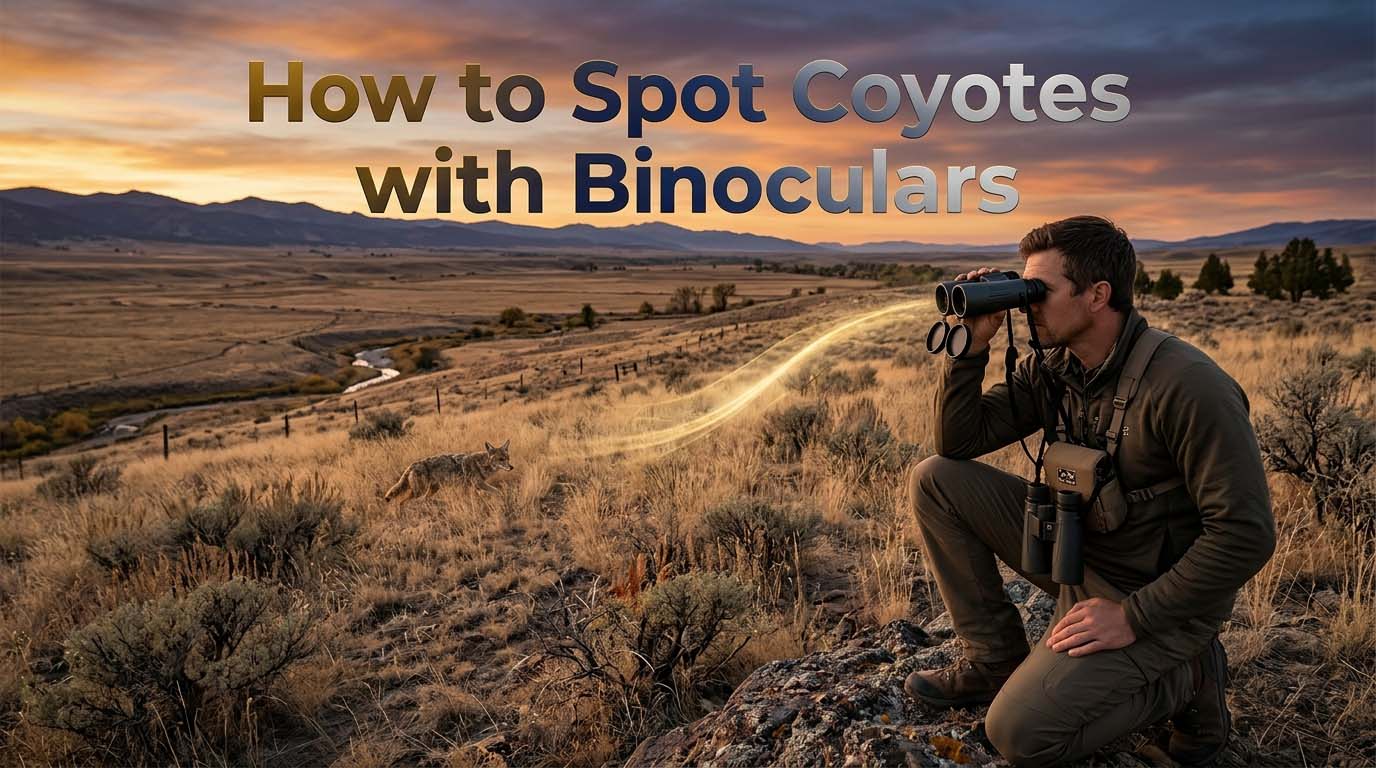
I remember the first time I realized looking and spotting were not the same thing. I was kneeling on a ridgetop, staring through a pair of 10x42s at a field I knew held coyotes. I scanned it a dozen times. I saw nothing. Then I changed my approach. I slowed down. I started reading the ground instead of searching it. I spotted a single ear tip moving through the grass. That coyote had been there the whole time. My eyes were just moving too fast.
The jump from looking to spotting is not about the binoculars. It is about a repeatable system. Here is how I build that system.
The Three-Phase Spotting Sequence
A coyote will give you a chance. He will move. He will flick an ear. He will break the horizon. You need a search pattern that catches that moment.
Phase 1: Vantage
I get as high as I can safely glass from. Even a small rise matters. From a high spot, a coyote’s silhouette breaks against the ground behind him. If I am in flat country, I use a truck hood, a fence post, or a rock pile. The goal is to gain two or three feet of height.
Phase 2: Grid
I divide my field of view into three overlapping horizontal strips. I scan the near strip from left to right. Then the middle. Then the far. I do not jump around. If my eyes start to wander, I take the glass down for ten seconds and start over.
Phase 3: Freeze
When I see an anomaly — a dark spot, a strange shadow — I stop moving. I settle the glass on that spot. I breathe out. I wait. Nine times out of ten, nothing happens. The tenth time, the shadow stands up and becomes a coyote.
Reading Coyote Behavior Through the Glass
Once you pick up a coyote, do not just watch him. Read him. He is telling you what he is about to do.
Posture
A coyote that is belly-low is hunting or nervous. A coyote that is standing tall with a straight tail is confident and moving. If he stops and goes stiff-legged, he might be about to bolt.
Gait
The coyote lope is a smooth, ground-eating stride. A fox has a bouncier stride. A domestic dog typically has a wider, heavier movement. Watch the legs. A coyote’s back legs track close to his front legs.
The Look-Back
Coyotes stop and look back frequently. If you see a coyote do this, remember the exact spot he was looking at. That is where he came from, or where he senses a threat. It is a valuable piece of information for your next setup.
Binocular Specs: What Actually Matters for Spotting
Buying binoculars for coyote hunting is a trade-off. No single spec is perfect for every situation.
Magnification vs. Field of View
An 8x or 8.5x gives you a wider field of view. That matters when you are scanning for movement. A 10x gives you detail but narrows your view. I use 8x in the brush and 10x in open country. If I go higher than 10x, I need a tripod.
Objective Lens
42mm is the standard for a reason. It gathers enough light for dawn and dusk without being too heavy. 50mm is better for low light but heavy to hold for a long sit. If you glass from a vehicle, the extra weight is less of an issue.
Thermal Considerations
If you are using thermal, resolution matters. A 384 sensor works well under 300 yards. A 640 sensor lets you read behavior at distance. Do not forget to adjust your palette. White Hot works in most conditions, but Green Hot can cut glare on hot ground.
Optimal Times and Terrain
Your glassing is only as good as your timing. You can have the best technique in the world and see nothing if the animals are bedded down.
Seasonal Peaks
Late winter is prime time. Coyotes are breeding and moving more during daylight. Summer is good for spotting pups near dens in the evening. The hour before a cold front is excellent. They feed heavily before a storm.
Terrain Edges
Coyotes travel the edges. They do not walk through the middle of a field if they can walk the ditch line. They do not cross a ridge if they can walk the saddle. Glass the edges. Fence lines, creek bottoms, tree lines — these are the highways.
Wind Strategy
Coyotes travel into the wind. Position yourself so you are glassing the upwind terrain. You will catch them checking the wind. If you glass a crosswind ridge, you are looking at their back trail.
The Solo Hunter’s Tactical Glassing System
Hunting alone means your eyes are your only spotter. You have to be efficient.
Long Sits
I commit to a 20-minute scan. I do not lower the glass unless I need to rest my eyes. I use a tripod or a rifle rest to keep the glass steady. If I lower the glass every two minutes, I will never get the full picture.
Reacquiring a Coyote
If you look away and lose a coyote, do not pan wildly. Pick the last landmark you saw him near. Start your scan from that landmark and work out in a spiral. Do not guess. Use the terrain to predict where he might have gone.
Marking Position
I mentally note a bush or a rock next to the coyote. I keep my glass fixed on the coyote, but I use the landmark to guide my eye if I have to look away. If you do not have an integrated laser rangefinder, this natural reference point is your best tool.
Confirming Identity at Long Range
At 300 yards, a coyote can look like a lot of things. Here is the checklist I run through before I decide to call.
- Ears: Large and set wide. A fox has smaller ears set closer together.
- Chest: Narrow and tucked in. A dog has a barrel chest.
- Tail: Hangs straight down or straight back. A fox tail touches the ground. A dog tail curls up.
- Movement: Smooth and linear. He does not meander.
Night-Specific Glassing for Thermal Users
Thermal changes the game, but the fundamentals of scanning stay the same. The biggest mistake I see is zooming in too fast.
Palette Selection
White Hot is the standard for a reason. A coyote’s body heat shows as a bright white core. If you are in dry grass, try Black Hot. It can make the coyote stand out against the bright background. Sepia is easier on the eyes for long sits.
Gain and Contrast
Turn the gain down until the background is dark and the coyote is clear. Too much gain washes out the outline. You want the coyote to be a distinct shape against the background.
Scan at Low Power
Find the coyote at base magnification. A moving dot is easy to track in a wide field. Zoom in only to confirm species and read behavior. If you start at high magnification, you will lose him the second he moves into brush.
Frequently Asked Questions
How do I prevent eye fatigue during long glassing sessions?
Set your diopter correctly for your dominant eye. This makes the sharp image match your eye’s natural focus. Use a tripod. Holding a 10x binocular steady is tiring and forces your eyes to work harder.
Can I spot coyotes during the day with an 8×42 binocular?
Yes. 8×42 is a classic daytime coyote spotting tool. The wide field of view helps you catch movement. Look for shadows in the heat of the day. Look for shapes under trees.
What time of day are coyotes most visible through binoculars?
Dawn and dusk are the best times. The low angle of the sun creates shadows and highlights. Coyotes are also naturally more active during these twilight periods, especially during breeding season.
How do I tell a coyote from a fox at 400 yards?
Look at the tail and the gait. A coyote tail hangs straight down. A fox tail is long and bushy and drags behind. A coyote has a smooth lope. A fox bounces.
Should I hunt from a vehicle or on foot for better spotting?
A vehicle gives you a stable platform and a higher vantage point. You can glass longer without fatigue. On foot, you can get better angles and sneak closer. Both work. The vehicle is easier on your body.
My thermal binoculars show a hot spot — how do I confirm it is a coyote before calling?
Watch the movement. A coyote moves with a smooth, low stride. A deer will raise its head high. A cow is a square block of heat. A coyote has a distinct hot core and cold legs. Wait for movement to confirm the shape.
The Kit That Makes Spotting Easier
You do not need a lot to be effective. These three things make the biggest difference in a long glassing session.
Tripod
A lightweight tripod with a fluid head is the best investment you can make for long glassing sessions. It stabilizes the image and reduces fatigue. You will see more detail and hold the glass longer.
Harness
A quality binocular harness keeps the weight on your chest instead of your neck. It also keeps the glass from swinging when you move. This is a comfort upgrade that pays off after the first hour.
Red Light
A headlamp with a red LED protects your night vision and lets you take notes or read a map without signaling your position. The discipline of writing down what you see improves your scanning over time.