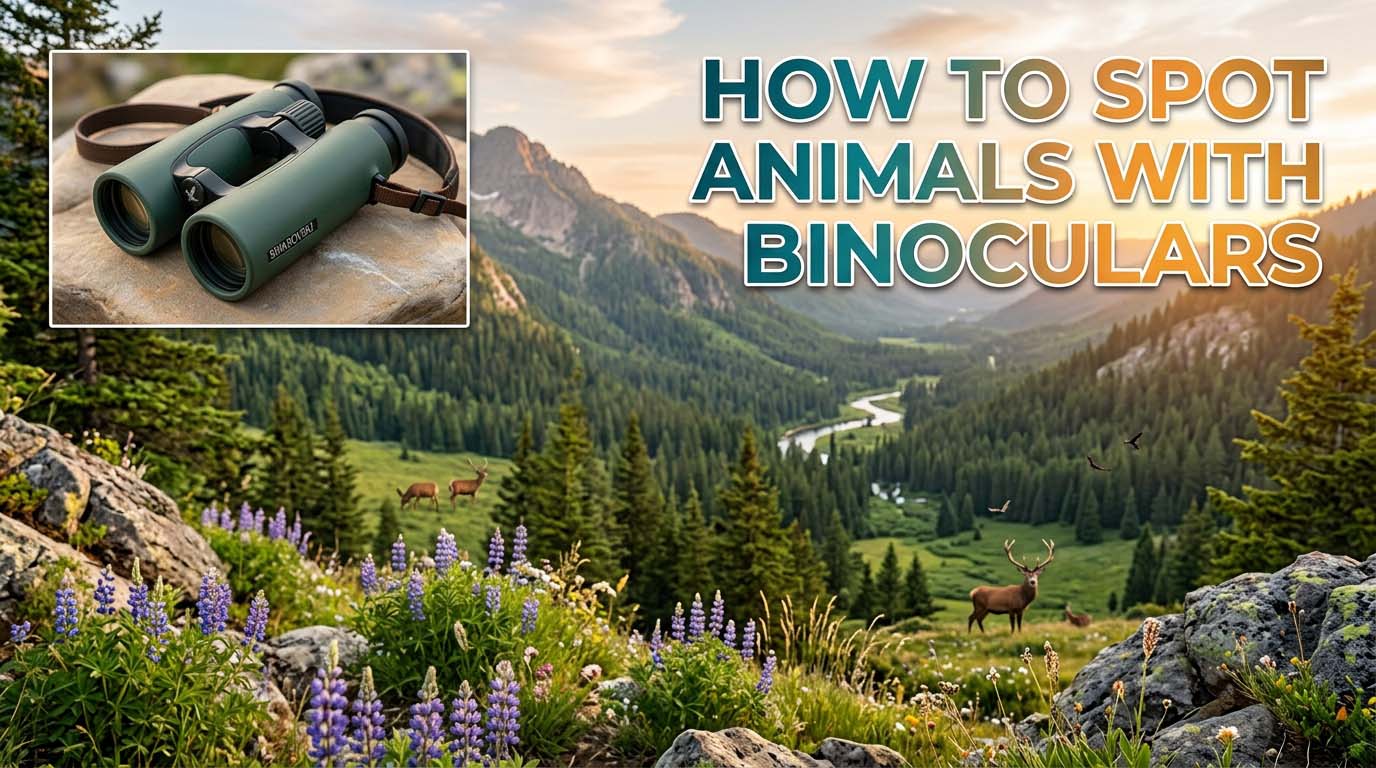
Effective wildlife spotting with binoculars isn’t just about having good optics. It’s about a systematic method that combines habitat awareness, scanning rhythm, and visual interpretation.
The core technique is scan-confirm-identify: use your naked eyes to pre-scan, then lift binoculars only when something catches your attention. This one principle changes everything.
Most people pick up their binoculars and immediately start scanning the landscape. That’s backwards. Your eyes have a wider field of view and are better at detecting movement than a magnified lens. Your binoculars are for confirmation and identification, not for initial search.
Position Your Body for Stability
Before you look through any lens, get your body steady. A shaky view makes spotting animals harder because you lose detail and waste time refocusing.
Sit or kneel if possible. This lowers your center of gravity and reduces sway. If standing, brace your elbows against your chest or a tree trunk. A common mistake is holding binoculars with arms fully extended. Keep them close to your face and tuck your elbows in.
Set your focus correctly before you start. Adjust the center wheel until one eye sees clearly. Then close that eye and use the diopter ring (usually near the right eyepiece) to sharpen the other eye. After this, the center wheel handles all distance changes. Do this once at the start of your outing.
Pre-Scan with Naked Eyes Before Lifting
This step separates beginners from effective spotters. Your naked eyes pick up motion faster than binoculars because they have a wider field and better peripheral vision.
Stand still for 30 seconds and let your eyes adjust. Look for movement first. A flicker of brown against green, a sudden shift in a shadow, or a bird taking off from a branch. These are your cues.
Next, scan for shapes. Animal bodies form horizontal lines in a vertical world. A deer’s back is a straight line across a field of grass. An elk’s antlers are jagged shapes against a skyline. Train your eyes to see these unnatural lines.
Use a grid pattern. Start at the top left and sweep right, then drop down one row and sweep left. Cover the entire landscape like a lawnmower. This prevents you from staring at one spot or skipping whole areas.
Listen for animal sounds. Rustling leaves, snapping twigs, or bird alarm calls tell you where animals are moving. Mark the direction in your mind before raising binoculars.
The Binocular Scan
Only lift your binoculars when you have a target area from your naked-eye scan. Do not sweep with binoculars open wide. That creates motion blur and makes you miss animals.
Hold binoculars loosely but steady. A death grip introduces shake. Keep both eyes open if possible. This prevents eye strain and helps you maintain awareness of your surroundings.
Use a slow wave motion. Scan left to right, pausing 3 to 5 seconds per zone. Animals often freeze when they sense something. A quick sweep will pass right over a motionless deer. The pause gives your brain time to register what your eyes are seeing.
When you find an animal, lower your binoculars immediately and note the location against a landmark. Then lift again to confirm. This trains your brain to hold the position without relying on optics.
Why Higher Magnification Can Hurt Your Spotting
Many beginners think 10x or 12x magnification is better for spotting. It’s not. Higher magnification narrows your field of view and amplifies hand shake.
8x or 7x binoculars are ideal for spotting. They give you a wider field of view, making it easier to find animals. You see more of the landscape at once, which compensates for the lower magnification.
If you use 10x, expect to miss animals that are close or moving fast. The narrow field means you scan in smaller strips, taking longer to cover the same area. For spotting, wider is better. You can always zoom in later with a spotting scope if needed.
Track a Moving Animal Without Losing It
Once you spot an animal, the challenge is keeping it in view while it moves. Most people panic and jerk the binoculars, losing the target.
First, lower your binoculars and watch the animal’s path with your naked eyes. Estimate its direction of travel. Then lift the binoculars slightly ahead of the animal, not directly on it. Let the animal walk into your field of view.
Stay focused on the animal’s head or a specific feature like its ear. This gives your brain a visual anchor. If the animal stops, freeze your movement. Animals often look straight at binoculars because they catch the reflection. Hold still until the animal relaxes.
If you lose the animal, do not frantically search. Lower binoculars, re-locate with your naked eyes, and try again. This takes practice but becomes automatic.
Read Animal Behavior Through the Lens
Binoculars are not just magnifiers. They let you read animal behavior from a distance, which helps you predict movement.
An animal with its head up and ears swiveling is alert. It knows something is wrong. Do not move or make noise. Wait until it lowers its head to graze or look away. That is your window to reposition.
A sudden stillness after grazing means the animal sensed something. Freeze completely. If you move now, it will bolt.
Watch the tail. Deer flick their tails before running. A raised tail is a warning to others. If you see this, prepare for the animal to disappear.
Use these behavioral cues to plan your next move. If the animal is moving toward a thicket, anticipate its path and position yourself for a better view on the other side. Binoculars turn into a prediction tool, not just a viewing tool.
Scenario Adaptations
One technique does not work everywhere. Different environments require different approaches.
Dense Forest
Forests limit your depth of field. Animals appear close but hidden. Use a low-angle kneeling position to look under branches. Scan in small grid sections of about 10 feet by 10 feet.
Look for horizontal lines against vertical tree trunks. That line is probably an animal’s back. Also look for eye shine. In low light, animal eyes reflect ambient light as small pinpoints. This works even in daytime under heavy canopy.
Open Plains and Meadows
Here you have unlimited distance but few reference points. Scan the horizon first for shapes against the skyline. Then scan the middle ground for movement. The foreground is usually empty unless animals are very close.
Use a rapid horizon sweep followed by slow middle-ground scans. Animals on open ground often freeze. The slow scan catches them.
Dawn and Dusk
These are the best times for activity but worst for visibility. Your eyes need time to adjust to low light. Wait 10 minutes before raising binoculars.
Use binoculars with large objective lenses (50mm) for better light gathering. Focus on silhouettes against the lighter sky rather than trying to see color or detail. Move slowly. Animals rely on movement detection in low light.
From a Vehicle
Vehicles offer height and a stable platform. Rest your binoculars on the window frame or a rolled-down window. Scan from the road outward. Animals near roads are accustomed to vehicles but not to people outside them.
Frequently Asked Questions
How do I spot animals at night without artificial light?
Use binoculars with at least 50mm objective lenses to gather more ambient light. Scan silhouettes against the sky or moonlit areas. Rely on movement sounds and thermal cues like heat shimmer. Do not use a flashlight—it blinds your night vision and scares animals.
Can binoculars replace a spotting scope for wildlife?
Yes for scanning and general identification, but not for long-distance detail. Binoculars excel for movement detection and finding animals. A spotting scope is better for counting antler points or identifying small field marks at 200 yards or more. Use both if you can.
What is the best way to spot animals in thick brush?
Kneel low to see under leaves and branches. Scan in small sections, no more than 5 feet wide. Look for horizontal lines, which are likely animal backs. Listen for rustling first. Many animals in brush are heard before seen.
Should I use image stabilization binoculars for spotting?
Yes, if your budget allows. Image stabilization eliminates jitter, allowing you to scan longer without fatigue and see more detail at higher magnifications. The downside is added weight and battery dependency. For stationary spotting, they are excellent. For hiking, consider the trade-off.
How do I train my eyes to see movement faster?
Practice passive scanning while walking. The goal is to notice any unnatural shape or color shift without actively trying. Start in open areas where movement is obvious. Over weeks, your peripheral vision will sharpen. Also practice scanning with your naked eyes before using binoculars every single time.